Order Total (1 Item Items):
Shipping Destination:

Ellerton Nerida (119 results)
Skip to main search results
Search filters
Product Type
- All Product Types
- Books (119)
- Magazines & Periodicals (No further results match this refinement)
- Comics (No further results match this refinement)
- Sheet Music (No further results match this refinement)
- Art, Prints & Posters (No further results match this refinement)
- Photographs (No further results match this refinement)
- Maps (No further results match this refinement)
- Manuscripts & Paper Collectibles (No further results match this refinement)
Condition Learn more
- New (108)
- As New, Fine or Near Fine (7)
- Very Good or Good (2)
- Fair or Poor (No further results match this refinement)
- As Described (2)
Binding
Collectible Attributes
- First Edition (2)
- Signed (No further results match this refinement)
- Dust Jacket (No further results match this refinement)
- Seller-Supplied Images (45)
- Not Print on Demand (78)
Language (1)
Free Shipping
Seller Location
Seller Rating
-

Using Design Research and History to Tackle a Fundamental Problem with School Algebra.
Book 4 of 10: History of Mathematics EducationSeller: Universitätsbuchhandlung Herta Hold GmbH, Berlin, Germany
Association Member: GIAQ ILAB VDA
Seller rating 5 out of 5 stars

First Edition
1st edition 2018. XXIV, 327 p. Hardcover. Versand aus Deutschland / We dispatch from Germany via Air Mail. Einband bestoßen, daher Mängelexemplar gestempelt, sonst sehr guter Zustand. Imperfect copy due to slightly bumped cover, apart from this in very good condition. Stamped. History of Mathematics Education. Sprache: Englisch.
-

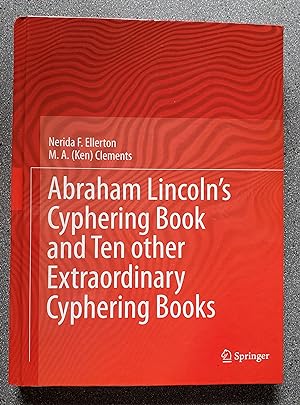
Abraham Lincoln's Cyphering Book and Ten other Extraordinary Cyphering Books.
Seller: Universitätsbuchhandlung Herta Hold GmbH, Berlin, Germany
Association Member: GIAQ ILAB VDA
Seller rating 5 out of 5 stars
367 p. Hardcover. Versand aus Deutschland / We dispatch from Germany via Air Mail. Einband bestoßen, daher Mängelexemplar gestempelt, sonst sehr guter Zustand. Imperfect copy due to slightly bumped cover, apart from this in very good condition. Stamped. Sprache: Englisch.
-

-

-

-
Abraham Lincoln's Cyphering Book and Ten Other Extraordinary Cyphering Books
Language: English
Published by Springer, Cham; Heidelberg; New York; Dordrecht; London, 2014
ISBN 10: 3319025015 ISBN 13: 9783319025018
Hardcover. Condition: Fine. No Jacket. 2014. Fine hardback book. No dust jacket. An as new copy, it's square, tight and clean. 367pp. Sm 4to. (AL).
-

Condition: As New. Unread book in perfect condition.
-
-
Thomas Jefferson and his Decimals 1775-1810: Neglected Years in the History of U.S. School Mathematics
Seller: Ria Christie Collections, Uxbridge, United Kingdom
Seller rating 5 out of 5 stars
£ 49.30
£ 11.98 shipping
Ships from United Kingdom to U.S.A.Quantity: Over 20 available
Add to basketCondition: New. In.
-
Thomas Jefferson and his Decimals 1775-1810: Neglected Years in the History of U.S. School Mathematics
Seller: Ria Christie Collections, Uxbridge, United Kingdom
Seller rating 5 out of 5 stars
£ 49.62
£ 11.98 shipping
Ships from United Kingdom to U.S.A.Quantity: Over 20 available
Add to basketCondition: New. In.
-

Thomas Jefferson and His Decimals 1775-1810 : Neglected Years in the History of U.S. School Mathematics
Seller: GreatBookPricesUK, Woodford Green, United Kingdom
Seller rating 5 out of 5 stars
Condition: New.
-
Condition: New. pp. 220.
-

Mathematical Problem Solving. From Research to Effective Practice
Book 3 of 24: Research in Mathematics EducationLanguage: English
Published by Springer Science + Business Media LLC, New York, 2015
ISBN 10: 1461462576 ISBN 13: 9781461462576
Seller: Barter Books Ltd, Alnwick, NORTH, United Kingdom
Association Member: IOBA
Seller rating 5 out of 5 stars
First Edition
Condition: Very Good. First Edition. VG : in very good condition without dust jacket. 240mm x 160mm (9" x 6"). xxxi, 569pp. Second book in the Research in Mathematical Education series. Heavy item - shipping supplement may apply for overseas. Illustrated hardback laminated board cover.
-

Thomas Jefferson and His Decimals 1775-1810 : Neglected Years in the History of U.S. School Mathematics
Seller: GreatBookPricesUK, Woodford Green, United Kingdom
Seller rating 5 out of 5 stars
Condition: As New. Unread book in perfect condition.
-
Hardcover. Condition: Brand New. 2015 edition. 220 pages. 10.00x7.25x0.75 inches. In Stock.
-

-

-

-

-

-
Paperback. Condition: Brand New. reprint edition. 224 pages. 9.30x6.20x0.53 inches. In Stock.
-

Thomas Jefferson and his Decimals 1775-1810: Neglected Years in the History of U.S. School Mathematics
Language: English
Published by Springer International Publishing, Springer International Publishing Dez 2014, 2014
ISBN 10: 331902504X ISBN 13: 9783319025049
Seller: buchversandmimpf2000, Emtmannsberg, BAYE, Germany
Seller rating 5 out of 5 stars
Buch. Condition: Neu. Neuware -This well-illustrated book, by two established historians of school mathematics, documents Thomas Jefferson¿s quest, after 1775, to introduce a form of decimal currency to the fledgling United States of America. The book describes a remarkable study showing how the United States¿ decision to adopt a fully decimalized, carefully conceived national currency ultimately had a profound effect on U.S. school mathematics curricula.The book shows, by analyzing a large set of arithmetic textbooks and an even larger set of handwritten cyphering books, that although most eighteenth- and nineteenth-century authors of arithmetic textbooks included sections on vulgar and decimal fractions, most school students who prepared cyphering books did not study either vulgar or decimal fractions. In other words, author-intended school arithmetic curricula were not matched by teacher-implemented school arithmetic curricula. Amazingly, that state of affairs continued even after the U.S. Mint began minting dollars, cents and dimes in the 1790s. In U.S. schools between 1775 and 1810 it was often the case that Federal money was studied but decimal fractions were not. That gradually changed during the first century of the formal existence of the United States of America. By contrast, Chapter 6 reports a comparative analysis of data showing that in Great Britain only a minority of eighteenth- and nineteenth-century school students studied decimal fractions. Clements and Ellerton argue that Jefferson¿s success in establishing a system of decimalized Federal money had educationally significant effects on implemented school arithmetic curricula in the United States of America.The lens through which Clements and Ellerton have analyzed their large data sets has been the lag-time theoretical position which they have developed. That theory posits that the time between when an important mathematical ¿discovery¿ is made (or a concept is¿created¿) and when that discovery (or concept) becomes an important part of school mathematics is dependent on mathematical, social, political and economic factors. Thus, lag time varies from region to region, and from nation to nation.Clements and Ellerton are the first to identify the years after 1775 as the dawn of a new day in U.S. school mathematics¿traditionally, historians have argued that nothing in U.S. school mathematics was worthy of serious study until the 1820s. This book emphasizes the importance of the acceptance of decimal currency so far as school mathematics is concerned. It also draws attention to the consequences for school mathematics of the conscious decision of the U.S. Congress not to proceed with Thomas Jefferson¿s grand scheme for a system of decimalized weights and measures.Springer Verlag GmbH, Tiergartenstr. 17, 69121 Heidelberg 224 pp. Englisch.
-
-

Thomas Jefferson and his Decimals 1775¿1810: Neglected Years in the History of U.S. School Mathematics
Language: English
Published by Springer International Publishing, 2016
ISBN 10: 3319347101 ISBN 13: 9783319347103
Taschenbuch. Condition: Neu. Druck auf Anfrage Neuware - Printed after ordering - This well-illustrated book, by two established historians of school mathematics, documents Thomas Jefferson's quest, after 1775, to introduce a form of decimal currency to the fledgling United States of America. The book describes a remarkable study showing how the United States' decision to adopt a fully decimalized, carefully conceived national currency ultimately had a profound effect on U.S. school mathematics curricula.The book shows, by analyzing a large set of arithmetic textbooks and an even larger set of handwritten cyphering books, that although most eighteenth- and nineteenth-century authors of arithmetic textbooks included sections on vulgar and decimal fractions, most school students who prepared cyphering books did not study either vulgar or decimal fractions. In other words, author-intended school arithmetic curricula were not matched by teacher-implemented school arithmetic curricula. Amazingly, that state of affairs continued even after the U.S. Mint began minting dollars, cents and dimes in the 1790s. In U.S. schools between 1775 and 1810 it was often the case that Federal money was studied but decimal fractions were not. That gradually changed during the first century of the formal existence of the United States of America. By contrast, Chapter 6 reports a comparative analysis of data showing that in Great Britain only a minority of eighteenth- and nineteenth-century school students studied decimal fractions. Clements and Ellerton argue that Jefferson's success in establishing a system of decimalized Federal money had educationally significant effects on implemented school arithmetic curricula in the United States of America.The lens through which Clements and Ellerton have analyzed their large data sets has been the lag-time theoretical position which they have developed. That theory posits that the time between when an important mathematical 'discovery' is made (or a concept is'created') and when that discovery (or concept) becomes an important part of school mathematics is dependent on mathematical, social, political and economic factors. Thus, lag time varies from region to region, and from nation to nation.Clements and Ellerton are the first to identify the years after 1775 as the dawn of a new day in U.S. school mathematics-traditionally, historians have argued that nothing in U.S. school mathematics was worthy of serious study until the 1820s. This book emphasizes the importance of the acceptance of decimal currency so far as school mathematics is concerned. It also draws attention to the consequences for school mathematics of the conscious decision of the U.S. Congress not to proceed with Thomas Jefferson's grand scheme for a system of decimalized weights and measures.
-

Thomas Jefferson and his Decimals 1775-1810: Neglected Years in the History of U.S. School Mathematics
Language: English
Published by Springer International Publishing, Springer International Publishing, 2014
ISBN 10: 331902504X ISBN 13: 9783319025049
Buch. Condition: Neu. Druck auf Anfrage Neuware - Printed after ordering - This well-illustrated book, by two established historians of school mathematics, documents Thomas Jefferson's quest, after 1775, to introduce a form of decimal currency to the fledgling United States of America. The book describes a remarkable study showing how the United States' decision to adopt a fully decimalized, carefully conceived national currency ultimately had a profound effect on U.S. school mathematics curricula.The book shows, by analyzing a large set of arithmetic textbooks and an even larger set of handwritten cyphering books, that although most eighteenth- and nineteenth-century authors of arithmetic textbooks included sections on vulgar and decimal fractions, most school students who prepared cyphering books did not study either vulgar or decimal fractions. In other words, author-intended school arithmetic curricula were not matched by teacher-implemented school arithmetic curricula. Amazingly, that state of affairs continued even after the U.S. Mint began minting dollars, cents and dimes in the 1790s. In U.S. schools between 1775 and 1810 it was often the case that Federal money was studied but decimal fractions were not. That gradually changed during the first century of the formal existence of the United States of America. By contrast, Chapter 6 reports a comparative analysis of data showing that in Great Britain only a minority of eighteenth- and nineteenth-century school students studied decimal fractions. Clements and Ellerton argue that Jefferson's success in establishing a system of decimalized Federal money had educationally significant effects on implemented school arithmetic curricula in the United States of America.The lens through which Clements and Ellerton have analyzed their large data sets has been the lag-time theoretical position which they have developed. That theory posits that the time between when an important mathematical 'discovery' is made (or a concept is'created') and when that discovery (or concept) becomes an important part of school mathematics is dependent on mathematical, social, political and economic factors. Thus, lag time varies from region to region, and from nation to nation.Clements and Ellerton are the first to identify the years after 1775 as the dawn of a new day in U.S. school mathematics-traditionally, historians have argued that nothing in U.S. school mathematics was worthy of serious study until the 1820s. This book emphasizes the importance of the acceptance of decimal currency so far as school mathematics is concerned. It also draws attention to the consequences for school mathematics of the conscious decision of the U.S. Congress not to proceed with Thomas Jefferson's grand scheme for a system of decimalized weights and measures.
-

School Mathematics: The Challenge to Change
Seller: Phatpocket Limited, Waltham Abbey, HERTS, United Kingdom
Seller rating 5 out of 5 stars
Condition: Good. Your purchase helps support Sri Lankan Children's Charity 'The Rainbow Centre'. Shows some signs of wear but in good overall condition. Our donations to The Rainbow Centre have helped provide an education and a safe haven to hundreds of children who live in appalling conditions.
-
-
Condition: New. pp. 224 Softcover reprint of the original 1st ed. 2015 edition NO-PA16APR2015-KAP.
-
Rewriting the History of School Mathematics in North America 1607-1861: The Central Role of Cyphering Books
Seller: Ria Christie Collections, Uxbridge, United Kingdom
Seller rating 5 out of 5 stars
£ 94.30
£ 11.98 shipping
Ships from United Kingdom to U.S.A.Quantity: Over 20 available
Add to basketCondition: New. In.
-
Rewriting the History of School Mathematics in North America 1607-1861: The Central Role of Cyphering Books
Seller: Ria Christie Collections, Uxbridge, United Kingdom
Seller rating 5 out of 5 stars
£ 94.30
£ 11.98 shipping
Ships from United Kingdom to U.S.A.Quantity: Over 20 available
Add to basketCondition: New. In.