Order Total (1 Item Items):
Shipping Destination:

Count Dorsay (16 results)
Skip to main search results
Search filters
Product Type
- All Product Types
- Books (11)
- Magazines & Periodicals (No further results match this refinement)
- Comics (No further results match this refinement)
- Sheet Music (No further results match this refinement)
- Art, Prints & Posters (No further results match this refinement)
- Photographs (No further results match this refinement)
- Maps (No further results match this refinement)
- Manuscripts & Paper Collectibles (5)
Condition Learn more
- New (No further results match this refinement)
- As New, Fine or Near Fine (No further results match this refinement)
- Very Good or Good (3)
- Fair or Poor (1)
- As Described (12)
Binding
Collectible Attributes
Language (2)
Free Shipping
- Free Shipping to U.S.A. (No further results match this refinement)
Seller Location
Seller Rating
-

Etiquette; or A Guide to the Usages of Society with a Glance at Bad Habits
Language: English
Published by T. B. Peterson, Philadelphia, 1843
Hardcover. Condition: Poor. Etiquette book containing various rules and manners to follow, and instructions for how to Waltz at the end. 64 Pages. Engraved portrait and frontis. Pages foxed. Both covers and spine are missing. Still complete and readable.
-
Engraving of the poet Walter Savage Landor by H. W. Smith after a drawing by Alfred d'Orsay, with original sample of his handwriting.
Published by Neither item with date or place
Seller: Richard M. Ford Ltd, London, United Kingdom
Seller rating 5 out of 5 stars

The engraving, which is not in the collection of the National Portrait Gallery, is on a piece of 19 x 14 cm paper, with tissue guard. The image measures around 8 cm square, and shows Landor's head in profile, looking to the left, with 'A. D'Orsay' beneath to the left, and 'H. W. Smith' beneath to the right. In good condition, lightly-aged, with small stain to one edge of border. Attached to a piece of paper, along with the piece of Landor's autograph, which is on a 1 x 18.5 cm strip of grey paper cut from a letter, and is in fair condition, lightly-creased. It reads: 'Signora Fields "44" with Mr Landor's compliments.'.
-

ETIQUETTE; OR, A GUIDE TO THE USAGES OF SOCIETY. With a Glance at Bad Habits. "Manners Make the Man." To which is added, the True Theory of the Rhenish or Spanish Waltz, and of the German Waltz a Deux Temps, Analysed and Explained for the First Time. Waltzing is the art of a gentleman, and never yet was taught or understood by a dancing-master
Published by Published by Wilson & Company 162 Nassau Street. Stereotyped by Redfield and Savage, New York, 1843
Seller: Bartleby's Books, ABAA, Chevy Chase, MD, U.S.A.
Association Member: ABAA ESA ILAB IOBA
Seller rating 5 out of 5 stars
First Edition
First American edition. 8vo. 21 cm. 64 pp. Disbound. Not in Imprints. Lacks portrait.
-
[Blessington Papers][ The Collection of Autograph Letters and Historical Documents formed by Alfred Morrison (Second Series, 1882-1893). The Blessington Papers.
Published by Printed for Private Circulation London: Printed by Strangeways & Sons Tower Street Cambridge Circus W.C, 1895
Seller: Richard M. Ford Ltd, London, United Kingdom
Seller rating 5 out of 5 stars
Manuscript / Paper Collectible
Quarto: ii + 234 pp. In original grey boards and cloth spine, with chipped white label. Unopened. Good, with slightly discoloured endpapers. Extensive transcriptions from the Countess of Blessington's correspondence, the writers ranging from Mrs Abell ('Napoleon's pet English child at St. Helena') to Nathaniel Parker Willis.
-
Carlyle's First Love: Margaret Gordon, Lady Bannerman An account of her life, ancestry and homes, her family and friends
Published by John Lane: The Bodley Head, London, 1910
Seller: Rooke Books PBFA, Bath, United Kingdom
Association Member: PBFA
Seller rating 5 out of 5 stars
First Edition
Leather. Condition: Very Good. Count Alfred G. D'Orsay; Daniel Maclise (illustrator). First edition. An illustrated first edition copy of this biography of Margaret Gordon, Lady Bannerman, the first love of Thomas Carlyle. The first edition of this work in a full morocco binding, with marbled paste downs, endpapers and edges. Ink inscriptions to the front free end paper and first blank page. Illustrated with a colour frontispiece and a further 20 plates, one of which is a folding plate. Folding family tree to the rear. Collated complete. Raymond Clare Archibald (1875-1955) was a prominent Canadian-American mathematician. Known for his work as a historian of mathematics, Archibald contributed to many journals and authored a number of books. This was his biography of Margaret Gordon, Lady Bannerman, who was at one time the first love of Thomas Carlyle, a Scottish essayist, historian, and philosopher. In a full morocco binding. Externally very smart, with only light rubbing to the spine joints. Spine is slightly darkened. Internally, firmly bound. Pages are bright and clean, but with a scattering of spots throughout. Very Good. book.
-
Four ink drawings, portraits in the style of Daniel Maclise's illustrations to William Maginn's 'Gallery of Illustrious Literary Characters' in Fraser's Magazine, and possibly depicting John Nichols, Theodore Hook, Percival Bankes and William Jerdan.
Published by London; s and 1830s?, 1820
Seller: Richard M. Ford Ltd, London, United Kingdom
Seller rating 5 out of 5 stars
Fraser's Magazine launched in London in February 1830, and to begin with its most popular feature was Maginn's 'Gallery of Illustrious Literary Characters', with illlustrations by Maclise (collected in book form in 1873). The four portraits, all busts, are somewhat reminiscent of those in that work, but must be earlier if the identification of John Nichol, who died in 1828, is correct. The four are on separate pieces of paper, laid down 2 X 2 (with the four sitters looking inwards towards the centre of the page) on a leaf torn from an album. They are certainly originals, one at least done in sepia, with pencil outlines visible under the ink. The condition of three of the portraits is good, but the third described below (possibly D'Orsay) is somewhat foxed. Clockwise from top left, they are a bespectacled figure, tentatively identified as John Nichols (on paper 12 x 7.5 cm); a complacent individual reading a book, possibly Percival Bankes or Maginn himself (12 x 8.5 cm); another complacent individual, with too much chin and bottom lip, possibly Count D'Orsay, William Jerdan or David Moir (13 x 9 cm); and finally a portly figure looking uncommonly like Theodore Hook (12 x 8 cm). On the reverse is a lithographic print, on india paper (23.5 x 18.5 cm), looking very much like a pencil drawing, being a full-length portrait of an old bespectacled gentleman in profile, reading 'Cobbet's [sic]' newspaper, dressed in an old-fashioned cutaway jacket and hessian boots, with his dog behind him. In the bottom right-hand corner is 'Ob. October 1852 Aet 86 No. 1852'. See Image.
-
Etiquette; Or, A Guide to the Usages of Society with a Glance at Bad Habits; To which is Added the True Theory of the Rhenish or Spanish Waltz, and of the German Waltz a Deux Temps. . . . Waltzing is the Art of a Gentleman,and was never yet Taught or Undnerstood by a Dancing Master
Published by Wilson and Company. Brother Jonathan Monthly Library, New York, 1843
Seller: White Fox Rare Books and Antiques, ABAA/ILAB, New York, NY, U.S.A.
Association Member: ABAA ESA ILAB PBFA
Seller rating 5 out of 5 stars
First Edition
Wraps. Condition: Very Good. First Edition. 8vo. 21.5 by 14.5 cm. 64 pp. Frontis portrait of Count D'Orsay, and the profile is of the actual Count, although supposedly he wasn't the actual author. Day was. The crediting of d'Orsay would seem a calculated effort to provide an aristocratic gloss to the subject, one which "to the manor born" then, and probably still, carries weight. A French answer to Beau Brummel, he was close to, and/or entangled with, many of the glitterati of London society, including Lord Byron and Benjamin Disraeli, who wrote a novel that whose central character was based on d'Orsay. But besides his eventful life with its ups and downs, d'Orsay was an accomplished amateur artist, and perhaps this was a tie with Day, who also wrote about miniature painting, among other topics such as his five years in the West Indies -- topics unrelated to etiquette. Or it could just be that Day was a hack ghost writer. In any case, this work of etiquette was meant to instruct Americans on how things were done by polite society in England, which was the real Count's milieu for much of his adult life. From the preface, one would think it was an American printing of a tract previously published in England, but we believe the American publication was the one and only at the time The work is typical in its rules-based thrust of do's and don'ts, many on topics that have no pertinence in the modern world, such as calling on someone or snuff. The writing is faultlessly lucid. A fine example are the opening words of the text proper: "Etiquette is the barrier which society draws around itself as a protection against offences the 'law' can not touch." Not to be slighted are the dozen pages at the end about the waltz, then of course the rage of Europe. Its inclusion here signifies that the dance that had scandalized society in the 1820s because it was about one on one between the sexes had now become accepted. The section has several tables to explicate the intricacies of the steps. Wraps have some grubbiness. Some of the sooty film can be erased, but not all. Edges show some wear, with minor dog-earring and a roll to the paper. Closed tear along lower front joint fold. Dampstains affects the lower portion of the interior leaves, most distinctly in the front and the back, and in both cases fading as one proceeds towards the center. Light foxing appears occasionally throughout.
-

Original Autograph by & Portrait of Lord George Cavendish Bentinck.
Published by London, UK: The Lady's Newspaper., 1848
Seller: Wittenborn Art Books, San Francisco, CA, U.S.A.
Seller rating 5 out of 5 stars
Manuscript / Paper Collectible Signed
Condition: Good. Original Autograph of Bentinck, Ink on Laid Paper 4.25" x 1.5" mounted to larger sheet, Very Good.7" x 7.5" Portrait of G. Bentinck [facsimile signature], originally published in J. Mitchell Royal Library, printed by M. & N. Hanhart in 1840. D'Orsay Fecit 20 Decr. 1840 Bretby Park [signed in plate]. Very Good. Clipping affixed to verso. Newspaper reprint, mounted on same larger sheet (10" x 12" Good with marginal tears, staining, creasing).
-
[Countess of Blessington (Marguerite Gardiner), Irish author and literary hostess.] Autograph Note in the third person to editor Samuel Carter Hall, wishing 'to consult him, about having an Enquiry executed'.
Published by 'Saturday Evening' no place or date but on paper with watermarked date, 1831
Seller: Richard M. Ford Ltd, London, United Kingdom
Seller rating 5 out of 5 stars
Manuscript / Paper Collectible
1p, 12mo. Bifolium. Addressed on reverse of the second leaf, with broken seal in red wax, 'To / | S. C. Hall Esqre | 59 Sloane Street'. In fair condition, on aged paper. Folded by Blessington into a diamond-shaped packet. Reads: 'Saturday Evening. | Lady Blessingtons Compts. To Mr Hall, and requests that he will call on her, as soon as may suit his convenience, as she wishes to consult him, about having an Enquiry executed.'.
-
Autograph Letter Signed, to "Mon cher ami", writing from the house of his correspondent's good friend, Madame Anson, assuring him that he can rely on her in regard to the invitation to Doncaster, inviting him to visit and renew acquaintance.
Published by In French. A good one page example, 7 x 4 inches, light traces of mounting.
Seller: Julian Browning Rare Books & Manuscripts, London, United Kingdom
Seller rating 5 out of 5 stars
25 Hill Street, undated. Count Alfred D'Orsay (1801-52), artist, the last of the dandies, who defied convention with Lady Blessington in a society of authors, artists, and men of fashion.
-
[Count d'Orsay, French painter and dandy.] Individual etched portraits of Prince Talleyrand and Comte Montrond, on the same leaf, each with caption stating 'Sketched by D'Orsay'.
Published by London? Circa ?, 1831
Seller: Richard M. Ford Ltd, London, United Kingdom
Seller rating 5 out of 5 stars
Manuscript / Paper Collectible
Two etchings in black ink, printed side by side on a 23.5 x 18 cm piece of wove paper, with a thin printed line dividing them. Possibly proofs of two plates on conjoined leaves in a book. In fair condition, lightly aged and creased, with a tiny nick at foot and dog-eared corners. Each of the sketches is full-length, and has a caption at foot, in a facsimile of D'Orsay's hand. To the left, 11.5 x 18 cm, is 'Pce Talleyrand | Sketched by D'Orsay', depicting Talleyrand, in left profile, with outdoor coat and hat in trailing left hand, his right hand resting on a walking stick and his crippled right leg slightly raised. To the right, 12 x 18 cm, is 'Cte Montrond | Sketched by D'Orsay', depicting a portly Montrond with back to the viewer, sitting astride a plain chair, with playing cards in his left hand held up to his face. Unusual. The two etching are in the British Museum Department of Prints and Drawings, both donated by Michael Hoadley, the Talleyrand with Museum Number E.118-1980, and the Montrond with Museum Number E.117-1980. Neither description states whether or not they are on the same piece of paper, as with the present item. See the frontispiece to Linda Kelly's book 'Talleyrand in London': 'Le prince de Talleyrand & Mr Montrond jouant au whist fait par le comte Alfred d'Orsay', which is dated to 1831.
-
![Seller image for [Comte d'Orsay; French Benevolent Society] Autograph Letter Signed "Ct d'Orsay" to "M. le Chevalier", in French, thanks his correspondent for "le charmante Poème", discussing the state and progress of the French Benevolent Society just founded. for sale by Richard M. Ford Ltd](https://pictures.abebooks.com/inventory/md/md31364460415.jpg)
[Comte d'Orsay; French Benevolent Society] Autograph Letter Signed "Ct d'Orsay" to "M. le Chevalier", in French, thanks his correspondent for "le charmante Poème", discussing the state and progress of the French Benevolent Society just founded.
Published by Gore House Kensington Gore 5 Dec See image, 1842
Seller: Richard M. Ford Ltd, London, United Kingdom
Seller rating 5 out of 5 stars
Four pages, 16mo, bifolium, in narrow "frame" of stiffer paper, good condition. He thanks him for the "charmante Poème" that he's sent "que je l'ai lu devant plusieurs personnes qui l'ont beaucoup admiré, et je vous remercie d'avoir pensé a moi - je vous envoye les Statuts incomplets de notre Societé [French Benevolent Society established this year 1842], car les dernières souscriptions, ni les derniers supports ne sont pas encore imprimés - j'ai assisté hier a une séance de notre comité, et j'ai eu le plaisir de voir que nous avons deja fait un immense bien, considérant nos ressources[.] Si vous vouliez [causer?] avec le Dr Berrier Fontaine [il?] vous etonneroit en vous racontant des Exemples de misère presque incroyables - [.]". Docketed in red ink with year and name of letter writer.
-
[ Alfred D'Orsay, Count D'Orsay, French dandy. ] Autograph Letter Signed ('A. d'Orsay') to his attorney 'Du Pasquier' [J. M. Du Pasquier], touching on his financial embarrassment and his bust of the Duke of Wellington.
Published by Place not stated. 23 October, 1851
Seller: Richard M. Ford Ltd, London, United Kingdom
Seller rating 5 out of 5 stars
Manuscript / Paper Collectible
4pp., 8vo. Bifolium. In very good condition, lightly-aged. Neatly placed with a windowpane mount onto a leaf of cream paper. Writing within a year of his demise, D'Orsay begins by defending himself to his attorney: 'My Dear Du Pasquier | You received my letter yesterday about Mousley. I could not act otherwise, and even I have no right to complain when a man is losing more than 5000 by me, to find fault that he did not send me £1300. I am astonished that you are so severe. I am sorry that you will not give your assistance in this affair. Do as you like. I said to Mousley that I would not act without you, now you release me of my word, I have written to him that I will sign the Deed when he chooses.' He now turns to 'Simonnet', who has drawn a cheque on Pasquier without notice, as he is 'embarrassed in his affairs'. Regarding a 'difference in the account' he explains: 'You do not calculate, the Models, of the Queen, and the Wellington and Lions, which are still in his hands, and which are belonging to you, when you call for them.' The 'Second Wellington' has arrived at the custom house and is 'much better, according to your taste, as it is done au R and you are wrong not to take it, as I am sure the Duke would take one. - The head is admirable. ' he asks if Pasquier 'had the Reins & & of the Queen changed by Matifal. You ought if it is not done. - The End of all this, will be that I will be obliged to buy all these things you refuse from Simonnet - Thats Comfortable for me!!' The letter continues with a reference to 'Reid's business', 'Davis' and 'Ford': 'Yes they can annoy me here, not arresting my person, but make Trials, and possibly obtain judgment to sell my Effects, and if one English Creditor begun, [sic] there is no reason why others would not go on.' He consequently asks him to do all he can 'with Morel'. He concludes with a reference to a 'Nephew' who is 'in London to bring me back the powder'.
-
[Count d'Orsay; mesmerism] Autograph Letter Signed "d'Orsay" to "Mon Cher Albert" [not identified] advising Albert to attend a seance involving a clairvoyant (Alexis), his controller (Marcillet) & distinguished professor of Medicine, Dr Elliotson.
Published by No place or date
Seller: Richard M. Ford Ltd, London, United Kingdom
Seller rating 5 out of 5 stars
One page, 12mo, bifolium, good condition apart from 1/4in. strip of glue from previous laying down on blank page [4]. In French. "Mon Cher Albert | J'ai recu ce matin un Billet du Dr Elliotson [note below] qui dans ce moment n'a aucun sujet digne d'etre montre a vos Dames. Mais si vous tenez a les Etonner magnetiquement, cela vous coutera 5£. allez chez Mr Marcillet qui demeure Maddox St. No. 5. fixez le jour d'une seance pour voir Alexis [a clairvoyant. See Notes below], dites que vous venez de ma part et vous conviendrez avec moi, que ce garcon bouleverse le monde de fond encomble. Tout a vous | d'Orsay". Translation provided on request.Note: a. Elliotson, John, 1791-1868, distinguished professor of medicine, for example "He was always at the 'leading edge' of his profession: he was one of the first in Britain to use and promote the stethoscope, and one of the first to use acupuncture" [see Wikipedia]; b. [Marcillet] A website on "The Orphic Circle Meets At Craven Cottage" suggest that Elliotson and Marcillet were involved in Spiritualism ("The Orphic Circle Meets At Craven Cottage") as does this letter by d'Orsay. "Alexis was a French boy" -- Alexis was Alexis Didier, the clairvoyant controlled by J.B. Marcillet, whom Dickens first encountered at John Elliotson's (or was it at Craven Cottage?) and subsequently raved of in his correspondence as "the Magnetic Boy". We are clearly seeing here a glimpse of Didier as a child, during his first stint in London in 1844.".
-

Autograph Note Signed / Unsigned Portrait
Seller: Main Street Fine Books & Mss, ABAA, Galena, IL, U.S.A.
Association Member: ABAA ILAB MWABA
Seller rating 5 out of 5 stars
Signed
Memorable French dilettante artist, famed fop and hanger-on, a legendary man of fashion and society wit who befriended royalty and nobility as well as Lord Byron and Benjamin Disraeli. ANS (in French), 1p, 4" X 5½", Gore House, 1 March 1841. Addressed to Mr. Plunkett. Very good. Faint age toning; mounting traces on verso. Writing from the house in Middlesex, England, which he and long-time friend Lady Blessington occupied from 1836 to 1849 and made a well-known literary salon, d'Orsay writes an admirer that (roughly translated) "Here is what you want, I hope that the great favor serves as more important than the autograph of your devoted Cte. d'Orsay." Boldly penned in brown ink. Accompanied by an outstanding heavy stock 8" X 10½" printed caricature of d'Orsay, an original plate from "A Gallery of Illustrious Literary Characters (1830-1838) Drawn by the Late Daniel Maclise" (London, 1874). An intriguing if cryptic letter, partially signed.
-
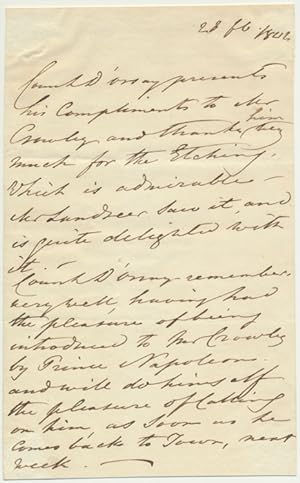
Autograph Letter Signed (third person)
Seller: Main Street Fine Books & Mss, ABAA, Galena, IL, U.S.A.
Association Member: ABAA ILAB MWABA
Seller rating 5 out of 5 stars
Signed
Memorable French dilettante artist, famed fop and hanger-on, a legendary man of fashion and society wit who befriended royalty and nobility as well as Lord Byron and Benjamin Disraeli. Third person ALS, 1p, 4½" X 7" (lightly tipped to heavy stock album leaf), n.p., 1844 February 23. Very good. Lightly age toned. Interesting third-person note signed twice within the text. In part: "Count D'Orsay presents his compliments to Mr Crowley and thanks him very much for the Etching, which is admirable -- Mr Landseer Saw it, and is quite delighted with it. Count D'Orsay remembers very well, having had the pleasure of being introduced to Mr Crowley by Prince Napoleon." Recipient is most likely Nicholas Joseph Crowley (1819-57), well known IRish portrait painter who resided in London. Landseer of course refers to Edwin Landseer (1802-73), English artist famed for his paintings and sculptures of animals. d'Orsay was well known as a fanatical supporter of all things Bonaparte. Prince Louis Napoleon (later Emperor Napoleon III) was often hosted at d'Orsay's fashionable residence in London, and it may have been during one of these visits that the Prince introduced d'Orsay to Crowley. Quite handsome letter, signed two times in the third person, with interesting references.