Order Total (1 Item Items):
Shipping Destination:

Compton Arthur Holly (43 results)
Skip to main search results
Search filters
Product Type
- All Product Types
- Books (42)
- Magazines & Periodicals (No further results match this refinement)
- Comics (No further results match this refinement)
- Sheet Music (No further results match this refinement)
- Art, Prints & Posters (No further results match this refinement)
- Photographs (No further results match this refinement)
- Maps (No further results match this refinement)
- Manuscripts & Paper Collectibles (1)
Condition Learn more
- New (12)
- As New, Fine or Near Fine (7)
- Very Good or Good (13)
- Fair or Poor (No further results match this refinement)
- As Described (11)
Binding
Collectible Attributes
Language (2)
Free Shipping
Seller Location
Seller Rating
-

THE COSMOS of ARTHUR HOLLY COMPTON. Ed., Marjorie Johnston.
Published by NY: Alfred A. Knopf 1967., 1967
VG, unmarked Hardback; DJ-G/VG, small taped tear. xxi + 468 pp + xv pp.
-

Scientific Papers of Arthur Holly Compton: X-Ray and Other Studies
Language: English
Published by University of Chicago Press, 1973
ISBN 10: 0226114309 ISBN 13: 9780226114309
First Edition
Hardcover. Condition: Good. 1st Edition. Has some light general reading/shelfwear, with a few nicks to dustjacket and some tanning to page edges - otherwise this is a clean, tight copy. Dispatch within 24hrs from the UK. Book.
-
Scientific Papers of Arthur Holly Compton: X-Ray and Other Studies
Published by University of Chicago Press, Chicago, 1973
Seller: Argosy Book Store, ABAA, ILAB, New York, NY, U.S.A.
Seller rating 5 out of 5 stars

hardcover. Condition: very good(+). Illustrated. 777 pages. Thick 4to., red cloth boards. Chicago: University of Chicago Press, (1973). A very good(+) copy.
-
The Cosmos of Arthur Holly Compton, The Public Papers, Both Scientific and Humanistic (signed)
Published by Alfred A. Knopf, New York, 1967
First Edition Signed
Hardcover. Condition: Very Good condition. Dust Jacket Condition: Good dust jacket. NOTa library discard (illustrator). First edition (so stated). New York: Alfred A. Knopf, 1967. INSCRIBED / SIGNED by Marjorie Johnston on the front free endpaper. The inscription reads in part: "To Sydney I. Asher (name is hard to read, may not be spelled right) with best wishes and deep appreciation of your friendly and expert help. (signed) Marjorie Johnston, December 31, 1967." Very Good condition in a Good dust jacket (small edge chips / short closed tears). NOT price clipped ($10.00). The jacket is protected by a removable Brodart clear-plastic sleeve. Minor damp stain at the bottom edge of the cover -- no text pages are affected. NOT bad -- PHOTOS UPON REQUEST. Internal condition is FINE but for paper clip impression at the top edge of a few preliminary pages. Pages are otherwise crisp, clean and unmarked. Laid in are copies of two reviews of the book. Foreword by Vannevar Bush. Includes a 50 page informal autobiography. Compton was awarded the 1927 Nobel Prize in Physics. Has a chronology of Compton's life and a 182 item bibliography of his scientific publications. Index. Bound in the original blue cloth, stamped in metallic blue and shiny silver. Complete with dust jacket. INSCRIBED / SIGNED by Marjorie Johnston. First edition (so stated). Hardcover. Very Good condition/Good dust jacket. Illus. by NOTa library discard. 8vo. xxi, 468pp. + xviii. Great Packaging, Fast Shipping.
-
The Cosmos of Arthur Holly Compton
Published by Alfred A. Knopf, New York, 1967
Seller: Ground Zero Books, Ltd., Silver Spring, MD, U.S.A.
Seller rating 4 out of 5 stars

First Edition
Condition: very good, fair to good. First Edition. 483, notes, chronology, bibliography, index, separate erratum sheet, some soiling pp. vi-vii, DJ soiled: sm tears, sm pcs missing sp. Arthur Holly Compton won the Nobel Prize for Physics in 1927 for his work on the particle nature of the photon, and led the field of cosmic-ray researches.
-
The Cosmos of Arthur Holly Compton.
Published by New York, Knopf 1967., 1967
Seller: Grant's Bookshop, Cheltenham, VIC, Australia
Association Member: ANZAAB ILAB
Seller rating 4 out of 5 stars
8vo, d/w; xx, 468pp. A minor stain on upper edge, small mark on ffe, all else near fine. The public papers, both scientific and humanistic.
-
480 S., OLn., 1. Aufl., 8° guter Zustand. Bücher.
-
The Dedication Of The University Chapel At The University Of Chicago
Language: English
Published by The University Of Chicago, Chicago, 1928
Seller: Arroyo Seco Books, Pasadena, Member IOBA, Pasadena, CA, U.S.A.
Association Member: IOBA
Seller rating 5 out of 5 stars
First Edition
Soft cover. Condition: Very Good +. Two Photographs (illustrator). 1st Edition. 32 Pp. Grey Card Covers Printed In Black. Very Good +, Slight Wear. Ownership Signature Of Forrest Alva Kingsbury, Professor Of Psychology.
-
Scientific Papers of Arthur Holly Compton: X-Ray and Other Studies
Language: English
Published by University of Chicago Press, 1973
ISBN 10: 0226114309 ISBN 13: 9780226114309
Condition: new.
-

Condition: New. KlappentextrnrnThis volume is based upon the twelfth series of lectures delivered at Yale University on the Foundation established by the late Dwight H. Terry of Plymouth, Connecticut, through his gift of an endowment fund for the delivery and s.
-
![Seller image for The Cosmos Of Arthur Holly Compton [With Errata Slip] for sale by Arroyo Seco Books, Pasadena, Member IOBA](https://pictures.abebooks.com/inventory/md/md17317834186.jpg)
The Cosmos Of Arthur Holly Compton [With Errata Slip]
Language: English
Published by Alfred A. Knopf, New York, 1967
Seller: Arroyo Seco Books, Pasadena, Member IOBA, Pasadena, CA, U.S.A.
Association Member: IOBA
Seller rating 5 out of 5 stars
First Edition
Hardcover. Condition: Fine. Dust Jacket Condition: Near Fine. 1st Edition. Xxi,468, Xv Pp. Blue Cloth, Gilt. First Printing. With The Two Page Errata Sheet, Actually The Full Note On The Compton Effect Which Should Have Been On P. 430. Fine, No Wear Or Marks Or Stains Or Fading. Dj Lightly Used, Three Short Closed Tears, Not Price-Clipped, Slight Rubbing At Corners.
-
Scientific Papers of Arthur Holly Compton: X-Ray and Other Studies
Language: English
Published by University of Chicago Press, 1973
ISBN 10: 0226114309 ISBN 13: 9780226114309
Seller: The Book House, Inc. - St. Louis, St. Louis, MO, U.S.A.
Association Member: IOBA MWABA
Seller rating 5 out of 5 stars
First Edition
Hardcover. Condition: Very Good. Dust Jacket Condition: Very Good. First Edition. Very Good Hardcover with Very Good dustjacket.
-
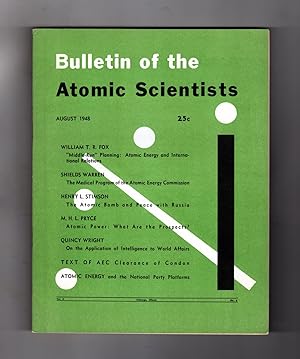
The Bulletin of the Atomic Scientists. August, 1948. Edward U. Condon Cleared by Atomic Energy Commission; AEC Medical Program (Isotopes Symposium); Joyce Clennam Stearns; British Scientists on International Atomic Control; Atomic Power Prospects; Atomic Peace with Russia?: United Nations & Atomic Energy News; On the Application of Intelligence to World Affairs; Middle-Run International Planning
Language: English
Published by Atomic Scientists of Chicago, Chicago, 1948
Seller: Singularity Rare & Fine, Baldwinsville, NY, U.S.A.
Seller rating 5 out of 5 stars
First Edition
Soft cover. Condition: Fine. 1st Edition. Fine; see scans and description. Chicago: Atomic Scientists of Chicago, 1948. The August, 1948 issue of The Bulletin of the Atomic Scientists. The famous and historic Doomsday Clock - shown on each cover since 1947, two years after the publication's inception - here shows the time to be eight minutes of midnight as of mid-1948. Quarto, illustrated staple-bound wraps, 32 pp. (pages 225 through 256 for the annual volume, pages then being numbered after the fashion of the time). Fine; no flaws. Even the inevitable page paper toning is almost nonexistent. A handsome example; see all scans. Established in 1945 by biophysicist Eugene Rabinowitch and physicist Hyman Goldsmith in response to a correctly-perceived demand for nuclear information at the time by the general public, The Bulletin of the Atomic Scientists is without doubt the most historically significant non-technical publication on the subject of "'global security and public policy issues related to the dangers posed by nuclear and other weapons of mass destruction, climate change,[2] and emerging technologies and diseases". Hence, over the years, BAS has become a geopolitical instrument, rather than a nuclear watchdog alone. Feature articles in this vintage 1948 issue: Edward U. Condon Cleared by Atomic Energy Commission; AEC Medical Program (Isotopes Symposium); Joyce Clennam Stearns; British Scientists on International Atomic Control; Atomic Power Prospects; Atomic Peace with Russia?: United Nations & Atomic Energy News; On the Application of Intelligence to World Affairs; Middle-Run International Planning. More, of course; see scan of contents. Contributors include William T. R. Fox; Shields Warren; Arthur Holly Compton (discoverer of The Compton Effect); Henry L. Stimson; M. H. L. Pryce; Philip Quincy Wright; Peter Kihss; and the editors. Very, very scarce as the original monthly softcover issue. Ships in a new, sturdy, protective box - not a bag. LPR30.
-

Scientific Papers of Arthur Holly Compton: X-Ray and Other Studies
Language: English
Published by University of Chicago Press, 1973
ISBN 10: 0226114309 ISBN 13: 9780226114309
Seller: Arroyo Seco Books, Pasadena, Member IOBA, Pasadena, CA, U.S.A.
Association Member: IOBA
Seller rating 5 out of 5 stars
First Edition
Hardcover. Condition: Fine. Dust Jacket Condition: Near Fine. 1st Edition. Xxix, (Vii), 777 Pop. Red-Brown Cloth, Spine Gilt. Fine, No Marks Or Wear. Dust Jacket With Light Rubbing Mostly To Top And Bottom Edges Of Spine Panel.
-

The Freedom of Man
Language: English
Published by Yale University Press Mär 2030, 2030
ISBN 10: 030013570X ISBN 13: 9780300135701
Buch. Condition: Neu. Neuware - This volume is based upon the twelfth series of lectures delivered at Yale University on the Foundation established by the late Dwight H. Terry of Plymouth, Connecticut, through his gift of an endowment fund for the delivery and subsequent publication of 'Lectures on Religion in the Light of Science and Philosophy.' The deed of gift declares that 'the object of this Foundation is not the promotion of scientific investigation and discovery, but rather the assimilation and interpretation of that which has been or shall be hereafter discovered, and its application to human welfare, especially by the building of the truths of science and philosophy into the structure of a broadened and purified religion.
-
The Cosmos of Arthur Holly Compton
Language: English
Published by Alfred A. Knopf, 1967
First Edition
Hardcover. Condition: Very Good. Dust Jacket Condition: Very Good. 1st Edition. Very good, clean, tight copy. Inscribed by Compton to previous owners. Text free of marks. Professional book dealer since 1999. All orders are processed promptly and carefully packaged with tracking.
-
![Seller image for The intensity of X-ray reflection, and the distribution of the electrons in atoms . by Arthur H. Compton 1917 [LeatherBound] for sale by S N Books World](https://pictures.abebooks.com/inventory/md/md30639781887.jpg)
The intensity of X-ray reflection, and the distribution of the electrons in atoms . by Arthur H. Compton 1917 [LeatherBound]
Language: English
Publication Date: 2025
Leatherbound. Condition: NEW. BOOKS ARE EXEMPT FROM IMPORT DUTIES AND TARIFFS; NO EXTRA CHARGES APPLY. Leather Binding on Spine and Corners with Golden leaf printing on spine. Bound in genuine leather with Satin ribbon page markers and Spine with raised gilt bands. A perfect gift for your loved ones. Reprinted from 1917 edition. NO changes have been made to the original text. This is NOT a retyped or an ocr'd reprint. Illustrations, Index, if any, are included in black and white. Each page is checked manually before printing. As this print on demand book is reprinted from a very old book, there could be some missing or flawed pages, but we always try to make the book as complete as possible. Fold-outs, if any, are not part of the book. If the original book was published in multiple volumes then this reprint is of only one volume, not the whole set and contains approximately 36 pages. IF YOU WISH TO ORDER PARTICULAR VOLUME OR ALL THE VOLUMES YOU CAN CONTACT US. Resized as per current standards. Sewing binding for longer life, where the book block is actually sewn (smythe sewn/section sewn) with thread before binding which results in a more durable type of binding. Language: English.
-
![Seller image for X-rays and electrons; an outline of recent X-ray theory, by Arthur H. Compton. 1926 [LeatherBound] for sale by S N Books World](https://pictures.abebooks.com/inventory/md/md31376181706.jpg)
X-rays and electrons; an outline of recent X-ray theory, by Arthur H. Compton. 1926 [LeatherBound]
Language: English
Publication Date: 2025
LeatherBound. Condition: New. BOOKS ARE EXEMPT FROM IMPORT DUTIES AND TARIFFS; NO EXTRA CHARGES APPLY. Leatherbound edition. Condition: New. Leather Binding on Spine and Corners with Golden leaf printing on spine. Bound in genuine leather with Satin ribbon page markers and Spine with raised gilt bands. Pages: 432. A perfect gift for your loved ones. Reprinted from 1926 edition. NO changes have been made to the original text. This is NOT a retyped or an ocr'd reprint. Illustrations, Index, if any, are included in black and white. Each page is checked manually before printing. As this print on demand book is reprinted from a very old book, there could be some missing or flawed pages, but we always try to make the book as complete as possible. Fold-outs, if any, are not part of the book. If the original book was published in multiple volumes then this reprint is of only one volume, not the whole set. IF YOU WISH TO ORDER PARTICULAR VOLUME OR ALL THE VOLUMES YOU CAN CONTACT US. Resized as per current standards. Sewing binding for longer life, where the book block is actually sewn (smythe sewn/section sewn) with thread before binding which results in a more durable type of binding. Language: English Pages: 432.
-
Atomic quest: A personal narrative
Published by Oxford University Press, 1956
Seller: World of Rare Books, Goring-by-Sea, SXW, United Kingdom
Seller rating 5 out of 5 stars
Condition: Good. 1956. No Edition Stated. 370 pages. Orange pictorial dust jacket over black cloth with gilt title to spine. Contains black and white photographic plates. Red pen mark to lower text block edge. Pages remain bright and clear with minimal tanning and foxing. Heavier tanning and foxing to text block edges. Illustrations and plates are bright and clear, with some light tanning and foxing to edges. Binding remains firm. Boards have mild edge wear with slight rubbing to surfaces. Very light crushing to spine ends. Gilt lettering is bright and clear. Unclipped jacket has light edge wear with tears and creasing. Jacket is in removable plastic cover.
-
Hardcover. Condition: Fine. Dust Jacket Condition: Near Fine. Holly Compton (illustrator). 1st Edition. 8vo. Original gilt cloth. fine in a fine dust jacket, jacket is quite rare for this title. this is the Terry Lectures at Yale University. Dr. Compton, Nobel laureate, spoke of issues in Philosophy and Science and of man's fate. These lectures inspired Karl Popper later to write an essay entitled Clouds and Clocks. Dr. Popper a famous philosopher of Science, is also famous for his confrontation with Prof Ludwig Wittgenstein in the society Of Mind at Cambridge University. in addition. Dr. Compton composed a letter to Arthur Ziern on Washington University stationary as Chancellor of Washington University about a gift to the university by Ziern in the original envelope, enclosed a rare and fine letter both. Signed by Author(s).
-
Atomic Quest. A Personal Narrative.
Published by Oxford University Press, New York, 1956
First Edition
Hardcover. Condition: Very Good. Dust Jacket Condition: No Dustwrapper. First Edition. Arthur Holly Compton was an American physicist who won the Nobel Prize in Physics in 1927 for his 1923 discovery of the Compton effect, which demonstrated the particle nature of electromagnetic radiation. At that time, it was a remarkable revelation: while the wave characteristics of light had been convincingly established, the concept that light possessed both wave and particle attributes faced considerable skepticism. He is also recognized for his role as the head of the Metallurgical Laboratory at the University of Chicago during the Manhattan Project. Portrait frontis, 19 pages, 370 pages, 9 illustrations. Original brown cloth, lettered spine and upper board. Mall damp mark to the front boards at bottom edge and just catching outer margins of first and last pages. Contents bright and clean throughout. Size: 13 x 20 cms. Category: Atomic & Nuclear; Special Features; Featured Items; New Arrivals; This item may require more postage than the rates shown for delivery outside the UK. If extra postage is required we will contact you before processing your order and you will be given the details and option to decline the extra cost. Cosmo Books : 28 years selling on ABE; 28 years of taking care of customers on ABE; A seller you can rely on.
-
Symposium Sôbre Raios Cósmicos: Rio de Janeiro Agôsto 4-8 1941
Published by Imprensa Nacional/ Academia Brasileira de Ciências, Rio de Janeiro, 1943
Hardcover. Condition: Very Good. With articles in English and Portuguese. With numerous full-page black and white photographs. Copy on coated paper. Recent binding in false leather, 19x27cm, 180p. Rio de Janeiro, Imprensa Nacional / Academia Brasileira de Ciências, 1943. Original brochure covers preserved, with restorations. First and only edition. Solid and complete copy, in good overall condition, without annotations, underlining, signatures, marks, holes, or loose pages. Very rare copy of these proceedings of the 1941 Cosmic Ray Symposium in Rio, with articles by leading physicists such as Giuseppe Occhialini, Arthur Compton, and several of the patriarchs of science in Brazil, including Gleb Wataghin, Abrahão de Moraes, Mário Schönberg, B. Gross, Carlos Chagas Jr., Marcelo Damy, Paulus Pompeia, F.X. Roser, Ernest O. Wollan, Yolande Monteux, etc. Enviar feedback.
-

Atomic Energy as a Human Asset. Franklin Medal lecture
Published by American Philosophical Society, Philadelphia, 1946
Seller: Bolerium Books Inc., San Francisco, CA, U.S.A.
Seller rating 5 out of 5 stars
pp. [70]-79, wraps, evenly toned, otherwise very good. 8x10.5 inches. Reprinted from the Proceedings of the American Philosophical Society, Volume 90, Number 1, 1946. Speech presented on the occasion of Compton's receipt of the Benjamin Franklin medal, awarded by the American Philosophical Society. Compton lectures on how atomic weapons would allow a centralized mechanism for enforcing global peace, as an atomic war would be too destructive, and states that maintaining peace must be the objective of world government. Compton, a researcher who worked on the Manhattan Project in Chicago, recommended the use of the atomic bomb against Japan. He had received the Nobel Prize in 1927. In 1946, Compton also received a Medal for Merit from the US government.
-
Atomic Quest - A Personal Narrative
Published by Oxford University Press - New York / London, 1956
Seller: Barberry Lane Booksellers, Bar Harbor, ME, U.S.A.
Seller rating 4 out of 5 stars
First Edition
Hardcover. Condition: Very Good. 1st Edition. Brown cloth on boards with red and silver lettering to front, same to spine. Book is tight and square with some minor rubbing to corners and scuffing to head of spine. Biggest flaw is some discoloration to the covers and fading to the lettering on both front and spine. Interior is quite good, at least Very good, perhaps Near Fine, with just the faint remnant of where a marker bled through a stick-on note to inside front cover. No DJ but a solid copy of a VERY RARE book. Compton was the recipient of the 1927 Nobel Prize in Physics and leader of the Manhattan Project. Arthur Holly Compton (18921962) was an American physicist whose study of X-rays during the early 1920s led to his discovery of the Compton Effect. For this discovery, he won the Nobel Prize in Physics in 1927, sharing it with Charles Wilson. His discoveries were key to the eventual development of atomic energy. He was asked to join the Manhattan Project in 1942, becoming head of "X-Projects" at the Metallurgical Laboratory at the University of Chicago. First Edition, First Printing (Only statement on copyright page is 1956).
-
Cloth Over Board. Condition: Good. Dust Jacket Condition: Rough w/ Protective Cover. 1st Edition. tight binding; clean pages; some discoloring due to age; dust jacket wear and tear around edges/corners; larger tears around spine at top, bottom & mid Size: 8vo - over 7¾" - 9¾" tall. 1st Edition.
-
Hardcover. Condition: Very Good. First Edition; First Printing. Hardcover. 8vo. Published by Oxford University Press, New York, 1956. 370 pgs. Illustrated. First Edition/FIrst Printing. DJ has light shelf-wear present to the DJ extremities. Bound in cloth boards with titles present to the spine and front board. Boards have light shelf-wear present to the extremities. No ownership marks present. Text has remains of penciled notes present. Binding tight and solid. Arthur Holly Compton was an American physicist who won the Nobel Prize in Physics in 1927 for his 1923 discovery of the Compton effect, which demonstrated the particle nature of electromagnetic radiation. At that time, it was a remarkable revelation: while the wave characteristics of light had been convincingly established, the concept that light possessed both wave and particle attributes faced considerable skepticism. ; 8vo 8" - 9" tall.
-
'A Quantum Theory of the Scattering of X-rays by Light Elements,' pp. 483-502 in Physical Review, Second Series, Vol. 25, No. 5, May 1923
Published by American Physical Society, Lancaster, PA & Corning, NY, 1923
Seller: SOPHIA RARE BOOKS, Koebenhavn V, Denmark
Seller rating 5 out of 5 stars
First Edition
Hardcover. First edition. DISCOVERY OF THE COMPTON EFFECT. First edition, journal issue in original printed wrappers, of the 'Compton effect,' which demonstrated the existence of quanta of electromagnetic radiation, later called photons. "This discovery 'created a sensation among the physicists of the time.' There were the inevitable controversies surrounding a discovery of such major proportions. Nevertheless, the photon idea was rapidly accepted. Sommerfeld incorporated the Compton effect in his new edition of Atombau und Spektrallinien with the comment, 'It is probably the most important discovery which could have been made in the current state of physics'" (Pais, Subtle is the Lord, p. 414). "Arthur Holly Compton will always be remembered as one of the world's great physicists. His discovery of the Compton effect, so vital in the development of quantum physics, has ensured him a secure place among the great scientists" (DSB). The explanation and measurement of the Compton effect earned Compton a share of the Nobel Prize in physics in 1927. Compton (1892-1962) received his PhD from Princeton in 1916 for research on the intensity distribution of X-rays reflected from crystals. After a period working for the Westinghouse Company he returned to fundamental research in 1919, when he obtained one of the first National Research Council Fellowships (established by Millikan). He used it to spend a year at the Cavendish Laboratory in Cambridge, where he continued his experiments on the scattering of radiation. In 1920 Compton moved to Washington University in St. Louis, where he continued his work on X-ray scattering, using a Bragg spectrometer he had brought from Cambridge. By this time it had become apparent that the scattered radiation had a wavelength longer than that of the primary radiation, and that the shift of wavelength varied with the scattering angle: this became known as the Compton effect. "It was only late in 1922, when considering all data available to him, that Compton saw the necessity for a light quantum with energy and momentum to explain the scattering of X-rays. Compton read a paper entitled 'A quantum theory of the scattering of X-rays by light elements' at a meeting of the American Physical Society in Chicago, which took place on 1 and 2 December 1922. Its abstract begins as follows: 'The hypothesis is suggested that when an X-ray quantum is scattered it spends all its energy and momentum upon some particular electron. The electron in turn scatters the ray to some definite direction. The change in momentum of the X-ray quantum due to the change in direction of its propagation results in a recoil of the scattering electron. The energy in the scattered quantum is thus less than the energy of the primary quantum by the kinetic energy of recoil of the scattering electron.' "The full paper was published a little later [the offered paper]. It contains the calculation of the shift in wavelength between primary and secondary radiation as a function of scattering angle. Compton had data for only one scattering angle, 90 degrees, for which he had measured the spectrum. It was obtained with a primary radiation which was the K? radiation of molybdenum produced by an X-ray tube with a molybdenum anticathode" (Brandt, The Harvest of a Century, Chapter 31). "The Compton effect, aptly characterized by Karl K. Darrow as one of the most superbly lucid processes in nature, is now part of the fabric of physics; and it is of interest to recall its influence on the development of the quantum theory during the years 19231930. "In the first place, it provided conclusive proof that Einstein's concept of a photon as having both energy and directed momentum was essentially correct. Einstein himself brought considerable attention to Compton's discovery by his discussions at the Berlin seminars. Interest was also high at Gottingen, Munich, Zurich, Copenhagen, and other Continental centers where theoretical physics was rapidly developing. "However, the quantitative proof of the photon character of radiation had been established by Compton's use of a Bragg crystal spectrometer, the function of which depended directly on the wave nature of X-rays. Thus a more general synthesis was clearly required, in which both the corpuscular photon and the electromagnetic wave would be included and would continue to play the roles demanded by experiment "The final great synthesis of quantum mechanics and quantum electrodynamics was forced upon physics by the crucial experiments of the Compton effect, electron diffraction, space quantization, and the existence of sharp spectral lines, which could not be brought into line with classical theory. It required the final relativistic form of quantum mechanics, developed by Paul Dirac, to give a completely quantitative explanation of Compton scattering in regard to both intensity and state of polarization by the formula derived by O. Klein and Nishina from the Dirac relativistic theory of the electron" (DSB). For a detailed account of Compton's work, see the Introduction to Scientific Papers of Arthur Holly Compton: X-ray and other studies, University of Chicago Press, 1974. 8vo, pp. 8, 483-584, 9-12. Original printed wrappers. Rare in this condition.
-
Hardcover. Condition: Very Good. No Jacket. black and white photographs (illustrator). 1st Edition. Tight binding, solid brown boards with sharp corners, bright red and silver lettering to front board and spine strip, gently ruffled at head of spine, clean, unmarked pages throughout. Nice sharp copy by Nobel Prize winning scientist. 1st edition, 1st printing.
-
ATOMIC QUEST: A PERSONAL NARRATIVE
Published by Oxford University Press, New York, 1956
First Edition
Hardcover. First Edition; Second Printing. Good+ in a Very Good price clipped dust jacket. All four corners of front and rear flaps clipped. Damp staining on boards. Shelfwear on spine. Small closed tear on spine crown. Light foxing on top text block edge.
-
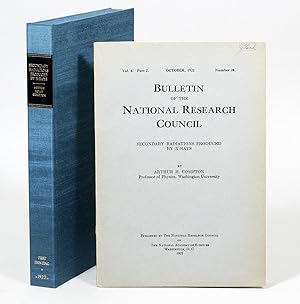
Secondary Radiations Produced by X-Rays
Published by The National Research Council of The National Academy of Sciences, Washington, DC, 1922
Seller: Manhattan Rare Book Company, ABAA, ILAB, New York, NY, U.S.A.
Seller rating 5 out of 5 stars
First Edition
Original wrappers. Condition: Fine. First edition. FIRST EDITION IN ORIGINAL WRAPPERS of Compton's report providing the data and experimental evidence for the dual wave-particle nature of electromagnetic radiation, later called "the Compton effect". "One surprise Compton observed while wrestling with his X-ray equipment was that the scattered X-ray changes its frequency. He had explored the effect very deeply to make sure it really resulted from the scattering and not from one of the many secondary effects. Finally he had obtained a clear picture: X-rays approach the metal at a different frequency. This change was like discovering that a violet flower's mirror image looks red. "Compton eventually wrote a report for the National Research Council in which he set forth his X-ray data and observations. Although he still had no explanation for the frequency change, he included it and many other findings in his data, establishing numbers and equations that had long eluded physicists. He also showed a new experimental way of using X-rays to calculate the number of electrons in an atom. This technique, at last, gave physicists an independent technique to confirm quantum assumptions about atomic structure. Compton had moved to the first rank among experimental physicists, but he still wondered about that frequency change. Why does a scattered X-ray change frequency but light bouncing off a mirror does not?" Toward the end of his paper, Compton entertains the idea of light quanta, but then dismisses it. He writes on page 55: "The experiments described above, showing that the wave-length of the scattered X-ray is greater than that of the incident X-ray, present, however, a serious difficulty to this conclusion. This change in wave-length was found to receive quantitative explanation on the view that the radiation was received and emitted by each scattering electron in discrete quanta. No alternative explanation has as yet suggested itself. Nevertheless, the cogency of the argument based on interference phenomena is so great that it seems to me questionable whether the quantum interpretation is the correct one." Only a few weeks later, however, Compton changed his mind. In November, he "gave his breakthrough lecture, telling his students that the theory of light quanta was indispensable for explaining his X-ray scattering experiments. In December he reported his discovery to the American Physical Society's annual meeting, and two weeks later he sent the report to The Physical Review. The journal, however, was not in the habit of receiving revolutionary papers and did not schedule its publication until May 1923" (Bolles, Einstein Defiant: Genius Versus Genius in the Quantum Revolution). IN: Bulletin of the National Research Council, Vol 4, Part 2, No. 20, October 1922. pp. 1-56 [the whole issue]. Washington, D.C.: The National Research Council of The National Academy of Sciences, 1922. Octavo, original wrappers; custom box. Small owner signature on front wrapper. Just a touch of toning to wrapper edges. An extremely rare survival in such fine condition.