Order Total (1 Item Items):
Shipping Destination:

Charles Lemon Editor (6 results)
Skip to main search results
Search filters
Product Type
- All Product Types
- Books (5)
- Magazines & Periodicals (No further results match this refinement)
- Comics (No further results match this refinement)
- Sheet Music (No further results match this refinement)
- Art, Prints & Posters (No further results match this refinement)
- Photographs (No further results match this refinement)
- Maps (No further results match this refinement)
- Manuscripts & Paper Collectibles (1)
Condition Learn more
- New (2)
- As New, Fine or Near Fine (No further results match this refinement)
- Very Good or Good (2)
- Fair or Poor (No further results match this refinement)
- As Described (2)
Binding
Collectible Attributes
- First Edition (1)
- Signed (No further results match this refinement)
- Dust Jacket (No further results match this refinement)
- Seller-Supplied Images (2)
- Not Print on Demand (6)
Language (2)
Free Shipping
- Free Shipping to U.S.A. (No further results match this refinement)
Seller Location
Seller Rating
-

DEATH ORCHIDS - and Other Bizarre Tales - Pulp Classics
Published by Robert Weinberg - Pulp Press, Oak Lawn, Illinois, 1976
First Edition
Soft cover. Condition: Very Good+. H. J. Ward; Harry Lemon Parkhurst; (illustrator). First Edition. Trade paperback format. Lightly rubbed on the corners with a flat uncreased spine; no interior markings. Cover art by H. J. Ward and Harry Lemon Parkhurst. This story collection contains: The Monster Wants More than a Mate by Brent North; Betrothal of the Thing by Gabriel Wilson; Bride for the Half Dead by Charles Marquis Warren; Doomsday Fate by Jeffry Strictland; Beautiful as Death by William B. Rainey; Mesa of Madness by Robert Leslie Bellem; and Death Orchids by Ellery Watson Calder. Size: 8vo. Book.
-

A Leaf from an Unopened Volume, or, The Manuscript of an Unfortunate Author: An Angrian Story
Language: English
Published by Bronte Society, Haworth, 1986
ISBN 10: 0950582921 ISBN 13: 9780950582924
Softcover (booklet). Published in 1986. Newly transcribed and edited by Charles Lemon. This story was originally written in 1834 and typical of the imaginary world she created with her brother Branwell. Angria was an extension of Glass Town, while Emily and Anne invented their own private world of Gondal. They wrote in tiny script in handmade books which are difficult to read. Some extracts are included in this text. Includes black and white illustrations and the text is reproduced in legible text. Originally edited by Lord Charles Albert and Published by Sergeant Tree, January the 17th 1834. Good condition. Inscription on inside front cover.
-

[Punch] Letter, headed 'Copy', in contemporary hand, from 'X.' to 'Mr. Editor' [of Punch].
Published by 1 May, 1859
Seller: Richard M. Ford Ltd, London, United Kingdom
Seller rating 5 out of 5 stars

Manuscript / Paper Collectible
12mo, 4 pp. Bifolium. Watermarked 'TOWGOOD'S | SUPER FINE | 1859'. Eighty-seven lines of text. Text clear and complete on aged and grubby paper. With little hope of influencing the editor of Punch, the author feels compelled to 'write and tell you what I and many others think about your Publication and the malignant spite you display towards individuals who happen to incur your wrath'. This 'malignity', he feels, 'must be derived from that murderous old ruffian from whom your publication takes its name, and which alone prevents it being an influential publication. Men laugh at the jokes in it, and admire the skill of Mr. Leech and his assistants, but II have yet to find the Man whose opinions were ever changed by anything he saw in "Punch".' He gives two examples of 'many instances of individuals who have been persecuted' by the magazine: the actor Charles Kean and 'Mr Williams of Lambeth'. What had Kean 'done to incur the wrath of "Punch"? Simply offended one of its staff'. As for Williams, he had stated, 'in a Speech to the Electors of Lambeth [.] that he had been offered a Title which he rejected - now that was nothing but the truth, for you know very well that a Baronetcy really was offered to Mr Williams and rejected'. The author accuses 'Punch' of being 'ready enough to make yourself a mere tool of corruption [.] trying to do that by ridicule which those in power could not do by flattery'. Quotes 'the advice given this day by the "Weekly Dispatch" to the "Saturday Review", before concluding 'You need not make any funny (?) remarks about any grammatical errors that may appear in this letter. If there are any I admit them, for I do not profess to be a Scholar'.
-

A CENTENARY HISTORY of the BRONTÃ SOCIETY 1893-1993. Supplement to Volume 20 Bronte Society Transactions. (ENGLISH LITERATURE, CHARLOTTE & EMILY, BRONTES)
Language: English
Published by Titus, Wilson & Sons, Kendal, 1993
ISBN 10: 0003097765 ISBN 13: 9780003097764
Paperback. Condition: New.
-
A CENTENARY HISTORY of the BRONTÃ SOCIETY 1893-1993. Supplement to Volume 20 Bronte Society Transactions. (ENGLISH LITERATURE, CHARLOTTE & EMILY, BRONTES)
Published by Titus, Wilson & Sons, Kendal, 1993
Paperback. Condition: New.
-
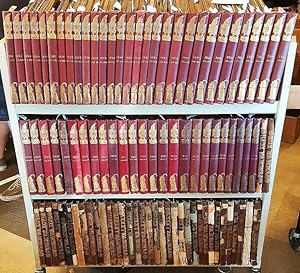
Punch: Or the London Charivari (135 volumes) (Volumes 1-15; 17-23; 25; 32-33; 36; 41-46; 48-49; 54-145; 147-155)
Published by Punch Office, 1841
Seller: Sequitur Books, Boonsboro, MD, U.S.A.
Association Member: IOBA
Seller rating 5 out of 5 stars
Hardcover. Condition: Good. Punch or the London Charivari. Profusely illustrated. Massive 135 volume set. Includes volumes 1-15; 17-23; 25; 32-33; 36; 41-46; 48-49; 54-145; 147-155. 4to, 30 cm. Bound in publisher's red cloth with gold Punch and Toby on spine. Some of the early volumes lacking spines, chipping with loss to the original cloth bindings. Volumes bound in 6 month intervals, Jan-June; July-Dec. Punch was a British magazine of humor and satire established in 1841. It quickly it rose to pre-eminence as a widely-read weekly that blended social commentary, with humor and wit. Punch appealed to reform-minded Victorian British middle-class sentiment, without espousing revolutionary spirit or radicalism. For example, the magazine's support for the repeal of the corn-laws and general support for the aims of the Chartists. The magazine was thickly populated by the political cartoons of John Tenniel and other artists. Punch's satirized the evolving political situation of 19th century Europe and relayed moderate British sentiments on the dangers of Prussian autocracy, performance in the Crimean War, Italian nationalism (Garibaldi), colonial affairs, etc. Of particular interest to American readers is Punch's commentary and cartoons of United States policy during the civil war. Punch shows a decidedly negative view of U.S. international assertiveness in their naval blockade and threats to Canada. Additionally, the emancipation proclamation, the role of blacks, and President Lincoln's policies are caricatured in its pages. This is an oversized or heavy book, that requires additional postage for international delivery outside the US.