Order Total (1 Item Items):
Shipping Destination:

Chandler Raymond Thornton (10 results)
Skip to main search results
Search filters
Product Type
- All Product Types
- Books (10)
- Magazines & Periodicals (No further results match this refinement)
- Comics (No further results match this refinement)
- Sheet Music (No further results match this refinement)
- Art, Prints & Posters (No further results match this refinement)
- Photographs (No further results match this refinement)
- Maps (No further results match this refinement)
- Manuscripts & Paper Collectibles (No further results match this refinement)
Condition Learn more
- New (No further results match this refinement)
- As New, Fine or Near Fine (1)
- Very Good or Good (7)
- Fair or Poor (No further results match this refinement)
- As Described (2)
Binding
Collectible Attributes
Language (2)
Free Shipping
- Free Shipping to U.S.A. (No further results match this refinement)
Seller Location
Seller Rating
-
The Little Sister
Published by Hamish Hamilton, London, 1949
Seller: The Book Collector, Inc. ABAA, ILAB, Fort Worth, TX, U.S.A.
Association Member: ABAA ILAB IOBA TXBA
Seller rating 4 out of 5 stars

First Edition
Hardcover. Condition: Very Good. 1st Edition. 256 pages. Small octavo (7 1/2" x 5 1/4") bound in original publisher's red cloth with gilt lettering to spine. (Bruccol: XI) First English edition which precedes the American. The Little Sister is a 1949 novel by Raymond Chandler, the fifth in his popular Philip Marlowe series. The story is set in late 1940s Los Angeles. The novel centers on the little sister of a Hollywood starlet and has several scenes involving the film industry. it was partly inspired by Chandler's experience working as a screenwriter in Hollywood and his low opinion of the industry and most of the people in it. Chandler, along with Dashiell Hammett, defined the hardboiled school of detective fiction, popularized in pulp magazines such as Black Mask. The hardboiled school was an alternative to the traditional murder mysteries of people like Agatha Christie and Dorothy L. Sayers. Unlike the mannered, complex plots typical of these authors, the hardboiled stories moved "murder out of the Venetian vase and into the alley" and "gave murder back to the kind of people that commit it for reasons, not just to provide a corpse; and with the means at hand, not with hand-wrought dueling pistols, curare, and tropical fish." One thing that distinguished Chandler's hero Philip Marlowe even from his other hardboiled peers is that Marlowe often doesn't apprehend the criminal or explain every plot point at the end of the novel. Marlowe is a witness to events, and, at most, able to manipulate them in subtle ways to balance the scales of justice a bit. Nowhere is this more apparent than in The Little Sister. Marlowe is always arriving too late to prevent a murder or catch the criminal. Even at the very end when he has finally solved the complex riddle of the case, his last act is simply to notify the police too late and let events take their course. Condition: Spine sunned, some bumps to heal edges, previous owner's initials on front end paper else a very good copy lacking jacket.
-
Spanish Blood: A Collection of Short Stories
Language: English
Published by World Publishing Company, Cleveland and New York, 1946
Seller: The Book Collector, Inc. ABAA, ILAB, Fort Worth, TX, U.S.A.
Association Member: ABAA ILAB IOBA TXBA
Seller rating 4 out of 5 stars
First Edition
Hardcover. Condition: Very Good. Dust Jacket Condition: Very Good. 1st Edition. 221 pages. Octavo (8 1/4" x 5 1/2" bound in original publisher's black with red label decorative scroll to spine and front cover in original pictorial jacket. First edition. Adventure, Love and Terror in this Collection of five great Crime stories: Spanish Blood, The King in Yellow, Pearls are a Nuisance, Nevada Gas, and Trouble is My Business. While these stories were previously published in paperback form, this is their first publication in a hardcover format. Condition: Corners bumped, pages age toned as usual. Jacket chipped at spine ends and corners, some light edge wear else a very good copy in like jacket.
-
The Long Good-Bye
Language: English
Published by Hamish Hamilton, London, 1953
Seller: The Book Collector, Inc. ABAA, ILAB, Fort Worth, TX, U.S.A.
Association Member: ABAA ILAB IOBA TXBA
Seller rating 4 out of 5 stars
First Edition
Hardcover. Condition: Very Good. Dust Jacket Condition: Very Good. 1st Edition. 320 pages. Small octavo (7 1/2" x 5 1/4") bound in original publisher's maroon with silver lettering to spine in original pictorial jacket. Jacket design by Fritz Wegner. (Bruccoli A10.1.a.) First edition, first printing. The English edition preceded the American by a few months. The Long Good-bye is a novel by Raymond Chandler, published in 1953, his sixth novel featuring the private investigator Philip Marlowe. Some critics consider it inferior to The Big Sleep or Farewell, My Lovely, but others rank it as the best of his work. Chandler, in a letter to a friend, called the novel "my best book". The novel is notable for using hard-boiled detective fiction as a vehicle for social criticism and for including autobiographical elements from Chandler's life. In 1955, the novel received the Edgar Award for Best Novel. It was later adapted as a 1973 film of the same name, updated to 1970s Los Angeles and starring Elliott Gould. Condition: Previous owner's small neat signature and acquired date and place on front end paper, head corners gently bumped. Jacket professionally repaired at spine ends and edges, slight rippling and soiling at back else a very good copy in like jacket.
-
Red Wind: A Collection of Short Stories
Published by World Publishing Company, Cleveland and New York, 1946
Seller: The Book Collector, Inc. ABAA, ILAB, Fort Worth, TX, U.S.A.
Association Member: ABAA ILAB IOBA TXBA
Seller rating 4 out of 5 stars
First Edition
Hardcover. Condition: Very Good. Dust Jacket Condition: Very Good. 1st Edition. 253 pages. Octavo (8 1/4" x 5 1/2") bound in original black cloth with red lettering to spine and front cover. (Firsts April 2000 page 52) First edition in book form. These short stories first appeared in the following periodicals Red Wind, January 1938 in dime Detective; Blackmailers Don't Shoot 1933 in the Black Mask; I'll Be Waiting 1939 in the Saturday Evening Post; Goldfish 1936 in Black Mask; Guns at Cyrano's 1936 in Black Mask. Critics and writers, ranging from W. H. Auden to Evelyn Waugh to Ian Fleming, greatly admired the finely wrought prose of Raymond Chandler . Although his swift-moving, hardboiled style was inspired mostly by Dashiell Hammett, his sharp and lyrical similes are original: "The muzzle of the Luger looked like the mouth of the Second Street tunnel"; "The minutes went by on tiptoe, with their fingers to their lips", defining private eye fiction genre , and leading to the coining of the adjective 'Chandleresque', which is subject and object of parody and pastiche. Yet, Philip Marlowe is not a stereotypical tough guy, but a complex, sometimes sentimental man of few friends, who attended university, speaks some Spanish and, at times , admires Mexicans, is a student of classical chess games and classical music. He will refuse a prospective client's money if he is ethically unsatisfied by the job. The high critical regard in which Chandler is generally held today is in contrast to the critical pans that stung Chandler in his lifetime. In a March 1942 letter to Mrs. Blanche Knopf, published in Selected Letters of Raymond Chandler, Chandler complained: "The thing that rather gets me down is that when I write something that is tough and fast and full of mayhem and murder, I get panned for being tough and fast and full of mayhem and murder, and then when I try to tone down a bit and develop the mental and emotional side of a situation, I get panned for leaving out what I was panned for putting in the first time ." Chandler's short stories and novels are evocatively written, conveying the time, place, and ambiance of Los Angeles and environs in the 1930s and 1940s. The places are real, if pseudonymous: Bay City is Santa Monica, Gray Lake is Silver Lake, and Idle Valley a synthesis of rich San Fernando Valley communities. Raymond Chandler also was a perceptive critic of pulp fiction; his essay "The Simple Art of Murder " is the standard reference work in the field . All but one of his novels have been cinematically adapted, notably The Big Sleep (1946), by Howard Hawks, with Humphrey Bogart as Philip Marlowe; novelist William Faulkner was a co-screenplay writer. Raymond Chandler's few screen writing efforts and the cinematic adaptation of his novels proved stylistically and thematically influential upon the American film noir genre. Condition: Pages age toned, shelf wear. Jacket edge chipped with closed tears and some small creases, spine ends and corners chipped else a very good copy in a about a very good jacket.
-

Ez adiorik
Published by Euskal Editorea, S.L., 2008
ISBN 10: 8493603724 ISBN 13: 9788493603724
Seller: Almacen de los Libros Olvidados, Barakaldo, BI, Spain
Seller rating 5 out of 5 stars

tapa blanda. Condition: 2ª Mano - Bueno. Dust Jacket Condition: 2ª Mano. Euskal Editorea, S.L. 2008. nombre ant rpop, marca de lectura. Libro.
-
The Little Sister
Published by Houghton Mifflin Company, Boston, 1949
Seller: The Book Collector, Inc. ABAA, ILAB, Fort Worth, TX, U.S.A.
Association Member: ABAA ILAB IOBA TXBA
Seller rating 4 out of 5 stars
First Edition
Hardcover. Condition: Very Good. Dust Jacket Condition: Very Good. 1st Edition. 249 pages. Octavo (8 1/2" x 6") bound in original publisher's red-orange cloth with blue lettering to spine and pictorial dagger to cover in original pictorial jacket. First American edition. The book was first published in the United Kingdom in June 1949; it was released in the United States three months later. The Little Sister is a 1949 novel by Raymond Chandler, the fifth in his popular Philip Marlowe series. The story is set in late 1940s Los Angeles. The novel centers on the little sister of a Hollywood starlet and has several scenes involving the film industry. it was partly inspired by Chandler's experience working as a screenwriter in Hollywood and his low opinion of the industry and most of the people in it. Chandler, along with Dashiell Hammett, defined the hardboiled school of detective fiction, popularized in pulp magazines such as Black Mask. The hardboiled school was an alternative to the traditional murder mysteries of people like Agatha Christie and Dorothy L. Sayers. Unlike the mannered, complex plots typical of these authors, the hardboiled stories moved "murder out of the Venetian vase and into the alley" and "gave murder back to the kind of people that commit it for reasons, not just to provide a corpse; and with the means at hand, not with hand-wrought dueling pistols, curare, and tropical fish." One thing that distinguished Chandler's hero Philip Marlowe even from his other hardboiled peers is that Marlowe often doesn't apprehend the criminal or explain every plot point at the end of the novel. Marlowe is a witness to events, and, at most, able to manipulate them in subtle ways to balance the scales of justice a bit. Nowhere is this more apparent than in The Little Sister. Marlowe is always arriving too late to prevent a murder or catch the criminal. Even at the very end when he has finally solved the complex riddle of the case, his last act is simply to notify the police too late and let events take their course. Condition: Quarter inch sunning to spine head. Jacket with some restoration to edges, spine head chipped, back cover lightly soiled else better than very good in a very good jacket.
-
Simple Art of Murder
Published by Houghton Mifflin Company, Boston, 1950
Seller: The Book Collector, Inc. ABAA, ILAB, Fort Worth, TX, U.S.A.
Association Member: ABAA ILAB IOBA TXBA
Seller rating 4 out of 5 stars
First Edition Signed
Hardcover. Condition: Very Good. Dust Jacket Condition: Very Good. 1st Edition. x+533 pages. Octavo (8 1/4" x 5 3/4") bound in original publisher's beige cloth with brown lettering to spine and cover in original pictorial jacket. Letter signed Ray, one page, 8.5 x 11, personal letterhead, December 31, 1947. Letter to Swanie, his literary agent H. N. Swanson, in full: David Tyler tells me he wrote to your office some time back saying he probably would not be my business manager after the end of the year 1947. He had some idea of taking a consular post with the British government (during the war he was Consular Security Officer at San Pedro), but this has fallen through due to great retrenchment in the British Foreign Service and on account of the dollar shortage. So he will be going on with me exactly as before. I expect to be in Los Angeles next Monday and believe I have to be in court Tuesday morning. After that I will go and see Joe. Happy New Year! Next to his signature, Chandler writes in his own hand: Davis says Monday. The Simple Art of Murder is hard-boiled detective fiction author Raymond Chandler's critical essay, a magazine article, and his collection of short stories. The essay was first published in The Atlantic Monthly in December 1944. The magazine article appeared in the Saturday Review of Literature, April 15, 1950. The article, somewhat rewritten, served to introduce the collection The Simple Art of Murder, 1950 (Houghton Mifflin Co.), which contained eight of Chandler's early stories pre-dating his first novel, The Big Sleep. The essay is considered a seminal piece of literary criticism. Although Chandler's primary topic is the art (and failings) of detective fiction, he touches on general literature and modern society as well. Chandler reserves his praise for Dashiell Hammett. Although Chandler and Hammett were contemporaries and grouped as the founders of the hard-boiled school, Chandler speaks of Hammett as the "one individual. picked out to represent the whole movement," noting Hammett's mastery of the "American language", his adherence to reality, and that he "gave murder back to the kind of people that commit it for reasons, not just to provide a corpse." Condition: Book plate to front paste-down, spine ends rubbed with a few minor splits, some age toning to edges. Jacket spine sunned, edge wear with some small chips and closed tears and creases, some tape repairs to verso, spine head chipped with tape repair else a very good copy in about a very good jacket. Signed by Author(s).
-
The Long Goodbye
Published by Houghton Mifflin Company, Boston, 1954
Seller: The Book Collector, Inc. ABAA, ILAB, Fort Worth, TX, U.S.A.
Association Member: ABAA ILAB IOBA TXBA
Seller rating 4 out of 5 stars
First Edition
Hardcover. Condition: Very Good. Dust Jacket Condition: Very Good. 1st Edition. 316 pages. Octavo (8 1/2" x 5 3/4") bound in publisher's half blue cloth with green edges with black lettering to spine and cover in original jacket. (Bruccoli A10.1.b.) First American edition, first printing. The English edition preceded the American by a few months. The Long Goodbye is a 1953 novel by Raymond Chandler, centered on his famous detective Philip Marlowe. While some critics consider it inferior to The Big Sleep or Farewell, My Lovely, others rank it as the best of his work. Chandler himself, in a letter to a friend, called the novel "my best book" and recalled the agony of writing it while his wife was terminally ill. The novel is notable for using hard-boiled detective fiction as a vehicle for social criticism, as well as for including autobiographical elements from Chandler's life. In 1955, the novel received the Edgar Award for Best Novel. The Long Goodbye is Chandler's most personal novel. He wrote it as his wife was dying and her illness and eventual death had a profound effect on him, driving him into fits of melancholy as well as talk of and even attempts at suicide. The novel contains two characters obviously based on Chandler himself and both of them highlight Chandler's awareness of his own flaws such as alcoholism as well as his insecurities (e.g., in the value of his writing). The most obvious Chandler substitute is the usually drunken author Roger Wade. Like Chandler, Wade had a string of successful novels behind him but as he got older he found it more difficult to write. Also, like Chandler, Wade's 316 pages. Octavo (8 1/2" x 5 3/4") bound in original publisher's half blue cloth with green edges with black lettering to spine and cover in original pictorial jacket. (Bruccoli A10.1.b.) First American edition, first printing. The English edition preceded the American by a few months. The Long Goodbye is a 1953 novel by Raymond Chandler, centered on his famous detective Philip Marlowe. While some critics consider it inferior to The Big Sleep or Farewell, My Lovely, others rank it as the best of his work. Chandler himself, in a letter to a friend, called the novel "my best book" and recalled the agony of writing it while his wife was terminally ill. The novel is notable for using hard-boiled detective fiction as a vehicle for social criticism, as well as for including autobiographical elements from Chandler's life. In 1955, the novel received the Edgar Award for Best Novel. The Long Goodbye is Chandler's most personal novel. He wrote it as his wife was dying and her illness and eventual death had a profound effect on him, driving him into fits of melancholy as well as talk of and even attempts at suicide. The novel contains two characters obviously based on Chandler himself and both of them highlight Chandler's awareness of his own flaws such as alcoholism as well as his insecurities (e.g., in the value of his writing). The most obvious Chandler substitute is the usually drunken author Roger Wade. Like Chandler, Wade had a string of successful novels behind him but as he got older he found it more difficult to write. Also, like Chandler, Wade's novels (romantic fiction) were viewed by many as not real literature and Wade obviously has the desire to be thought of as a serious author. Wade also stands in for Chandler in discussions about literature, e.g., praising F. Scott Fitzgerald. The other Chandler stand-in was Terry Lennox. Lennox was also an alcoholic. Also, like Chandler he had been in a war and the war had left emotional scars. In Lennox's case it was the Second World War; in Chandler's case it was the first. Lennox was a Canadian citizen but he had spent a great deal of time in England and retained the more restrained and formal attitude of an English gentleman. This made him somewhat of an anomaly in the fast paced and more informal world of wealthy Los Angeles that he inhabited due to his wife's money. Chandler was also raised in England and received a classical education there. Chandler.
-
Playback with Typed Letter Signed
Published by Houghton Mifflin Company, Boston, 1958
Seller: The Book Collector, Inc. ABAA, ILAB, Fort Worth, TX, U.S.A.
Association Member: ABAA ILAB IOBA TXBA
Seller rating 4 out of 5 stars
First Edition Signed
Hardcover. Condition: Near Fine. Dust Jacket Condition: Very Good. 1st Edition. 205 pages. Octavo (8 1/4" x 5 3/4") bound in original publisher's brown cloth with dark brown lettering to spine and circles to front cover in original pictorial jacket. Typed Letter Signed on an Adaptation of Playback. First edition. One page, 8.5 x 11, personal letterhead, January 9, 1948. Lengthy letter to Swanie, his literary agent H. N. Swanson. Chandler dissects a potential screenplay contract for Playback: "For such further changes and revisions as they need they should rely on my good will in the first place and in the second place on my interest in having the picture as good as it can be made" Playback is a novel by American-British writer Raymond Chandler featuring the private detective Philip Marlowe. It was first published in Britain in July 1958; the US edition followed in October that year. Chandler died the following year; Playback is his last completed novel. On 8 January 1947 Universal announced they had bought a story from Raymond Chandler called Playback. Joseph Sistrom was assigned to produce the film and it was intended Chandler would write the script. The novel was reworked by Chandler from the screenplay. The script, thought by some to be superior to the novel (generally considered to be the weakest of the seven Marlowe novels, perhaps because of its less complex plot and pat resolution), was published posthumously. Of all Chandler's novels, Playback is the only one never to have been adapted into a film. Condition: Corners gently bumped. Jacket spine ends rubbed and lightly chipped else near fine in a very good to fine jacket. Letter with folds else near fine. Signed by Author(s).
-
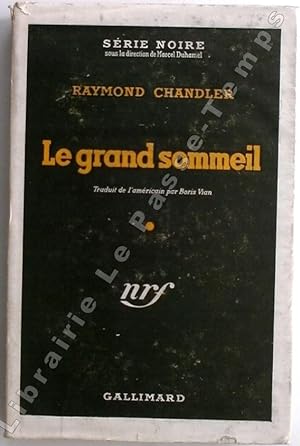
PARIS, NRF / Gallimard [Brodard et Taupin, Paris-Coulommiers] - Copyright 1948 / ACHEVÉ D'IMPRIMER LE 20 SEPTEMBRE 1948 / DL 4e trimestre 1948 [N° d'édition: 1408 / N° d'impression: 7133] - C.19x12x1,9 cm - Cartonnage éditeur jaune et noir titré en jaune; jaquette mate blanche et noire titrée en blanc et jaune, dos blanc et noir titré et NON numéroté en blanc et jaune, 4e de couverture blanc et noir au catalogue de la collection en blanc (14 titres); 250 et (4) pages. (Collection Série Noire, sous la direction de Marcel Duhamel - N° 13 - 135 fr.). Petit point au stylo sur le haut du dos de la jaquette. Bon état. BIEN COMPLET DE SA JAQUETTE. PREMIÈRE ÉDITION dans la collection: 14 titres au catalogue. Français Livres.