

Order Total (1 Item Items):
Shipping Destination:

Agnon Shai (12 results)
Skip to main search results
Search filters
Product Type
- All Product Types
- Books (12)
- Magazines & Periodicals (No further results match this refinement)
- Comics (No further results match this refinement)
- Sheet Music (No further results match this refinement)
- Art, Prints & Posters (No further results match this refinement)
- Photographs (No further results match this refinement)
- Maps (No further results match this refinement)
- Manuscripts & Paper Collectibles (No further results match this refinement)
Condition Learn more
- New (No further results match this refinement)
- As New, Fine or Near Fine (1)
- Very Good or Good (5)
- Fair or Poor (1)
- As Described (5)
Binding
Collectible Attributes
- First Edition (2)
- Signed (No further results match this refinement)
- Dust Jacket (2)
- Seller-Supplied Images (7)
- Not Print on Demand (12)
Language (4)
Free Shipping
- Free Shipping to U.S.A. (No further results match this refinement)
Seller Location
Seller Rating
-

Hardcover. Condition: Very Good. Text in Yiddish. Translation into Yiddish from Hebrew by Eliezer Rubenstein. Tape stains on inside and rear title pages. Stamp on rear cover from Hebrew Union Library.
-
Bi-levav yamim. (In the Heart of the Seas)
Published by Jerusalem: Schocken, 1956
Seller: Plurabelle Books Ltd, Cambridge, United Kingdom
Association Member: GIAQ
Seller rating 5 out of 5 stars

Paperback. Condition: Fair. slim booklet, issued as number 9 of a series by the Schocken publishers, front cover soiled, front detaching, text with pencil notes and addition notes to back inside cover, private name stamp, he.
-
Lengua de tierra. Antología del cuento israelí
Published by Adriana Hidalgo Editora, Buenos Aires, 2002
Seller: Libreria Ninon, Capital Federal, BSA, Argentina
Seller rating 1 out of 5 stars

Rústica. Excelente estado 196 pag. Selección, traducción del hebreo y prólogos de Henie Hajdenberg.
-
Lengua de tierra. Antología del cuento israelí
Published by Adriana Hidalgo Editora, Buenos Aires, 2002
Seller: Libreria Ninon, Capital Federal, BSA, Argentina
Seller rating 1 out of 5 stars
Rústica. Excelente estado 196 pag. Selección, traducción del hebreo y prólogos de Henie Hajdenberg.
-

Lengua de Tierra Antología del Cuento israelí
Language: Spanish
Published by Adriana Hidalgo Editora S.A., 1982
ISBN 10: 9879396766 ISBN 13: 9789879396766
Seller: Almacen de los Libros Olvidados, Barakaldo, BI, Spain
Seller rating 5 out of 5 stars
Tapa blanda. Condition: 2ª Mano. , . . NUEVO RETRACTILADO. Selección traducción del hebreo. y prólogos de Henie Hajdenberg.
-
20.5x12.5cm. 154 pages. Gilt hardcover with dust jacket. In good condition. The book is in : Danish.
-
Couverture souple. Condition: Très bon. Edition originale. First edition; In Hebrew.in-16° (11,5x15 cm); publisher's cardboard binding in good condition with very little wear at spine end and edges; title on paper label at the center of the front panel, perfect black end papers; inside as new, never read; 82 pages.
-
Mesibah Shel Sofrei Eretz Yisrael (Anthology of Writers in the Land of Israel)
Published by Book Bureau of the Union of Hebrew Writers and Literature, Tel Aviv, 1926
Seller: ERIC CHAIM KLINE, BOOKSELLER (ABAA ILAB), Santa Monica, CA, U.S.A.
Seller rating 4 out of 5 stars

First Edition
Softcover. Condition: g- to g+. First edition. Small folio. 110 columns (in Hebrew numbering) + 9 pages. Tan printed wrappers with avant-garde typography ("Haim" font) on the front cover in red. Typography designed by the acclaimed Hungarian-born graphic designer, painter and architect István Irsai (1896-1968). A scarce anthology of Hebrew writers in mandatory Palestine, this publication contains more than 70 contributions on a variety of subjects, from many of the most distinguished literary, academic and intellectual figures of the time including the likes of Mordechai Avi-Shaul (1898-1988), Avraham Avrunin (1869-1957), Yosef Aharonovich (1877-1937), Elisheva Bikhovski (1888-1949), S.Y. Agnon, Avigdor Hameiri, Ya'akov David Kamson (1900-1980), David Shimoni (David Shimonovich, 1891-1956) and Avraham Shlonsky (1900 1973). Includes a section of period advertisements at the rear. List of contributors on the front cover. Text in Hebrew. Wrappers sunned, with foxing and staining to the front cover. Some rubbing to extremities and chipping along the spine. Interior front cover, title page and a few sporadic pages throughout with some foxing. Wrappers in good-, interior in good+ condition overall. Scarce. Hebrew title: ???? ?? ????? ??"? Alternate title: ???? ?? ????? ???? ????? Designer's name: ??? ???-?? István Irsai (aka Pesach Ir-Shai, 1896-1968) was a Hungarian-born graphic designer, architect and painter. He is well known for inventing the now ubiquitous modernist Hebrew font "Haim", which was named after the writer Haim Nachman Bialik, an early supporter of Irsai's efforts. He was a prolific graphic designer in both Hungary and Palestine (later Israel).
-
DIE ERZÄHLUNG VOM TORASCHREIBER.
Language: German
Published by Marx & Co, Berlin, 1923
Seller: M.POLLAK ANTIQUARIAT Est.1899, ABA, ILAB, Tel-Aviv, Israel
Seller rating 5 out of 5 stars
Original Half Cloth. Condition: Very Good. Dust Jacket Condition: As New. 41pp. Printed by Drugulin press in Leipzig 400 copies were printed> (this copy without number> Initials by Joseph Budko. A very good copy in the original half cloth.
-
Das Buch von den Polnischen Juden Polin Ha'adina hakduma leTora veliteuda lemiyom sur Efraim meal Yehuda
Language: German
Published by Judischer Verlag, Berlin, Germany, 1916
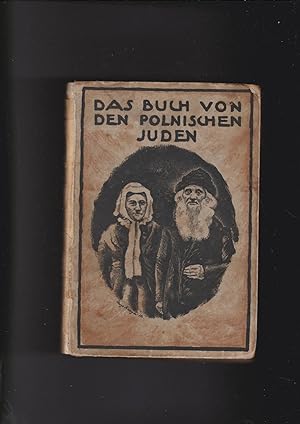
Hardcover. Condition: Very Good. No Jacket. Krayn, Hugo, Einbandzeichnung von (illustrator). In German. Illustrated. [6], 270 pages. 193 x 136 mm. Re-backed. First edition. 8vo. Original pictorial cloth designed by Berlin Secession artist Hugo Krayn. Additional pictorial title pages in both Hebrew and German, sixteen black and white plates. An anthology edited by Nobel Laureate Shmuel Yosef Agnon six years prior to his first major publication The Bridal Canopy (1922). The collection attempts to correct the stereotypical perception of Polish Jewry in the West and comprises short stories, accounts of legal restrictions, an architectural study of Polish synagogues, as well as numerous proverbs and other miscellanea. Shmuel Yosef Agnon (Shmuel Yosef Halevi Czaczkes)(Buczacz, Polish Galicia, then part of the Austro-Hungarian Empire, now Buchach, Ukraine, July 17, 1888 - Jerusalem, February 17, 1970) was an Austro-Hungarian-born Israeli novelist, poet, and short-story writer. He was one of the central figures of modern Hebrew literature. In Hebrew, he is known by the acronym Shai Agnon. In English, his works are published under the name S. Y. Agnon. His works deal with the conflict between the traditional Jewish life and language and the modern world. They also attempt to recapture the fading traditions of the European shtetl (village). In a wider context, he also contributed to broadening the characteristic conception of the narrator's role in literature. Agnon had a distinctive linguistic style, mixing modern and rabbinic Hebrew. In 1966, he shared the Nobel Prize in Literature with the poet Nelly Sachs. His father, Shalom Mordechai Halevy, was ordained as a rabbi, but worked in the fur trade, and had many connections among the Hasidim, his mother's side had ties to the Mitnagdim. He did not attend school and was schooled by his parents. In addition to studying Jewish texts, Agnon studied writings of the Haskalah, and was also tutored in German. At the age of eight, he began to write in Hebrew and Yiddish, At the age of 15, he published his first poem, in Yiddish, about the Kabbalist Joseph della Reina. He continued to write poems and stories in Hebrew and Yiddish, which were published in Galicia. In 1908, he moved to Jaffa in Ottoman Palestine. The first story he published there was "Agunot" ("Chained Wives"), which appeared that same year in the journal Ha`omer. He used the pen name "Agnon", derived from the title of the story, which he adopted as his official surname in 1924. In 1910, "Forsaken Wives" was translated into German. In 1912, at the urging of Yosef Haim Brenner, he published a novella, "Vehaya Ha'akov Lemishor" ("The Crooked Shall Be Made Straight"). In 1913, Agnon moved to Germany, where he met Esther Marx (1889-1973), the sister of Alexander Marx. They married in 1920 and had two children. In Germany he lived in Berlin and Bad Homburg vor der Höhe (1921-24). Salman Schocken, a businessman and later also publisher, became his literary patron and freed him from financial worries. From 1931 on, his work was published by Schocken Books, and his short stories appeared regularly in the newspaper Haaretz, also owned by the Schocken family. In Germany, he continued to write short stories and collaborated with Martin Buber on an anthology of Hasidic stories. Many of his early books appeared in Buber's Jüdischer Verlag (Berlin). The mostly assimilated, secular German Jews, Buber and Franz Rosenzweig among them, considered Agnon to be a legitimate relic, being a religious man, familiar with Jewish scripture. Gershom Scholem called him "the Jews' Jew". In 1924, a fire broke out in his home, destroying his manuscripts and rare book collection. Later that year, Agnon returned to Palestine and settled with his family in the Jerusalem neighborhood of Talpiot. In 1929, his library was destroyed again during anti-Jewish riots. Agnon writes about Jewish life, but with his own unique perspective and special touch. Agnon's writing often used words and phrases that differed from what would become established modern Hebrew.
-
Ve-Hayah he-Akov le-Mishor VeHaya HeHakov LeMishor [= And the rough ground shall become level][phrase from Isaiah 40:4]
Language: Hebrew
Published by Jüdischer Verlag, Berlin, Germany, 1919
Hardcover. Condition: Very Good +++. No Jacket. Budko, Joseph (1888-1940) (illustrator). In Hebrew. 96 pages. 19 x 14 cm. In original slipcase. 19 x 14 cm. 96 pages. Shmuel Yosef Agnon (Shmuel Yosef Halevi Czaczkes)(Buczacz, Polish Galicia, then part of the Austro-Hungarian Empire, now Buchach, Ukraine, July 17, 1888 - Jerusalem, February 17, 1970) was an Austro-Hungarian-born Israeli novelist, poet, and short-story writer. He was one of the central figures of modern Hebrew literature. In Hebrew, he is known by the acronym Shai Agnon. In English, his works are published under the name S. Y. Agnon. His works deal with the conflict between the traditional Jewish life and language and the modern world. They also attempt to recapture the fading traditions of the European shtetl (village). In a wider context, he also contributed to broadening the characteristic conception of the narrator's role in literature. Agnon had a distinctive linguistic style, mixing modern and rabbinic Hebrew. In 1966, he shared the Nobel Prize in Literature with the poet Nelly Sachs. His father, Shalom Mordechai Halevy, was ordained as a rabbi, but worked in the fur trade, and had many connections among the Hasidim, his mother's side had ties to the Mitnagdim. He did not attend school and was schooled by his parents. In addition to studying Jewish texts, Agnon studied writings of the Haskalah, and was also tutored in German. At the age of eight, he began to write in Hebrew and Yiddish, At the age of 15, he published his first poem, in Yiddish, about the Kabbalist Joseph della Reina. He continued to write poems and stories in Hebrew and Yiddish, which were published in Galicia. In 1908, he moved to Jaffa in Ottoman Palestine. The first story he published there was "Agunot" ("Chained Wives"), which appeared that same year in the journal Ha`omer. He used the pen name "Agnon", derived from the title of the story, which he adopted as his official surname in 1924. In 1910, "Forsaken Wives" was translated into German. In 1912, at the urging of Yosef Haim Brenner, he published a novella, "Vehaya Ha'akov Lemishor" ("The Crooked Shall Be Made Straight"). In 1913, Agnon moved to Germany, where he met Esther Marx (1889-1973), the sister of Alexander Marx. They married in 1920 and had two children. In Germany he lived in Berlin and Bad Homburg vor der Höhe (1921-24). Salman Schocken, a businessman and later also publisher, became his literary patron and freed him from financial worries. From 1931 on, his work was published by Schocken Books, and his short stories appeared regularly in the newspaper Haaretz, also owned by the Schocken family. In Germany, he continued to write short stories and collaborated with Martin Buber on an anthology of Hasidic stories. Many of his early books appeared in Buber's Jüdischer Verlag (Berlin). The mostly assimilated, secular German Jews, Buber and Franz Rosenzweig among them, considered Agnon to be a legitimate relic, being a religious man, familiar with Jewish scripture. Gershom Scholem called him "the Jews' Jew". In 1924, a fire broke out in his home, destroying his manuscripts and rare book collection. Later that year, Agnon returned to Palestine and settled with his family in the Jerusalem neighborhood of Talpiot. In 1929, his library was destroyed again during anti-Jewish riots. Agnon writes about Jewish life, but with his own unique perspective and special touch. Agnon's writing often used words and phrases that differed from what would become established modern Hebrew. His distinct language is based on traditional Jewish sources, such as the Torah and the Prophets, Midrashic literature, the Mishnah, and other Rabbinic literature. Agnon was twice awarded the Bialik Prize for literature (1934 and 1950). He was also twice awarded the Israel Prize, for literature (1954 and 1958).
-
Mesibah Shel Sofrei Eretz Yisrael (Anthology of Writers in the Land of Israel)
Published by Book Bureau of the Union of Hebrew Writers and Literature, Tel Aviv, 1925
Seller: Schoen Books, South Deerfield, MA, U.S.A.
Association Member: SNEAB
Seller rating 3 out of 5 stars

Library Binding. Condition: Good +. Small folio. 110 columns (in Hebrew numbering) + 9 page advertisments scarce work. in library binding pocket and tape on spine, pages furled kind of pasty slight soiling not affecting text Typography designed by Istvan Irsai who designed the Hebrew font "Haim" . More than 70 writers included in the anthology For example Avrunin, Hamieri, Shimoni, Shlonski.


![Seller image for Ve-Hayah he-Akov le-Mishor VeHaya HeHakov LeMishor [= And the rough ground shall become level][phrase from Isaiah 40:4] for sale by Meir Turner](https://pictures.abebooks.com/inventory/md/md20169579839.jpg)