

Order Total (1 Item Items):
Shipping Destination:

Gertler, J (122 results)
Skip to main search results
Search filters
Product Type
- All Product Types
- Books (122)
- Magazines & Periodicals (No further results match this refinement)
- Comics (No further results match this refinement)
- Sheet Music (No further results match this refinement)
- Art, Prints & Posters (No further results match this refinement)
- Photographs (No further results match this refinement)
- Maps (No further results match this refinement)
- Manuscripts & Paper Collectibles (No further results match this refinement)
Condition Learn more
Collectible Attributes
- First Edition (3)
- Signed (No further results match this refinement)
- Dust Jacket (2)
- Seller-Supplied Images (44)
- Not Print on Demand (112)
Language (5)
Free Shipping
Seller Location
Seller Rating
-

Annual Reviews in Control Volume 25, 2001
Language: English
Published by International Federation of Automatic Control, 2001
Hardcover. Condition: Very Good. Dust Jacket Condition: None. Sticker residue on cover.
-

Prying Eyes : Protect Your Privacy from People Who Sell to You, Snoop on You, or Steal from You
Language: English
Published by Random House Information Group, 2004
ISBN 10: 0375720936 ISBN 13: 9780375720932
Condition: Very Good. Pages intact with possible writing/highlighting. Binding strong with minor wear. Dust jackets/supplements may not be included. Stock photo provided. Product includes identifying sticker. Better World Books: Buy Books. Do Good.
-

Impact Evaluation in Practice
Language: English
Published by World Bank Publications, 2010
ISBN 10: 0821385410 ISBN 13: 9780821385418
Paperback. Condition: Very Good. No Jacket. May have limited writing in cover pages. Pages are unmarked. ~ ThriftBooks: Read More, Spend Less.
-
Paperback. Condition: Very Good. PAP/PSC. Grade 3 out 5 points. This is a used book. Book has wear on cover and pages. May have personalized notes/names, stickers/labels. Has no markings on pages. May not include extra materials like access codes, CDs, accessories, etc. All orders ship by next business day! We are a small company and very thankful for your business!
-
Impact Evaluation in Practice (World Bank Training)
Language: English
Published by World Bank Publications, 2010
ISBN 10: 0821385410 ISBN 13: 9780821385418
Condition: good. Befriedigend/Good: Durchschnittlich erhaltenes Buch bzw. Schutzumschlag mit Gebrauchsspuren, aber vollständigen Seiten. / Describes the average WORN book or dust jacket that has all the pages present.
-
Impact Evaluation in Practice (World Bank Training)
Language: English
Published by World Bank Publications, 2010
ISBN 10: 0821385410 ISBN 13: 9780821385418
Condition: very good. Gut/Very good: Buch bzw. Schutzumschlag mit wenigen Gebrauchsspuren an Einband, Schutzumschlag oder Seiten. / Describes a book or dust jacket that does show some signs of wear on either the binding, dust jacket or pages.
-

Transportation, Technology, and Society: Future Options.
Language: English
Published by Clark University Press,, Worcester:, 1978
ISBN 10: 0914206168 ISBN 13: 9780914206163
Seller: Grendel Books, ABAA/ILAB, Springfield, MA, U.S.A.
Association Member: ABAA ILAB IOBA SNEAB
Seller rating 5 out of 5 stars

First Edition
Hardcover. Condition: Near Fine. Dust Jacket Condition: Near Fine. First edition. Near fine in a near fine dust jacket.
-
Transportation, Technology, and Society: Future Options.
Language: English
Published by Clark University Press,, Worcester:, 1978
ISBN 10: 0914206168 ISBN 13: 9780914206163
Seller: Grendel Books, ABAA/ILAB, Springfield, MA, U.S.A.
Association Member: ABAA ILAB IOBA SNEAB
Seller rating 5 out of 5 stars
First Edition
Hardcover. Condition: Near Fine. Dust Jacket Condition: Very Good. First edition. Near fine in a very good (minor shelf wear, fading along spine) dust jacket.
-

Condition: good. Befriedigend/Good: Durchschnittlich erhaltenes Buch bzw. Schutzumschlag mit Gebrauchsspuren, aber vollständigen Seiten. / Describes the average WORN book or dust jacket that has all the pages present.
-
The New Industrial Geography: Regions, Regulation And Institutions
Language: English
Published by Routledge, 1999
Soft cover. Condition: New. ISBN:9780415513753.
-
Emerging Technologies in the Strategic Arena: A Primer: March 1987, P-7319
Published by Rand, CA, 1987
Seller: Between the Covers-Rare Books, Inc. ABAA, Gloucester City, NJ, U.S.A.
Association Member: ABAA ESA ILAB IOBA
Seller rating 5 out of 5 stars
Softcover. Condition: Very Good. Very good in wrappers, a paperback. Staple binding. 14 pages. Clean text. Sticker on rear cover. Light yellow line on front cover.
-

Impact Evaluation in Practice -Language: portuguese
Language: English
Published by World Bank Publications, 2014
ISBN 10: 146480088X ISBN 13: 9781464800887
Condition: As New. Unread book in perfect condition.
-
, Failure to prevent selective CA1 neuronal death and reduce cortical infarction following cerebral ischemia with inhibition of nitric oxide synthase. ,.
Published by Neuroscience 61, 1-11 (1994) ,, 1994
Broschürt. Obr. [SD52]. / Englisch 400g.
-

Avaliação De Impacto Na Prática
Language: English
Published by World Bank Publications, US, 2015
ISBN 10: 146480088X ISBN 13: 9781464800887
Seller: Rarewaves.com USA, London, LONDO, United Kingdom
Seller rating 5 out of 5 stars
Paperback. Condition: New. This book offers an accessible introduction to the topic of impact evaluation and its practise in development. While the book is geared principally towards development practitioners and policymakers designing prospective impact evaluations, we trust that it will be a valuable resource for students and others interested in using impact evaluation. Prospective impact evaluations should be used selectively to assess whether or not a programme has achieved its intended results, or to test alternatives for achieving those results. We consider that more and better impact evaluation will help strengthen the evidence base for development policies and programmes around the world. If governments and development practitioners can make policy decisions based on evidence - including evidence generated through impact evaluation - our hope is that development resources will be spent more effectively, and ultimately have a greater impact on reducing poverty and improving people's lives. The three chapters in this handbook provide a non-technical introduction to impact evaluations, including "Why Evaluate" in Chapter 1, "How to Evaluate" in Chapter 2 and "How to Implement Impact Evaluations" in Chapter 3. These elements are the basic 'tools' needed in order to successfully carry out an impact evaluation.From a methodological standpoint our approach to impact evaluation is largely pragmatic: we think that the most appropriate methods should be identified to fit the operational context and not the other way around. This is best achieved at the outset of the programme, through the design of prospective impact evaluation that can be built into the project's implementation. We argue that gaining consensus between key stakeholders and identifying an evaluation design that fits the political and operational context is as important as the method itself. We also believe strongly that impact evaluations should be upfront about their limitations and caveats. Finally, we strongly encourage policymakers and programme managers to consider impact evaluations in a logical framework that clearly sets out the causal pathways by which the programme works to produce outputs and influence final outcomes, and to combine impact evaluations with monitoring and selected complementary evaluation approach to gain a full picture of performance.This book builds on a core set of teaching materials developed for the "Turning Promises to Evidence" workshops organised by the office of the Chief Economist for Human Development (HDNCE) in partnership with regional units and the Development Economics Research Group (DECRG) at the World Bank.
-
Avaliao De Impacto Na Prtica (Paperback)
Language: English
Published by World Bank Publications, Washington, 2015
ISBN 10: 146480088X ISBN 13: 9781464800887
Paperback. Condition: new. Paperback. This book offers an accessible introduction to the topic of impact evaluation and its practise in development. While the book is geared principally towards development practitioners and policymakers designing prospective impact evaluations, we trust that it will be a valuable resource for students and others interested in using impact evaluation. Prospective impact evaluations should be used selectively to assess whether or not a programme has achieved its intended results, or to test alternatives for achieving those results. We consider that more and better impact evaluation will help strengthen the evidence base for development policies and programmes around the world. If governments and development practitioners can make policy decisions based on evidence - including evidence generated through impact evaluation - our hope is that development resources will be spent more effectively, and ultimately have a greater impact on reducing poverty and improving peoples lives. The three chapters in this handbook provide a non-technical introduction to impact evaluations, including Why Evaluate in Chapter 1, How to Evaluate in Chapter 2 and How to Implement Impact Evaluations in Chapter 3. These elements are the basic tools needed in order to successfully carry out an impact evaluation.From a methodological standpoint our approach to impact evaluation is largely pragmatic: we think that the most appropriate methods should be identified to fit the operational context and not the other way around. This is best achieved at the outset of the programme, through the design of prospective impact evaluation that can be built into the projects implementation. We argue that gaining consensus between key stakeholders and identifying an evaluation design that fits the political and operational context is as important as the method itself. We also believe strongly that impact evaluations should be upfront about their limitations and caveats. Finally, we strongly encourage policymakers and programme managers to consider impact evaluations in a logical framework that clearly sets out the causal pathways by which the programme works to produce outputs and influence final outcomes, and to combine impact evaluations with monitoring and selected complementary evaluation approach to gain a full picture of performance.This book builds on a core set of teaching materials developed for the Turning Promises to Evidence workshops organised by the office of the Chief Economist for Human Development (HDNCE) in partnership with regional units and the Development Economics Research Group (DECRG) at the World Bank. Shipping may be from multiple locations in the US or from the UK, depending on stock availability.
-
Impact Evaluation in Practice -Language: portuguese
Language: English
Published by World Bank Publications, 2014
ISBN 10: 146480088X ISBN 13: 9781464800887
Condition: New.
-

Avaliação de Impacto na Prática, Segunda edição (Portuguese Edition)
Language: Portuguese
Published by The World Bank (edition 2), 2018
ISBN 10: 1464808899 ISBN 13: 9781464808890
Paperback. Condition: Fair. 2. The item might be beaten up but readable. May contain markings or highlighting, as well as stains, bent corners, or any other major defect, but the text is not obscured in any way.
-

Impact Evaluation in Practice
Language: English
Published by World Bank Publications, 2010
ISBN 10: 0821385410 ISBN 13: 9780821385418
Condition: New.
-
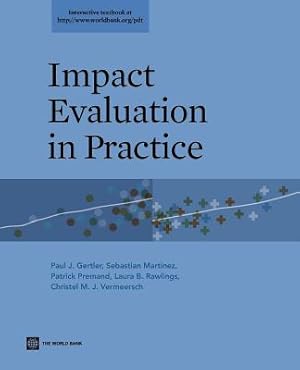
Impact Evaluation in Practice (Paperback or Softback)
Language: English
Published by World Bank Publications 12/13/2010, 2010
ISBN 10: 0821385410 ISBN 13: 9780821385418
Paperback or Softback. Condition: New. Impact Evaluation in Practice. Book.
-
Impact Evaluation in Practice (Portuguese Edition)
Language: English
Published by World Bank Publications, 2014
ISBN 10: 146480088X ISBN 13: 9781464800887
Condition: New. 262.
-
Paperback. Condition: Brand New. 262 pages. 9.20x7.20x0.70 inches. In Stock.
-
Avalia??o De Impacto Na Pr?tica
Language: English
Published by MP-WBK World Bank Group Publ, 2015
ISBN 10: 146480088X ISBN 13: 9781464800887
Seller: PBShop.store UK, Fairford, GLOS, United Kingdom
Seller rating 4 out of 5 stars

PAP. Condition: New. New Book. Shipped from UK. Established seller since 2000.
-

Impact Evaluation in Practice
Language: English
Published by World Bank Publications, 2010
ISBN 10: 0821385410 ISBN 13: 9780821385418
Condition: As New. Unread book in perfect condition.
-
Impact Evaluation in Practice
Seller: PBShop.store UK, Fairford, GLOS, United Kingdom
Seller rating 4 out of 5 stars
PAP. Condition: New. New Book. Shipped from UK. Established seller since 2000.
-
Avalia??o de Impacto na Pr?tica (Portuguese Edition)
Language: English
Published by World Bank Publications, 2015
ISBN 10: 146480088X ISBN 13: 9781464800887
Seller: Kennys Bookshop and Art Galleries Ltd., Galway, GY, Ireland
Seller rating 5 out of 5 stars
Condition: New. Num Pages: 262 pages. BIC Classification: KCM. Category: (G) General (US: Trade). Dimension: 235 x 184 x 18. Weight in Grams: 544. . 2015. Paperback. . . . .
-
Impact Evaluation in Practice (Portuguese Edition)
Language: English
Published by World Bank Publications, 2014
ISBN 10: 146480088X ISBN 13: 9781464800887
Condition: New. 262.
-
Impact Evaluation in Practice
Language: English
Published by World Bank Publications, 2016
ISBN 10: 1464807795 ISBN 13: 9781464807794
Condition: As New. Unread book in perfect condition.
-

Impact Evaluation in Practice
Language: English
Published by World Bank Publications, US, 2010
ISBN 10: 0821385410 ISBN 13: 9780821385418
Paperback. Condition: New. This book offers an accessible introduction to the topic of impact evaluation and its practice in development. While the book is geared principally towards development practitioners and policymakers designing prospective impact evaluations, we trust that it will be a valuable resource for students and others interested in using impact evaluation. Prospective impact evaluations should be used selectively to assess whether or not a program has achieved its intended results, or to test alternatives for achieving those results. We consider that more and better impact evaluation will help strengthen the evidence base for development policies and programs around the world. If governments and development practitioners can make policy decisions based on evidence - including evidence generated through impact evaluation - our hope is that development resources will be spent more effectively, and ultimately have a greater impact on reducing poverty and improving people's lives. The three chapters in this handbook provide a non-technical introduction to impact evaluations, including "Why Evaluate" in Chapter 1, "How to Evaluate" in Chapter 2 and "How to Implement Impact Evaluations" in Chapter 3. These elements are the basic 'tools' needed in order to successfully carry out an impact evaluation. From a methodological standpoint our approach to impact evaluation is largely pragmatic: we think that the most appropriate methods should be identified to fit the operational context, and not the other way around. This is best achieved at the outset of the program, through the design of prospective impact evaluation that can be built into the project's implementation. We argue that gaining consensus between key stakeholders and identifying an evaluation design that fits the political and operational context is as important as the method itself. We also believe strongly that impact evaluations should be upfront about their limitations and caveats. Finally, we strongly encourage policymakers and program managers to consider impact evaluations in a logical framework that clearly sets out the causal pathways by which the program works to produce outputs and influence final outcomes, and to combine impact evaluations with monitoring and selected complementary evaluation approach to gain a full picture of performance.
-
Avalia??o de Impacto na Pr?tica (eng)
Language: English
Published by World Bank Publications, 2015
ISBN 10: 146480088X ISBN 13: 9781464800887
Condition: new.
-
Impact Evaluation in Practice (Paperback)
Language: English
Published by World Bank Publications, Washington, 2010
ISBN 10: 0821385410 ISBN 13: 9780821385418
Paperback. Condition: new. Paperback. This book offers an accessible introduction to the topic of impact evaluation and its practice in development. While the book is geared principally towards development practitioners and policymakers designing prospective impact evaluations, we trust that it will be a valuable resource for students and others interested in using impact evaluation. Prospective impact evaluations should be used selectively to assess whether or not a program has achieved its intended results, or to test alternatives for achieving those results. We consider that more and better impact evaluation will help strengthen the evidence base for development policies and programs around the world. If governments and development practitioners can make policy decisions based on evidence - including evidence generated through impact evaluation - our hope is that development resources will be spent more effectively, and ultimately have a greater impact on reducing poverty and improving peoples lives. The three chapters in this handbook provide a non-technical introduction to impact evaluations, including Why Evaluate in Chapter 1, How to Evaluate in Chapter 2 and How to Implement Impact Evaluations in Chapter 3. These elements are the basic tools needed in order to successfully carry out an impact evaluation. From a methodological standpoint our approach to impact evaluation is largely pragmatic: we think that the most appropriate methods should be identified to fit the operational context, and not the other way around. This is best achieved at the outset of the program, through the design of prospective impact evaluation that can be built into the projects implementation. We argue that gaining consensus between key stakeholders and identifying an evaluation design that fits the political and operational context is as important as the method itself. We also believe strongly that impact evaluations should be upfront about their limitations and caveats. Finally, we strongly encourage policymakers and program managers to consider impact evaluations in a logical framework that clearly sets out the causal pathways by which the program works to produce outputs and influence final outcomes, and to combine impact evaluations with monitoring and selected complementary evaluation approach to gain a full picture of performance. Offers an accessible introduction to the topic of impact evaluation and its practice in development. While the book is geared principally towards development practitioners and policymakers designing prospective impact evaluations, it will also be a valuable resource for students and others interested in using impact evaluation. Shipping may be from multiple locations in the US or from the UK, depending on stock availability.


