

Martin Firrell
Martin Firrell (born 4 April 1963, Paris, France) has been described variously as a cultural activist, a campaigner, a public artist, or benevolent provocateur, stimulating debate in public space to promote positive social change.
Firrell has raised questions about the politics of ageing, individual liberty, the right to personal idiosyncrasy, cultural diversity, LGBT+ and gender equality, faith, climate change, masculinity, what constitutes a meaningful and purposeful life, hero worship, fair and truthful government, and the quality of human lived experience.
His work has been summarised as 'art as debate'.
Firrell was educated in England but left school unofficially at 14 because he 'had no more use for it'. He educated himself during his absence from school by walking and reading in the Norfolk countryside.
He read early 20th century-literature extensively, citing the works of Virginia Woolf, Gertrude Stein, and the French writer Marguerite Duras (with whom he shares his birthday and a high degree of political sympathy) as key influences on his later development.
It was a passage in Anaïs Nin's novel The Four Chambered Heart that set Firrell on the path of socially engaged public works. In the passage in question, the novel's protagonist declares that literature fails to prepare us for, or guide us through, the calamities or challenges of life, and is therefore worthless.
'In a very early work, (The Beautiful and The Grave, Providence Press, published 1992) more than twenty years ago, I wrote that art should be a force for good, and I have stuck faithfully to that premise. If you can raise debate, eventually change will follow.'
Firrell sets out to remedy Nin’s ‘worthlessness’ of words by using language to raise provocative questions about society, relevant to the vast majority of people and freely available in public.
Two early works point to the agenda Firrell has explored extensively in mature works. Lucid Between Bouts of Sanity, published in a tri-lingual edition in 1996, is a manifesto in four sections exploring the reductive nature of action, the flaws in language, the difficulty of meaning anything accurately to anyone, and the possibility of using a constrained and reduced language to find a new expressive power.
'I felt it must be possible to describe the limits within which all language must operate and so designate a clearly defined space for my own experimentation.'
The manifesto was published in French, English and Russian and distributed at the ICA Cafe in London and the Literaturnaya Cafe in St Petersburg.
Postcards 1998 is an early, and now extremely rare, print project of 14 postcards in a green card slipcase. The project consists of 13 texts presented where postcards customarily display a picture, and a 14th card showing a photographic portrait of the artist (taken by Russian Concert Pianist, Yekaterina Lebedeva, using a disposable camera) on the Pont des Arts in Paris, mid cartwheel. It was the first of Firrell's works conceived with the sole aim of having a direct presence and influence in people's daily lives.
'I wanted to make a work that could be pinned up in the family kitchen because it spoke to a family member in some personal and significant way. I wanted to explore the possibilities of being more deeply implicated in life.'
This project can be regarded as a working prototype with influence over all subsequent works including large-scale projections of text in public space and works investigating the deeper value of mass popular culture.
Popular items by Martin Firrell
View all offers-
The First Manifesto of Surrealism: NO 2 (Publisher's Choice)
Goll, Yvan; Firrell, Martin
Item prices starting from
View 20 offers£ 7.36
-
Ugly Sweaty Men Become CEOs all the Time. Ugly Sweaty Women Don't.: 3 (socialart.work)
Beale, Inga; Firrell, Martin; De Gouges, Olympe
Item prices starting from
View 15 offers£ 8.36
-
Protection for Women: The 1589 Feminist Text in Modern English
Anger, Jane
Item prices starting from
View 20 offers£ 8.04
-
Socialism Is a Moral Idea: 1 (socialart.work)
Short, Clare; Firrell, Martin; Kenney, Annie; Pendred, Pleasance; Lytton, Constance; Davison, Emily
Item prices starting from
View 14 offers£ 9.19
-
50% of the Time the Right Person for the Job Must Be a Woman: 5 (Socialart.Work)
Garfield, LIV; Firrell, Martin; Besant, Annie
Item prices starting from
View 17 offers£ 6.33
-
Let the London Sewers Overflow: Jane Anger's Protection for Women: 6 (socialart.work)
Anger, Jane
Item prices starting from
View 17 offers£ 8.64
-
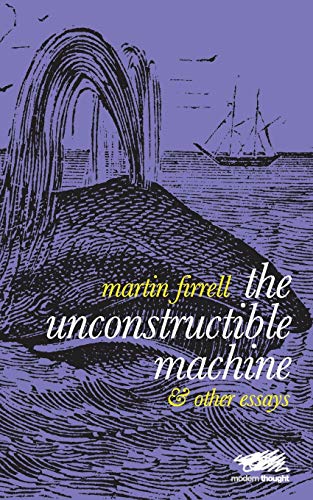
The Unconstructible Machine: & Other Essays
Firrell, Martin
Item prices starting from
View 12 offers£ 7.04
Also find
New -
Art and Theosophy: Texts by Martin Firrell and A. L. Pogosky: 2 (Modern Theosophy)
Firrell, Martin; Pogosky, Aleksandra
Item prices starting from
View 20 offers£ 12.29
Also find
New



You've viewed 8 of 13 titles