Linden West
My name is Linden West and I am Professor of Education at Canterbury Christ Church University, in the UK. I was recently visiting professor at the University of Milano-Bicocca, Paris Nanterre and Michigan State. In 2020, I was honoured to be inducted into the International Adult and Continuing Education Hall of Fame.
My book, written with Laura Formenti, Transforming perspectives in lifelong learning and adult education: a dialogue, recently won the prestigious American Association for Adult and Continuing Education's (AAACE) Cyril O. Houle prize. The Award was established in 1981 to honour the scholarship and memory of Cyril O. Houle, professor of adult education at the University of Chicago. It is given annually for a book published in English in the previous year that reflects universal concerns of adult educators. Nominated works exemplify outstanding literature in adult education. Writing the book was a kind of pilgrimage, no less, across the landscapes of lifelong learning and adult education. It involved deepening dialogue between ourselves about the nature of transformation, and conversations with diverse authors like Mezirow, Brookfield, Bauman, Freire, Tawney, Williams, Freud, Jung, Spielrein, Bateson, Dewey, Dante, Dirkx, Honneth, Adriana Cavarero, Williams, Britzman, Tawney, Lorenzetto, Sofia Corradi, and others.
Transformation can be a troubling concept, meaning all things to all people. It risks being evacuated of meaning. It can be a kind of fetish, in a difficult, liquid or fragile, hyper-consumerist, neo-liberal world of frightening change and discontents: transform or else you will join the ranks of the dispossessed! At a different level the rhetoric of transformative learning can sometimes neglect or ignore human defensiveness and resistance to learning, and our capacity for self-delusion and hatred of new ideas. This in a world of increasing xenophobia, fake news and closure to the other, no doubt exacerbated in the echo chambers of social media.
Dialogue becomes ever more essential, if difficult, and we model its possibilities across our own differences, as well as in contexts of conflict. In the process, we challenge various binaries: the material and spiritual, individual and collective, self and other, mind and body, psyche and society. We question the either or ism of the academy and suggest that an understanding of transformation and transformative learning is enriched when we transcend binary thinking and embrace the possibility of multiple perspectives.
Professor John Dirkx, from Michigan State University, in his review of Transforming Perspectives has called it '“A beautiful work in which Laura Formenti and Linden West invite us on a compelling pilgrimage of multiple perspectives of transformative learning. Rooted in auto/biographical narrative and engaging dialogical methods, the authors quickly draw us into a journey that takes us off the academic beaten path by, paradoxically, embracing well-established intellectual traditions, such as philosophy, art, and spirituality. Together we enter into worlds of light and height as well as darkness and depth.
Through their masterful representation and use of these traditions, the authors create for us a subjective journey that increasingly illuminates what it objectively means to more fully grasp and live the transformative dimensions of learning and adult education. It is a storied journey in which we weave in and out of the authors’ lives and experiences, their relationship and dialogue with one another, the lives of their research participants, and the powerful ideas that have guided and informed their pilgrimage.
A much welcomed and needed exploration of one of the most generative concepts in adult learning. After reading this book, you can’t help but think and feel differently both about transformative learning as a theoretical concept and yourself as an active participate in this dialogue. It’s a must read!”
There is news about another book co-edited with Alan Bainbridge, on psychoanalysis and education. This is now translated into Italian - Educazione e Psicoanalisi, Un dialogo da riavviare - and published by IPOC Press. Using Biographical Methods in Social Research, co-written with Barbara Merrill, is translated into Korean.
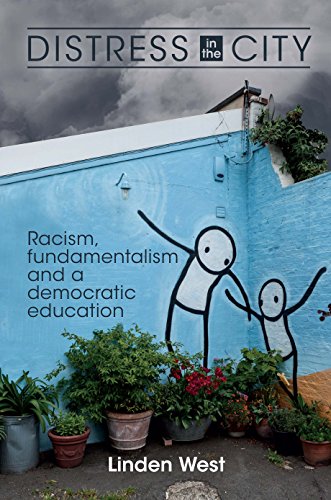
Reviews of 'Distress in the city: racism, fundamentalism and a democratic education', published by Trentham/IOE Books in 2016, have been enthusiastic. The book has spoken to many people concerned about the continuing rise of racism. Islamophobia and fundamentalisms of various kinds, alongside the retreat of the educational imagination. The book's originality, interdisciplinarity, and innovative methodology have been celebrated. It addresses the radicalisation of young Muslims as well as disaffection among other working class youth.
Distress in the city is a case study of a distressed post-industrial community - Stoke on Trent in the English Midlands - struggling with various discontents, based on the stories of those who live there. The stories illuminate how racism, Islamophobia and Islamism take hold and how the city is emblematic of wider problems across many societies. Stoke is a location, like many other places, of a fractured economy, a malfunctioning representative democracy, the weakening of working class self-help traditions, and the narrowing of education's purpose. But there are resources of hope, which include the recovery of lost histories of working class struggle against Nazi fundamentalism in the Lidice shall live campaign; and the inspirational development of workers education, in the city, at the beginning of the last century. The history encompasses the past (and possible future) role of universities in creating new social solidarities, working alongside local communities. Such history can inspire civic education in schools and communities. There are new adult education projects too bringing working class white and Muslim women together, to learn and dialogue, and take action to challenge austerity politics.
Popular items by Linden West
View all offers-
Distress in the City: Racism, fundamentalism and a democratic education
West, Linden
Item prices starting from
View 6 offers£ 1.96
Also find
Used -
Using Biographical Methods in Social Research
Merrill, Barbara; West, Linden
Item prices starting from
View 22 offers£ 4.37
-
Doctors on the Edge: General Practitioners, Health and Learning in the Inner-city
West, Linden
Item prices starting from
View 5 offers£ 3.98
Also find
Used -
Beyond Fragments: Adults, Motivation And Higher Education (Culture & Society)
West, Linden
Item prices starting from
View 42 offers£ 4.79
-
Discourses, Dialogue and Diversity in Biographical Research: An Ecology of Life and Learning: 10 (Research on the Education and Learning of Adults, 10)
Alan Bainbridge; Laura Formenti; Linden West
Item prices starting from
View 27 offers£ 39.76
-
Transforming Perspectives in Lifelong Learning and Adult Education: A Dialogue
Formenti, Laura; West, Linden
Item prices starting from
View 30 offers£ 102.02