

Ian Inkster
Raised in Warrington, Edinburgh, Khartoum, Lowestoft, and Harlow, my university education in UK was in economics, maths and economic history. After marrying a fellow-undergraduate, Lorainne Rich, we moved to Australia as I took up teaching in Economic History at the University of New South Wales in Sydney, where I later became Head and Professor. With three small children, after the death of my wife I moved back to UK to the Research Professorship in International History at Nottingham Trent University. By this time I had written a great numebr of papers as well as a few books including Japan as a Development Model? (1980), Science and Technology in History (1991),and Clever City (1991). Back in UK I devoted increasing attention to global history of industrialisation, with special attention to technology - the most recent outcome of that work is a long forthcoming paper on Chinese political economy and recent history for the International History Review. A great deal of my recent work is based on my Full Professorship in the Department of International Affairs of the Wenzao Ursuline University of Languages in Kaohsiung, Taiwan, and this has resulted in large projects on cultural and technological history, now formulated as two books under the titles 'The Camphor Wars. World History and the Indigenous Peoples of Taiwan circa 1800-1930'. (in preparation, forthcoming)and 'Selling the Nation and Eating Savages: Taiwan in the Colonizing World of the 1890s'.
A good way of doing world history is by taking interesting connections across the globe, tracing relationships and impacts over time and place. This usually leads to a certain amount of multidisciplinarity. My focus at the moment is cannibalism in China and Taiwan, not only considering the veracity of cannibal stories, but the use of the notion of cannibalism to denigrate Chinese culture in the eyes of the west. Carried in mostly Anglophone sources, stories about eating people in and about China served well in aid of the rise of Jaanese colonialism from the 1870s, especially in Taiwan (then Formosa) from the mid-1890s. So history takes you in a lot of directions - in this case including replies if not attacks on cultural anthropologists and post-modernists who from arm-chair (reclining) positions dismiss all talk of eating people as merely expressions of the self-interst of colonists. Almost certainly, most accounts did serve powerful imperialists in their downgrading of native ciultures, but this never in itself could mean that cannibalism did not exist.
But since returning to UK much more has happened. I married Lesley Yhearm and gained two more lovely kids as a result, lived in a 500 year old farm house in Nottingham, travelled a great deal, eating all meats offered me (and Lesley too!) from monkey, dog and cat to eel, snake, and lizard - baulking at very large fish-heads with eye balls included, they were difficult to get into the mouth, impossible to get out of the mouth - and of course never tried humans, the thrill is in the writing in this case. Two of the children are married and are looking after my four grandchildren for me, two are engaged to be married quite soon, so things are busy. But writing continues and is spreading out to include music and childrens' stories as well as my continued editorship of the UK journal History of Technology. My time divides between UK, Taiwan and Spain pretty neatly and my new position at SOAS keeps me interested and in the centre of things in London.
Infuriatingly, my books do just fine but are not academic best sellers. With me as with so many others, we want to get it right, erect a panoply of nuances to every statement, and by so doing increase our academic value whilst losing our potential readers! In the near future I intend to close my mind to such delicacies and go for the bright light of clarity - when I make more money and fame and am no longer reviewed so kindly, I shall toast my readers in a more expensive bottle of bubbly. Ha.
Popular items by Ian Inkster
View all offers-
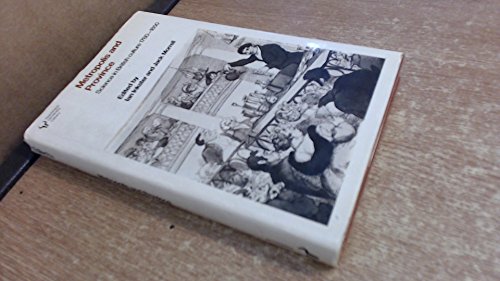
Metropolis and Province: Science in British Culture, 1780-1850
Item prices starting from
View 34 offers£ 5.35
-
Religious Dissent and the Aikin-Barbauld Circle, 1740–1860
Item prices starting from
View 44 offers£ 5.07
-
History of Technology: Includes Special Issue on the Professional Identity of Engineers v. 27 (History of Technology)
Ian Inkster
Item prices starting from
View 18 offers£ 4.61
-
-
History of Technology Volume 28: Special Issue: By Whose Standards? Standardization, Stability and Uniformity in the History of Information and Electr
Ian Inkster
Item prices starting from
View 12 offers£ 8.70
-
Science and Technology in History (Themes in Comparative History S.)
Inkster, Ian
Item prices starting from
View 4 offers£ 14.25
Also find
Used -
Technology and Industrialisation: Historical Case Studies and International Perspectives: 625 (Variorum Collected Studies)
Inkster, Ian
Item prices starting from
View 2 offers£ 17.94
Also find
Used -
Culture and Technology in Modern Japan (Culture & Technical Modern Japan): 1
Item prices starting from
View 12 offers£ 17.50


You've viewed 8 of 21 titles