Hillel I. Millgram
Hillel I Millgram has been cross-trained in a variety of disciplines during his life – studying among others science, intellectual history, theology and education – all of which inform his writings. At the Jewish Theological Seminary of America, where he was ordained, his main focus was Bible in what was then one of the premier Bible departments in the United States. Upon ordination he served in pulpits both in the United States and Canada. Now living in Jerusalem, he combines research and writing with teaching graduate courses in the Bible.
The central contention in all his writings is that the Books that make up the Bible remain relevant, despite the passage of thousands of years, precisely because of their radical nature: they challenge, each in its own way, the established consensus of what is important in life and how things should be done that has dominated humanity from the dawn of civilization to the present day. These Books all insist and that there are better ways of living than those of the dysfunctional world in which we find ourselves, and in so doing they break the box of stereotyped thinking that encloses us, opening us to previously unimagined possibilities.
Hillel Millgram writes:
"My works are books about the Bible, or to be more exact, books about selected biblical narratives. But they are very unlike most books that you will see on the subject. Their gestation proved to be not so much standard scholarly projects as voyages of discovery. They all began simply enough with the posing of a question such as: why is the evil King Ahab given equal billing with the great prophet Elijah in the tales that form the centerpiece of the Book of Kings, and indeed why is he mostly portrayed as a hero? The attempts to elucidate questions such as these quickly morphed into something else entirely: leaps into the unknown. I found that I had set forth to explore a region I thought I at least partially understood only to find myself on terra incognita, grappling with unanticipated issues and arriving at unexpected conclusions.
Often on voyages such as these, the outcome is so far from the original goal as to defy comprehension. So Columbus, setting forth to find a sea route to the Indies, discovered the Americas, yet unable to let go of his preconceptions continued to insist to his dying day that he had arrived at the offshore islands of Asia. Some adventurers, perhaps less sure of themselves, stumbling upon the unexpected, find within themselves the capacity to stretch their minds, admit the possibility of the previously inconceivable, and adjust their thinking to radically new possibilities.
I have attempted to follow the latter route, altering the framework of my thinking so as to embrace unexpected facts rather than try to explain them away on the basis of outmoded paradigms. These revisions in my thinking never took place overnight; in each case they constituted an extended process, sometimes lasting a year or more, and often vigorously resisted. As I was forced to revise my opinions – sometimes as a result of cogent criticism, sometimes after reading works previously unknown to me, most often by finding myself in some blind alley and being forced to retrace my steps and to rethink matters from a different perspective – I inevitably would find myself in dark and murky waters. It is always easier to remain with the traditional; the tried and true questions where the ground is seemingly firm under one’s feet. Yet my choice would be to follow the facts where they led. What emerged from these difficult gestations were the books that I have written."
Popular items by Hillel I. Millgram
View all offers-
Defiant Prophets: Jonah, Balaam, Jeremiah and Their Rebellion Against God
Hillel I. Millgram (author)
Item prices starting from
View 16 offers£ 28.98
-
Four Biblical Heroines and the Case for Female Authorship: An Analysis of the Women of Ruth, Esther and Eenesis 38
Millgram, Hillel I.
Item prices starting from
View 16 offers£ 28.98
-
The Joseph Paradox: A Radical Reading of Genesis 37-50
Millgram, Hillel I.
Item prices starting from
View 15 offers£ 26.43
-
The Elijah Enigma: The Prophet, King Ahab and the Rebirth of Monotheism in the Book of Kings
Millgram, Hillel I.
Item prices starting from
View 14 offers£ 34.92
-
Judges And Saviors, Deborah And Samson: Reflections of a World in Chaos
Hillel I. Millgram
Item prices starting from
View 14 offers£ 47.71
-
The Invention of Monotheist Ethics: v. 1: Exploring the First Book of Samuel: 1
Millgram, Hillel I.
Item prices starting from
View 9 offers£ 54.90
Also find
New -
-
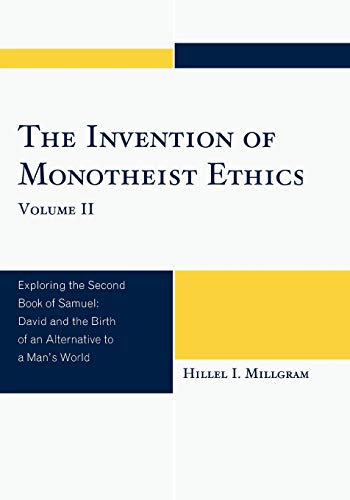
The Invention of Monotheist Ethics: v. 2: Exploring the Second Book of Samuel: 2
Hillel Millgram
Item prices starting from
View 11 offers£ 65.96