Stefano Bottoni
Stefano Bottoni was born in Bologna (Italy) in 1977 from a mixed Italian-Hungarian family. After graduating in 2001 in History at the University of Bologna with a prize-winning MA thesis on the Hungarian minorities in Central Europe after the II World War, he was admitted to the PhD program in “History of Europe” of his university. His project analysed the nationality policy in Communist Romania, focusing on the troubled history of the Hungarian Autonomous Region in Transylvania (1952-1960) and the anti-Hungarian reprisals carried out in Romania after the 1956 Hungarian revolution.
Between 2002 and 2005, when he got his PhD, he made extensive archival research in the Romanian, Hungarian and British archives, being among the first non-Romanian scholars to be given access to the formerly closed archives of the Romanian secret police (the Securitate). His PhD thesis has got Italian (2007), Hungarian (2008) and Romanian (2010) editions, while extracts of it were published in English and French as well. Among his recent publications, one finds a general history of Eastern Europe’s since 1919 (Un altro Novecento. L’Europa orientale dal 1919 ad oggi. Roma, Carocci, 2011), and a Hungarian-language article dealing with cooperation between the Hungarian and the Romanian state security apparatus during the Communist period („Baráti együttműködés”: a magyar–román állambiztonsági kapcsolatok 1945–1982. Történelmi Szemle, 2011/2). Since 2005 he teaches History of Eastern Europe and Comparative politics of Eastern Europe at the University of Bologna as a contract lecturer. Between 2007 and 2011 he also was an assistant research fellow at the University of Eastern Piedmont, POLIS Department of Political Science (Alessandria, Italy). In 2009 he became a research fellow at the Institute of History of the Hungarian Academy of Sciences.
His current interest field are the nationality question in modern and contemporary Eastern Europe, Hungarian-Romanian diplomatic relations after 1918, the political and social history of Transylvania and Slovakia in the Communist period, ethnic conflicts in Eastern Europe and post-Soviet area after the fall of Communism, and State-Church relationships in Eastern Europe in the communist and post-communist period.
Popular items by Stefano Bottoni
View all offers-
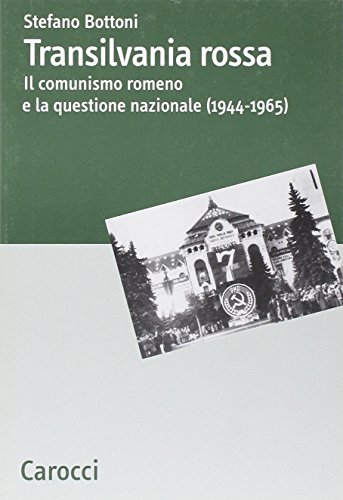
Transilvania rossa. Il comunismo romeno e la questione nazionale (1944-1965)
Stefano Bottoni
Item prices starting from
View 2 offers£ 16.56
Also find
New