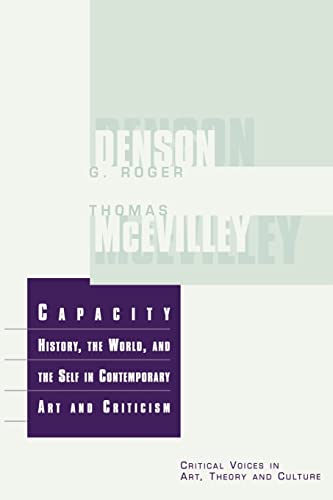
G. Roger Denson
G. Roger Denson (b. 1956) is perhaps best known for his art and cultural criticism and commentary on HUFFINGTON POST, and in the art journals, ART IN AMERICA, PARKETT, ARTSCRIBE and Duke University's CULTURAL POLITICS. He has worked as a curator of visual and performance media at the alternative space, HALLWALLS, as well as guest curating with the Albright-Knox Art Gallery, The New Museum and The Alternative Museum, both in NYC, A-Space, Toronto, Canada, and various New York Commercial galleries. Although he favors writing journalism over books, Denson’s books on criticism and art catalogues include, CAPACITY: HISTORY, THE WORLD AND THE SELF IN CONTEMPORARY ART AND CRITICISM, on the criticism of Thomas McEvilley (Routledge, 1996); DENNIS OPPENHEIM (B. Pinto de Almeida, Fundacao De Serralves Portugal, 1997); HUNTER REYNOLDS: MEMENTO MORI, MEMORITER (Trinitatiskirche, Cologne, Germany, 1994); and POETIC INJURY: THE SURREALIST LEGACY IN POSTMODERN PHOTOGRAPHY (The Alternative Museum, New York, 1987, with a preface by Rosalind Krauss and essays by Denson and Suzaan Boettger). He is currently writing SONATA OF CONSCIOUSNESS: THE PAINTING OF VASUDEO S. GAITONDE, on the late Indian visionary painter.
In 2005, Denson became a founding member of the Criticism and Writing MFA Program organized by Thomas McEvilley at The School of Visual Arts in New York. For the five years that he was with the program, he designed and taught two graduate courses, SEX, GENDER AND THE BODY IN GLOBAL ART HISTORY, and 20TH CENTURY CRITICAL THEORY: FROM MODERNISM TO POSTMODERNISM AND AFTER. Denson took a 10-year hiatus from art writing to write fiction, first as a screenwriter, then as a novelist. In 2010, Denson published his first novel, VOICE OF FORCE. In 2012, he published his second novel, ANTHONY IN THE DESERT.
In 2010, he wrote the e-book, THE BEAUTY WE FEAR: THE GREAT MOSQUES OF THE WORLD , in response to the so-called "Ground Zero Mosque" controversy, and to counter the myth that many Americans and Europeans carry in their minds of the mosque as breeding ground for terror.
When asked why his novels and screenplays have centered around protagonists who, even if they are agnostic or atheist, grapple with the issues of faith in a modern world, he responded, "In my effort to offset what has become seen among secular cultures as the dark face of faith, I've tried to portray individuals who still see some glimmer of the light of redemption coming from somewhere outside themselves--maybe it is Nature (the sky, the ocean, the desert), or some Whole they envision. They aren't converts to religion, but to the mythos of a great, transcendent POSSIBILITY."
"Ragland Hughes in VOICE OF FORCE (2010), for instance, is a middle-aged, hyper-sophisticated opera critic who is an agnostic faced for the first time with the faith of a young and immensely talented tenor when that faith comes between them. It is the tenor's faith that contributes to the prejudice against Hughes' sexuality, to the extent that it contributes to his utter demise."
"In my screenplay, APPALACHIAN ANGELS (2001), an 18-year-old West Virginia girl, Laraine Hodes, finds herself the victim of persecution when a traveling band of evangelicals learn she is an atheist at the same time as they convert her rapist father. I cast Anthony Anchor, in ANTHONY IN THE DESERT (2000, 2012), as my one convert, not to a religion, but to the mythos of a great, transcendent possibility that informs all the world's faiths. I go so far as to make Anthony analogous with many of the myths we've inherited from religion--not just St. Anthony of the Desert (including Flaubert's version of him), but also Francis of Assisi, Gautama Buddha, Arjuna Pandava, Muhammad, Jesus, Lao-Tzu, Black Elk, and so many others mystics and messianic figures from around the globe--coalescing them into one modern character enabled by modernism to resist many of the pressures that earlier mystics had to conform to."
"Even in my screenplay, THE PATIENT (2002), where I allow myself to go completely over the top in describing a bizarre reincarnation cult, I'm interested in elaborating how faith is something we reach for to reinforce otherwise subjective and inherited views of right and wrong. I do this by showing the cult being bent on making a Harvard psychoanalyst "pay" for what they believe are the crimes he committed against them in their various past lives. (I think of this as my campily overwrought ROSEMARY'S BABY.)"
"I'm most interested in trying to show human beings informed by a kind of enthralling aestheticism of ethics. In this way, I show that ethics are no more than a kind of pragmatic aesthetics. In other words, the mysticism that informed the founders, prophets, saints and mystics of the world's faiths is little more than the same response to the world and to cultures as that which compels artists and poets to produce their work. But somewhere along the way, power made, if not the founders of faiths, certainly their followers, to become despotic and dogmatic."
"The huge difference with my characters is that they weigh their mysticisms against the irrepressible skepticism that comes with clear-headed thinking. That's why I made ANTHONY IN THE DESERT a story about grappling with the mysticism that comes with being in awe of the world, while coming face-to-face with all the reasons that faiths go wrong when implementing religion. Reasons such as the pressure put on Anthony by others to lead them, despite that he doesn't want to lead. And, really, what keeps him from leading them--what saves him from the messianic complex, one might think--is the great guilt he carries with him."
"My protagonists don't find solace in faith as much as they do in the quest for POSSIBILITIES that gives them a purpose in the world, even though they know the world greets their aspirations with absurd indifference. And in the end, my novels and screenplays are never about religion, as much as they are about how thoughtful individuals have to find their own ethics and ideologies while maintaining an independence from the dictates and dogmas of religions. If I largely show my characters struggling with religious believers, it is because they've had the bad luck of being victimized or restrained by people who use religion, rather than their own power of conscience, as a vehicle of empowerment."
Denson's screenplays include: ANTHONY IN THE DESERT (drama) 2000-2003; APPALACHIAN ANGELS (drama) 2001; and THE PATIENT (metaphysical/suspense) 2002. ANTHONY IN THE DESERT in particular was honored variously by Paramount Pictures' Chesterfield Writer's Film Project; Mirimax Pictures' Project Greenlight; Francis Ford Coppola's American Zoetrope; Kevin Spacey's Trigger Street; and The Screenwriter's Community as a top script by an emerging screenwriter. In 2004, Denson co-wrote and edited the performance script for the marionette rock opera, DON'T TRUST ANYONE OVER THIRTY: ENTERTAINMENT BY DAN GRAHAM AND TONY OURSLER, performed at Art Basel Miami Beach; Thyssen-Bornemisza Art Contemporary, Vienna, Austria; and The Walker Art Center, Minneapolis, 2004-05. A film montage of the performance made by Tony Oursler was installed at the Whitney Biennial 2006, Whitney Museum of Art in New York.
Popular items by G. Roger Denson
View all offers-
-
Dennis Oppenheim
Denson, G. Roger; Almeida, Bernardo Pinto De; Pinto De Almeida, B.
Item prices starting from
View 3 offers£ 19.31
Also find
Used -
-
Capacity: The History, the World, and the Self in Contemporary Art and Criticism (Critical Voices in Art, Theory and Culture)
McEvilley, Thomas
Item prices starting from
View 48 offers£ 12.12