Peter Golden
Peter Golden is an award-winning journalist, historian, and novelist who, during the course of his long and varied career, has interviewed Presidents Richard Nixon, Gerald Ford, Ronald Reagan, and George H.W. Bush; Secretaries of State Henry Kissinger, Alexander Haig, George Shultz, and Lawrence Eagleburger; Israeli Prime Ministers Yitzhak Rabin, Shimon Peres, and Yitzhak Shamir; and Soviet President Mikhail Gorbachev.
Golden’s Quiet Diplomat, published in 1992, was a biography of industrialist and Republican political-insider Max M. Fisher. It made the Detroit Free Press bestseller list and was widely reviewed. Commentary magazine declared the biography a “meticulously researched and gracefully written book” that “gives us a concrete view of the emergence of American Jews into the mainstream of national politics since World War II.” In his review of the biography, political analyst J.J. Goldberg wrote that Quiet Diplomat was “a disturbing, challenging book. It suggests, without answering, a wide range of questions about the relationship between the American Jewish community and its ‘leadership,’ and between the Diaspora community and the state of Israel. . . . In the end, [Golden] leaves readers free to draw their own conclusions.” One facet of diplomacy Golden uncovered was that during a 1965 visit Fisher made to President Dwight D. Eisenhower at his Gettysburg farm, the president told him that he regretted pushing Israel to pull out of the Sinai. This fact was essentially unknown to historians until Golden wrote about it, and the claim was backed up by President Richard Nixon, who told Golden: “Eisenhower. . . told me—and I am sure he told others—that he thought the action that was taken [at Suez] was a mistake.”
Golden returned to journalism and won, among other kudos, the New York State Bar Association’s Media Award. Some of Golden’s work has appeared in the Detroit Free Press Magazine, The Albany Times Union, New Jersey Monthly, Microsoft’s eDirections, Beyond Computing, The Forward, Capital Magazine, and the Huffington Post.
In 2000, Golden co-wrote the memoir, I Rest My Case, chronicling the life of J. Stanley Shaw, one of the preeminent bankruptcy attorneys in the United States and the political leader in New York City that played a primary role in electing Mayor John v. Lindsay.
Golden’s first foray into fiction were the five interactive novels for computers he designed and wrote as part of the Bantam Books “Living Literature Series,” and he spent two years overseeing programmers in Silicon Valley.
In 2012, Golden’s novel, Comeback Love, which explored the changes in America during the 1960s, was published by Atria Books, an imprint of Simon & Schuster. Reviews were excellent—“Golden’s breakout debut fiction is a passionate story of love, loss and reconciliation. . . Grab a handful of tissues. . . then start speculating on actors best suited to bring Gordon and Glenna to the big screen.” (Kirkus) “Glenna and Gordon’s romance rises and falls with the familiar but engrossing tempo of reckless, youthful passion.” (Publishers Weekly) “Golden’s first novel resonates with the great experiences typical of a life—love, sorrow, loss, lessons, resolutions. . . . The sometimes subtle, sometimes dramatic emotional dancing Gordon and Glenna engage in reads as honestly and accurately as any love story between two people who come together, come apart, then reconnect decades later.” (Booklist)
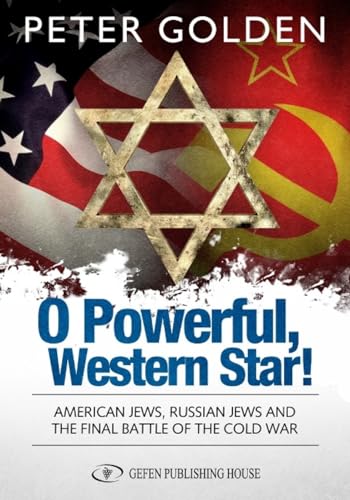
That same year, Golden’s history of the Cold War and its relationship to the Soviet Jewry movement, O Powerful Western Star! was published. Of the history, Professor Henry L. Feingold, the dean of American Jewish historians, wrote: “The rescue of Soviet Jewry was an enormously complex happening. Now Peter Golden has woven the entire story in a broad-ranging tapestry of historical incidents and processes. A talented novelist has been let loose to make sense of this crucial exodus with the result that a dense history has been magically transformed. O Powerful Western Star! reads like a good novel.” Publishers Weekly deemed the book “an extensively researched history” and observed that “given its politically-charged subject matter, Golden is remarkably even-handed.”
On November 3, 2015, Atria Books published Golden’s Wherever There Is Light, a sweeping, panoramic, historical novel that covers three generations in the intertwined lives of two families—the Roses, who are Jewish, and the Wakefields, who are African American. The novel delves into the little known history of the rescue of German Jews from the Nazis by traditionally African-American colleges. Julian Rose, a former bootlegger, and his love interest, Kendall Ann Wakefield, whose family founded the college and becomes a world-renowned photographer, are the main protagonists of the story. The novel looks at the problems of interracial love affairs starting in 1938 and takes place in New Jersey, South Florida, Greenwich Village and Paris. It concludes in 1966 by tracing the fate of all the characters, both major and minor, as they struggle to come to grips with the fact they were all as haunted by the times they lived in as they were by their own private battles.
Wherever There Is Light was featured in New York Magazine’s Fall Preview issue and selected by the Star-Ledger as one of the best books of the year. Overall, reviews were excellent. Here are excerpts:
Keenly detailed . . . compelling . . . Author Golden proves his stripes as a historian.”
Kirkus Reviews
Absorbing. . . vivid characters and strong storytelling
The Washington Post
Each setting is re-created with a socially conscious eye, from the horrifying racism of the Jim Crow South to the Greenwich Village art scene to postwar Paris, whose residents’ emotional suffering hasn’t dimmed their appreciation for beauty. Julian and Kendall are independent, courageous people who grow over time, and their story feels undeniably romantic.
Booklist
In November 2016, the memoir Golden wrote for Senator Joseph L. Bruno, Keep Swinging: A Memoir of Politics and Justice, was published. Bruno, the son of impoverished Italian immigrants, is a small-town American success story. After working his way out of Depression-era Glens Falls, NY, Bruno served in the United States Army in Korea, and as the leader of the Senate Republicans in New York, becoming one of the three most powerful men in the state. During his fourteen years in the Senate, he forged coalitions, achieved compromises, and brought together feuding legislative factions for the common good. In his memoir, you meet household names like Rudy Giuliani, Russell Simmons, Hillary Clinton, Al D’Amato, Donald Trump and Eliot Spitzer—and see them as you never have before—in the hallways where decisions are made and in behind the scenes conversations amongst friends and opponents.
On April 10, 2018, Atria Books published Golden’s new novel, Nothing Is Forgotten, which explores the relationship between the Holocaust and the Cold War. As novelist Karin Tanabe observed, the work is “historical fiction at its finest. . . a sweeping tale full of humor and heartbreak that takes us on a journey to explore how inherited histories can follow us through
generations.”
In March 2019, Golden was named a Literary Legend by the Albany Library Foundation.
In June 2021, Golden’s Our Darkest Hours: New York County Leadership & the COVID Pandemic was published. The pandemic took the life of over 50,000 New Yorkers in a year. These are the stories of leadership in the face of the chaotic response from the state and federal government.
In April 2023, The Talanian Way was published. Charles M. Talanian is the grandson of Armenian immigrants who built a real-estate empire. He is among the largest holders of commercial properties on Newbury Street in Boston, now considered one of the most exclusive streets in the United States.
In February 2025, Golden’s novel, Their Shadows Deep, the story of John F. Kennedy’s run for the White House in 1960, appeared.
On October 27, 2026, Golden’s new novel, A Girl from Ohio, will be published.
Popular items by Peter Golden
View all offers-
-
-
-
Our Darkest Hours: New York County Leadership?& the Covid Pandemic
Acquario, Stephen; Golden, Peter; LaVigne, Mark
Item prices starting from
View 38 offers£ 4.30
-
Governing on the Ground: The Past, Present, and Future of County Government
Golden, Peter
Item prices starting from
View 23 offers£ 9.12
-
Quiet Diplomat: Biography of Max M. Fisher
Golden, Peter
Item prices starting from
View 18 offers£ 15.57
-
O Powerful Western Star: American Jews, Russian Jews, and the Final Battle of the Cold War
Golden, Peter
Item prices starting from
View 16 offers£ 18.19
-