Aqeel Ansari
Aqeel Ansari graduated from Wharton following his studies at the Delhi School of Economics, Delhi, India. He immigrated to the United States in 1967. As a U.S. citizen, he was an economic advisor to the Saudi government from 1980 to 1985.
Ansari’s new book, The Idea of Equality: A Myth, An Ideal, or A Reality?, argues for a new social order, empowering readers with wisdom to trade prejudice for dignity for ease and satisfaction in life. He establishes the basis of equality in naturally endowed potential of dignity. He investigates the nature and purpose of revealed knowledge and discovers in it an infinite source of wisdom, seeking to extend the scope of human knowledge. He selects the Qur’an as an illustrative source of revealed knowledge and demonstrates how we can apply reason and intellect to obtain wisdom.
The book amplifies the forces of humanity to discipline the forces of civility. It challenges the nature and end of civil societies, which fail to establish harmony. The civil societies institutionalize competition to create winners and losers. The patriot competes in the secular arena to become prosperous. The faithful competes in the sacred arena for salvation of soul. Win or lose, the book argues, both the patriot and the faithful experience loss of balance and remain without dignity. Accordingly, it seeks to create a new social order in the society of equals, which is neither secular nor sacred, empowering readers with wisdom of revealed knowledge for striving with dignity as equals.
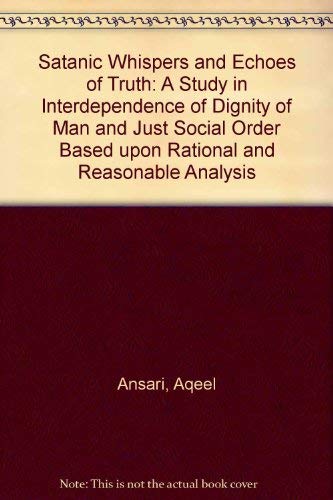
Ansari's earlier work, Satanic Whispers and Echoes of Truth, reinterprets history in secular-sacred coexistence; he calls it the Kshatriya-Brahmin syndrome, which consistently weakens man's resolve to strive for dignity. The book establishes the idea of a single humanity.
He conducted a two-year program in the greater Austin community, sharing his understanding of unity and universality of revealed knowledge as the basis of the idea of a single humanity. He was the keynote speaker at the opening of the Forum of Muslims for Unity in Austin. He delivered a series of lectures organized by the International Association of Unity Churches.
He strives to live and share the lifestyle of dignity. He finds his challenge in life in one word - DIGNITY. He perceives it as the antonym of prejudice. He has developed over the years the word into a concept and an idea of dignity. While striving for dignity creates harmony, he argues, living with prejudice is sure to cause misery.
Popular items by Aqeel Ansari
View all offers-
Satanic Whispers and Echoes of Truth: A Study in Interdependence of Dignity of Man and Just Social Order Based upon Rational and Reasonable Analysis
Ansari, Aqeel
Item prices starting from
View 2 offers£ 10.49
Also find
Used -
The Idea of Equality: A Myth, An Ideal, or A Reality?
Ansari, Aqeel A
Item prices starting from
View 8 offers£ 16.83