Pierce J. Howard
Pierce focuses on two specialties: assessment and cognitive science. In the area of assessment, he has designed and conducted employee attitude surveys, succession planning research, personality assessment, career development instrumentation and feedback, performance appraisal research, and in-depth selection assessments. In the area of cognitive science, he has conducted creativity workshops for R&D labs, problem analysis in industrial settings, problem prevention planning for product teams, decision analysis for engineering teams, employee involvement techniques for Total Quality Management programs, presentations on brain research for professional associations, presentations on effective learning techniques to various groups of educators, and workshops on learning and memory enhancement. His primary research interest at the present time is the Five-Factor Model of personality. His next project is to develop an integrated model of intelligence, and to coordinate intelligence and personality assessment for use as an aid in workplace decision making.
He has taught Organization Development as a Visiting Professor at the University of North Carolina at Charlotte, Queens University (Charlotte), and Pfeiffer University (Charlotte campus). In the Spring of 2010, he will teach a new course at the McColl School of Business (of Queens University) entitled "Personality Assessment at Work."
Pierce graduated from Davidson College with a B.A. in 1963. After a three-year tour of duty with the U.S. Army, he completed his Ph.D. in 1971 at the University of North Carolina in Chapel Hill. He is a member of the American Psychological Association, the International Society for the Study of Individual Differences, the American Society for Training and Development, and the Carolinas Organization Development Network. He has served on several boards of directors. He is the author of The Owner's Manual for the Brain: Practical Applications from Mind/Brain Research(2006; 3rd edition) and, along with Jane Howard, The Owner's Manual for Personality at Work (2000), The Big Five Workbook (1994), and the Professional Manual for the WorkPlace Big Five ProFile (2001). He and Jane are close to finishing a book on using the Big Five personality model with adolescents: The Owner's Manual for Personality from 12 to 22. His next book will be on the subject of happiness as a false god. Interests include chamber and choral music, crafts, and camping.
Popular items by Pierce J. Howard
View all offers-
Owner's Manual for the Brain: Everyday Applications from Mind-brain Research
Howard, Pierce J.
Item prices starting from
View 27 offers£ 3.79
-
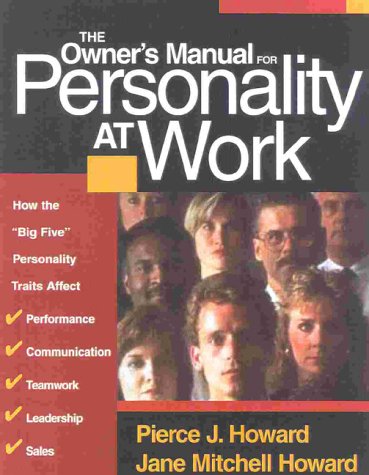
The Owner's Manual for Personality at Work: How the Big Five Personality Traits Affect Performance, Communication, Teamwork, Leadership, and Sales
Howard, Pierce J.; Howard, Jane Mitchell
Item prices starting from
View 21 offers£ 4.38
-
The Owner's Manual for the Brain: Everyday Applications from Mind-Brain Research
Howard, Pierce J.
Item prices starting from
View 69 offers£ 4.10
-
The Owner's Manual for the Brain (4th Edition): The Ultimate Guide to Peak Mental Performance at All Ages – A Practical Neuroscience Resource for Daily Applications and Wellbeing
Howard, Pierce
Item prices starting from
View 24 offers£ 5.60