Michael A. Schmidt
Dr. Schmidt did his doctoral (Ph.D.) research in Molecular Medicine and Biochemistry within the Life Sciences Division at NASA Ames Research Center. For his second doctorate, he received a Ph.D. in Neuroscience from Lancaster University (UK), with a focus on assessment and modification of neurotrophic molecular networks, emphasizing molecular network-directed countermeasures. This work formed the basis for his efforts to discover methods to protect the human brain from the radiation and isolation of deep space. He has done additional studies at the Massachusetts Institute of Technology (data and models; artificial neural networks) and the University of Colorado (metabolomics).
Dr. Michael A. Schmidt is the Founder, CEO, and Chief Scientific Officer of Sovaris Aerospace, a company focused on assessment and solutions applied to humans in space and extreme environments on earth. Dr. Schmidt is also co-chair of the Advanced Pattern Analysis & Countermeasures Group. His clinical and research work is focused on a systems approach to complex problems of human performance in extreme conditions. He applies the same complexity models derived from space flight countermeasure development to biomarker discovery, predictive analytics, and personalized medicine paradigms on earth, using a convergent variables approach.
Dr. Schmidt is co-developer of the personalized medicine program for the Corvette Racing Driver Science program and the 24 Hours of Le Mans racing series. He also directs the molecular profiling and countermeasures efforts for elite athletes ranging from NFL to NBA to Olympic athletes, and military Special Forces. Among these, he directed the molecular profiling and countermeasures effort for the Golden State Warriors, during their NBA record-setting 73-9 season in 2015-2016. He also works closely with the Nike Human Performance Division, advising on the molecular profiling & countermeasure efforts for NFL athletes. These professional human performance efforts include targeted and untargeted integrated omics profiling, combined with molecular network-directed countermeasures. Dr. Schmidt applies these same approaches to work with the commercial space flight sector for orbital and suborbital space flight, as well as with private and government missions directed toward the human habitation of space (Moon, Mars, etc.). Dr. Schmidt has also co-directed a Mayo Clinic research team ascent of Mount Kilimanjaro (expedition leader, Conrad Anker), studying the effects of altitude, hypobaric hypoxia, & targeted molecular countermeasures.
Dr. Schmidt is co-author of the paper, “Personalized Medicine in Human Space Flight: Using Omics Based Analyses to Develop Individualized Countermeasures that Enhance Astronaut Safety and Performance,” published in the journal Metabolomics in 2013. The paper was featured by Springer Science Media, highlighting the most influential papers of 2013 and 2014.
In 2016 (Metabolomics), he co-authored, “Incorporation of Omics Analyses into Artificial Gravity Research for Space Exploration Countermeasure Development,” along with Thomas J. Goodwin, Ph.D. (NASA Johnson Space Center) and Ralph Pelligra, M.D., (NASA Ames Research Center). In 2015, he presented an invited lecture at the NASA Human Research Program Integrated Pathway to Mars Symposium, entitled “Protecting Neural Structures and Cognitive Function during Prolonged Space Flight by Targeting the Brain Derived Neurotrophic Factor Molecular Network.”
As part of the Metabolomics Society Precision Medicine & Pharmacometabolomics Task Group, he was a lead author of “Metabolomics Enables Precision Medicine” (Metabolomics 2016). This paper was the 2017 winner of the Best Review Award in Metabolomics.
His forthcoming textbook chapter, “Pharmacogenomics and Pharmacometabolomics in Spaceflight,” will be released in The Handbook of Space Pharmaceuticals, published by Springer Nature in 2018.
Popular items by Michael A. Schmidt
View all offers-
Beyond Antibiotics: 50 (or So) Ways to Boost Immunity and Avoid Antibiotics
Schmidt, Michael A.; Smith, Lendon; Sehnert, Keith
Item prices starting from
View 28 offers£ 3.20
-
Childhood Ear Infections: What Every Parent and Physician Should Know About Prevention, Home Care and Alternative Treatment
Schmidt, Michael A.
Item prices starting from
View 15 offers£ 4.89
-
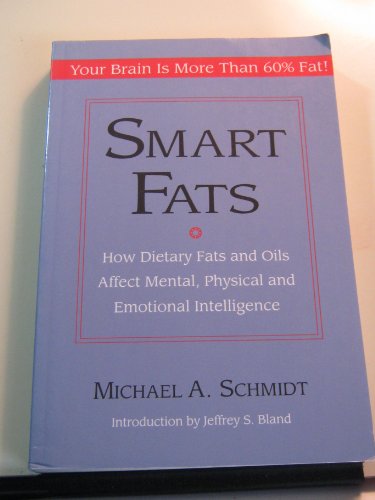
Smart Fats. How Dietary fats and Oils Affect Mental, Physical and Emotional Intelligence
Schmidt, Michael A.
Item prices starting from
View 19 offers£ 3.23
-
-
Healing Childhood Ear Infections: Causes, Prevention & Alternative Treatments
Schmidt, Michael A.
Item prices starting from
View 25 offers£ 3.93
-
Childhood Ear Infections: A Parent's Guide to Alternative Treatments
Schmidt Ph.D, Michael A.
Item prices starting from
View 24 offers£ 2.71
-
Brain-Building Nutrition: How Dietary Fats and Oils Affect Mental, Physical, and Emotional Intelligence
Schmidt Ph.D, Michael A.
Item prices starting from
View 45 offers£ 4.58
-
Beyond Antibiotics: Strategies for Living in a World of Emerging Infections and Antibiotic-ResistantBacteria
Schmidt Ph.D, Michael A.
Item prices starting from
View 21 offers£ 5.94