Preston G. Smith
Preston G. Smith received a Ph.D. in engineering from Stanford
University and for the next twenty years held engineering and
management positions in the aerospace, automotive, highway
safety, defense, and diversified industries. In 1984 he initiated a
corporate time-to-market program, and for the next twenty-nine
years, he was a Certified Management Consultant specializing
in accelerated and flexible product development techniques.
Consulting and training engagements for products as diverse as
semiconductors, heavy-duty trucks, and packaged food have taken
him to hundreds of venues in thirty-one countries.
Preston’s interest in development flexibility has been brewing
for years. His first book, Developing Products in Half the Time (with
Donald Reinertsen; originally published in 1991), covered the core
of flexibility—iterative and incremental development—in its fourth
chapter.
Another part of flexibility, responsive experimentation
(Chapter 4 of Flexible Product Development) includes rapid
prototyping (RP), which Preston started following in 1988. More
important, super-rapid prototyping machines, often called 3-D
printers, appeared in 1996. Although some people denigrated 3-D
printers as a “poor man’s RP system,” he saw the very low costs
and quick response of such systems as opportunities to radically
change how organizations develop new products by harnessing
this quick, inexpensive feedback. He led these developments by
keynoting at an RP conference in Australia in 1995, and he has
participated in six other RP conferences in Australia, the United
Kingdom, South Africa, and the United States since then.
Preston has urged the community to transform product
architecture (Chapter 3 of Flexible Product Development and Chapter 6
of Developing Products in Half the Time) from a solely technical
matter to a business strategy topic, although its role in enhancing
flexibility during development is still not widely appreciated.
The tipping point for him was in 2004, when the Agile
Development Conference (ADC) invited him to keynote. Agile
development aims precisely at flexibility, except that it only
pertains to software development. Having started his career in
the 1960s immersed in programming, he had been observing
software development for years. It impressed him that software
development projects have experienced more than their share of
spectacular failures, but this community has studied its failures,
done impressive research on methodologies, and improved—to a
greater extent than non-software product development, he believes.
Although software developers have a lead in understanding
their methodologies, the 2004 ADC invited Preston to speak—
characteristically—to see what they could learn from an allied
field. They rather confused who was the teacher and who was the
student. As a result, he has attended other agile conferences since
then, joined the Agile Alliance, and was a founding member of the
Agile Project Leadership Network (agileprojectmgt.com)—and he
took plentiful notes. As a result, what the agilists have achieved
in software development inspired him to write Flexible Product
Development, which provides comparable means for developing
other types of products flexibly.
Preston retired in 2013 and resides in Portland, Oregon USA.
Here are short descriptions of his three books:
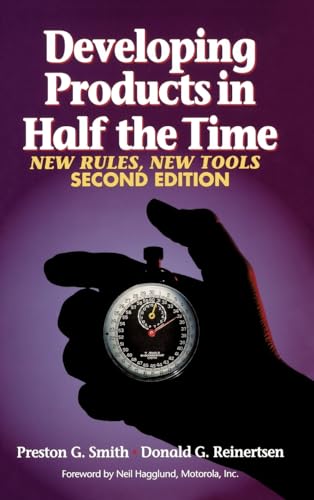
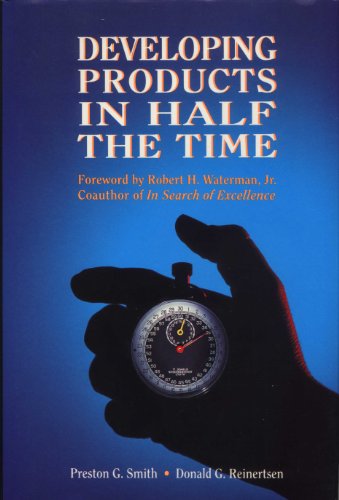
DEVELOPING PRODUCTS IN HALF THE TIME has become a classic in the time-to-market literature--90,000 English copies in circulation plus six translations. It was published originally in 1991, with a paperback update in 1995 and a second edition in 1998.
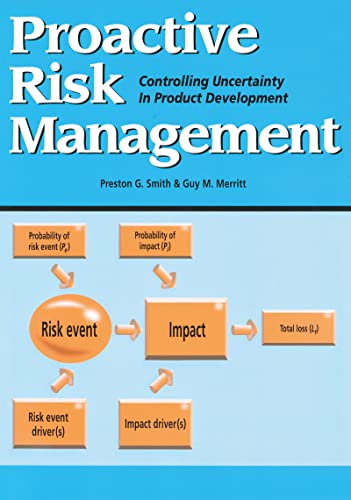
PROACTIVE RISK MANAGEMENT was written because Preston found that--even though Chapter 12 of Developing Products in Half the Time covers project risk management--companies were doing poorly at it. Specifically, companies with a phased-development process would typically identify and document project risks in an early phase. But then they would do nothing about these risks, and when the risks blossomed later in the project, it was embarrassing to see that they had been predicted. This book won the David Cleland Project Literature Award from the Project Management Institute in 2003 as the best project management publication in 2002.
FLEXIBLE PRODUCT DEVELOPMENT recognizes that, as the world has become more chaotic, it is unrealistic to presume, as we usually do in our plans, that the project will proceed to completion without changes. In fact, it is the nature of innovation that the project should change as we learn more about the customer and the product. So, instead of denying change, this book embraces change by reducing the cost of change and keeping options open. It aims to do for non-software products what agile software development has done for that field.
Popular items by Preston G. Smith
View all offers-
Developing Products in Half the Time: New Rules, New Tools
Smith, Preston G.; Reinertsen, Donald G.
Item prices starting from
View 66 offers£ 3.24
-
Proactive Risk Management: Controlling Uncertainty in Product Development
Preston G. Smith; Guy M. Merritt
Item prices starting from
View 46 offers£ 3.70
-
Flexible Product Development: Agile Hardware Development to Liberate Innovation
Smith, Preston G.
Item prices starting from
View 5 offers£ 6.04
-
Flexible Product Development: Building Agility for Changing Markets
Smith, Preston G.
Item prices starting from
View 12 offers£ 6.30
-
Developing Products in Half the Time (Competitive Manufacturing Series) by Preston G. Smith (1991-02-14)
Preston G. Smith;Donald G. Reinertsen
Item prices starting from
View 40 offers£ 3.86
Also find
Used