Vincent Lynch
Vincent Lynch has led an eclectic career, immersed in all disciplines of the arts. Author, Painter, printmaker, producer, director, author, actor, tai chi shirfu - which of these roles apply to Vincent Lynch, all of them. In challenging the standard definition of "artist" the portfolio Lynch submitted to the San Francisco Art Institute was not the traditional collection of oils, pastels and lithographs of a would be Rembrandt but rather it was a simple compilation of his poetry. This redefinition of art as non-medium specific will prove to be the glue that binds all of Lynch’s artistic activities throughout his career.
1970 - 1979
In the May 1971 Alumni Spring Fund Raiser Mr. Lynch constructed a performance piece comprised of a room sheeted in black vinyl with black and mylar strips that made up semi permeable walls of a simple black box maze. The room was dark except for a strobe light that pulsated in conjunction with the beat of tribal drums and chanting. Groups entered the maze like structure and winded there way through it. As the evening progressed the music and the strobe became more intense. From a vantage above the room Mr. Lynch and a gallery of observers was able to watch the deconstruction of the piece by its participants as the music and the light further disoriented them. This process piece was to be a seminal part of the next eight years of his life.
October 12 –November 11, 1973 – A show opened at the San Francisco Art Institute (hyper link to the show brochure content)– curated by Phil Linhares – Director of Exhibits at SFAI, who commented, “Vincent Lynch’s paintings are probably the most seldom seen and definitely the most experimental of this group. The paintings derive from Lynch’s interest in primitive ritual, architecture and spiritual development.”
Alfred Frankenstien, Senior Art Critic for the San Francisco Chronicle said of this show in his review, “the theme of man and the earth and the powers of nature is very strong throughout this show, but nowhere with such power and originality as in Lynch’s work.” (Vincent put a pdf link to the complete article here – have the link be on San Francisco Chronicle)
Of the work itself Mr Frankenstien said, “Michael Heizer digs up half a county to get where he is going, abstractly speaking. Lynch achieves a similar grandeur at a thickness of half an inch on a wall.
Judith L. Dunham of Art Week (Nov 3, 1973; Vol 4 Number 37) (Hyper link to this review) reviewed this show and stated, “The real surprise of the exhibit is the work of Vincent Lynch …Lynch’s process, which renders the specific nature of materials enigmatic, is an ingenious use of non-art substances for an esthetic end.”
In the Fall of 1974 Vincent showed in the South of Market Warehouse Exhibit. His pieces were installation works that featured process from which the term “passive,destructive/constructive process” was coined.
In the Fall of 1976 Vincent’s work appeared in a group show at the Los Angeles Institute of Contemporary Art.
March –April 1977 He exhibited at the University Art Museum in Berkeley California as part of the 18 Bay Artist Part II Show. It ran for 5 weeks and exhibited to 71,000 attendees.
Thomas Albright in his book “Art in the San Francisco Bay Area: 1945-1980” An Illustrated History (©1985 – University of California Press) listed Vincent Lynch’s work as “an extreme form of process-and –materials abstraction.”
1980- 1989
In 1976, while still engaged in “art as process”, Mr. Lynch’s creative interests took a turn into the area of music and from 1976 through 1984 he worked as Vice President of David Rubinson & Friends, managing a number of groups and musical talent like Herbie Hancock, members of the Jefferson Starship, The Pointer Sisters, Narada Michael Walden etc.
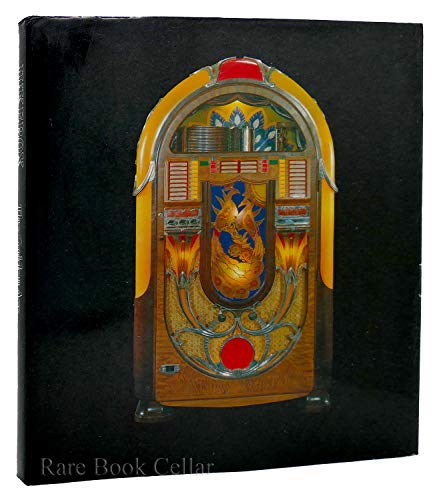
During this time he also became the foremost authority on the American Jukebox, authoring two books on the subject:“The Jukebox – The Golden Age – 1937 -1948” (©1981 – Putnam Publishing; Thames and Hudson and Lancaster Miller 2nd printing); and “American Jukebox – The Classic Years” (©1990 – Chronicle books - two editions) These books and his work in jukebox restoration helped to establish the Jukebox as an important cornerstone of Americana Folk Art. The architectural nature of these boxes and its tie to the original music of America fed further into his growing awareness of the evocative nature of archetypal imagery.
1985 brought another series of changes and influences that effected Mr. Lynch’s artistic development. A student of Tai Chi and the Martial Arts, Mr. Lynch was invited to attend and film the first Chinese International Wushu that was open to foreign entrants. The result of this trip was the award winning documentary “Kung Fu Diplomacy” which won awards in the Philadelphia Film and Video Festival and the San Mateo County Fil Festival in 1987.
1990- 2020
Over the next 15 years, Mr. Lynch, a Master of Tai Chi with 17 years of teaching experience and 35 years as a practitioner, will use this knowledge and vision to create 52 demonstration tapes in a series called “China’s Living Treasures” of the greatest living practitioners of the Chinese Martial Arts.
Mr Lynch's most recent literary works are:
Treasure of the Secret Island - a novella targeted at children aged 8-10 years old
A Year in the Marsh Lands - Seasonal Haiku
and an Autobiography - Forgotten Satoris Don't Count.
Popular items by Vincent Lynch
View all offers-
-
Crash the Crow: A Story of a Little Girl and a Big Bird
Lynch, Vincent
Item prices starting from
View 2 offers£ 12.47
Also find
New -
Forgotten Satoris Don't Count: a layman's memoir
Lynch, Vincent
Item prices starting from
View 1 offer£ 21.21
Also find
New -