John Hart
John Hart loves to roam in and as part of the natural world. He enjoys hiking in forests, along river banks, and on mountain ridges (and being absorbed by vistas seen from mountain tops), and paddling on lakes in a canoe or kayak. John has, too, a passion for social justice for all people and peoples. His embrace of nature (Earth and all living beings) and justice inspired him to originate and develop socioecological ethics (social justice within and among human communities, integrated with the wellbeing of Earth and all biota). While a university professor, he did not confine himself to his work in academic settings: teaching, writing books (eight to date), journal and periodical articles (more than two hundred published), and presentations around the world (on five continents, in eight countries, and in thirty-six US states). Rather, he has been a scholar-activist who engages theory and concrete conduct to effect social change. He has participated in three human rights movements over the decades: African American, Chicano (Mexican American, including as a candidate in La Raza Unida Party for the Texas State Legislature, at the invitation of the party’s founder; activists told him that he was an “honorary Chicano” because he was involved with community work for justice), and Indian (or, American Indian, erroneously called “Native American,” a term rejected by traditional Indian elders—spiritual leaders and healers—and community activists; at the invitation of Indian leaders, he was twice a Member of the Delegation of the International Indian Treaty Council to the United Nations International Human Rights Commission at its annual session in Geneva, Switzerland).
In "Third Displacement," socioecological ethics has evolved to become cosmosocioecological praxis ethics. It includes considerations of ethical principles adapted to or adopted from other-than-human intelligent beings, when Contact with them takes place: on Earth or in the heavens, in Earth’s dimension or in a different dimension of the cosmos.
John Hart’s involvement in social and ecological ethics has led to his friendship with distinguished people from around the US. Daniel Berrigan, SJ, peace activist, poet, and modern-day prophet (John especially remembers clinking a glass of bourbon in Dan’s Manhattan apartment, daughter Shanti’s christening in Dorothee Soelle’s apartment, and Daniel’s christening by a bonfire alongside a lake outside San Antonio). Twice each semester John had conversations with Nobel Peace Laureate Elie Wiesel—in his Boston University office or in his office or apartments in New York City. Indian elder friends include Lakota activist William Means, Executive Director, International Indian Treaty Council, singer Floyd Red Crow Westerman and others at the Annual Meetings of the IITC around the US, including Muskogee spiritual leader, healer, and activist Phillip Deere, spiritual leader of the IITC, who spoke at conferences John organized in Montana, and social activist, Kickapoo and Sauk Fox nations, Bill Wahpepah: Phillip and Bill W. told John on different occasions that he was “white on the outside but red on the inside.” Wanapum elders David and Myra Sohappy, traditional healers and human rights and fishing rights activists on the Columbia River, did a healing ceremony for John on Big Mountain, Arizona during an IITC conference, and remained friends thereafter. Margaret Race, PhD, Principal Investigator for the SETI (Search for ExtraTerrestrial Intelligence) Institute, with whom John discussed the possibility of exoEarth intelligent beings. Edward O. Wilson, University Research Professor Emeritus, Harvard University and John wrote complementary complimentary blurbs for each other’s book in 2006: respectively, “The Creation—An Appeal to Save Life on Earth”, and “Sacramental Commons: Christian Ecological Ethics”.
John Hart’s academic credentials for the past thirty-five years: Emeritus Professor of Christian Ethics, Boston University School of Theology (where his courses included “Sacred Earth: Indigenous Peoples’ Ecological Traditions” and “Spirit, Science and Space”); previously, he was Professor of Theology and Founding Director of the Environmental Studies Program, Carroll College, Helena, Montana.
John describes his first—and most dramatic—experience with an intelligently controlled Unidentified Flying Object in 1963: “I was a college sophomore. After dinner one night, when there was no distracting moonlight brightening the sky, the stars and planets shone brilliantly. Two friends and I decided to stroll downhill to the Hudson River and sit against the bank, gazing into the heavens. It was beautiful. Suddenly, to my right, I saw the largest, brightest, fastest, and lowest meteor I had ever seen, traveling south to north above the river. I waited for the meteor to fizzle out and disappear. When it was even with us, it abruptly changed course to go perpendicular to its previous trajectory, shot upward in the sky, and disappeared. I was amazed, and said to myself, “That’s impossible! I’ve studied physics. It should have exploded from the change in direction since it did not bank or slow down.” I blinked my eyes to erase the illusion, and said nothing to my friends because I ‘knew’ that I had not seen the event. After a few minutes, one of my friends said, “Did you see that object suddenly shoot off at a right angle to its previous path?” Relieved that I had not been seeing something that had not happened, I said that I had. Our other friend said nothing, though he had to have seen the incident. My first friend said that we must have seen a UFO. I agreed with him and we both laughed. We never spoke about it again.”
John has been a “ghost writer” for the Midwestern Catholic bishops’ twelve-state land statement, “Strangers and Guests: Toward Community in the Heartland” (1981); the western US (four states) Catholic bishops’ and western Canada (one province) bishops’ international bioregional statement, “The Columbia River Watershed: Caring for Creation and the Common Good” (2001); and the draft of Pope John Paul II’s 1979 homily at Living History Farms, near Des Moines, Iowa.
John was selected as a Lilly Teaching Scholar in Religion (1997-8), and for the Templeton Oxford Seminars in Science and Christianity (University of Oxford, England, summers, 1999-2001). He was invited, in 2015, as a “Distinguished Scholar in the Humanities” to participate in the “Blumberg Dialogue on Astrobiology and Religion,” Kluge Center, Library of Congress, and was a Member of the National Aeronautics and Space Agency (NASA) Astrobiology Institute (NAI) Astrobiology and Society Focus Group (2012-15).
John has been involved with the Earth Charter as a participant in the World Council of Churches Ecumenical Center meeting on Benchmark II (Geneva, Switzerland, 1999); in the 'Earth Charter Ethics Seminar' as one of 25 invited scholars from four continents (Pocantico Conference Center, New York, 2002); as a member of the delegation to Urbino, Italy for implementation planning meetings (2002); and as a participant in the Earth Charter +5 conference (Amsterdam, 2005).
John’s and Jane’s daughter, Shanti, is an archaeologist and university professor; their son, Daniel, is a school psychologist.
Popular items by John Hart
View all offers-
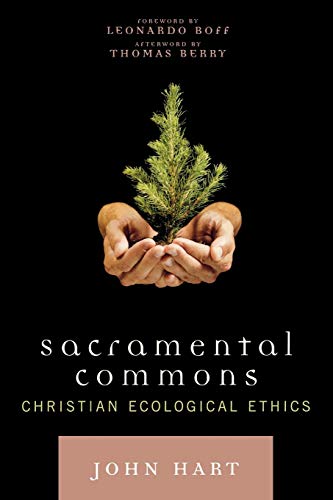
Sacramental Commons: Christian Ecological Ethics (Nature's Meaning)
Hart, John
Item prices starting from
View 34 offers£ 3.39
-
-
What are They Saying About Environmental Theology?
Hart, John
Item prices starting from
View 7 offers£ 5.38
-
Ethics and Technology: Innovation and Transformation in Community Contexts
Hart, John
Item prices starting from
View 2 offers£ 8.46
-
Third Displacement: Cosmobiology, Cosmolocality, Cosmosocioecology
Hart, John
Item prices starting from
View 37 offers£ 21.25
-
Encountering ETI: Aliens in Avatar and the Americas
Hart, John
Item prices starting from
View 39 offers£ 21.52
-
Cosmic Commons: Spirit, Science, and Space
Hart MD, John
Item prices starting from
View 35 offers£ 14.10