At least six million American children have difficulties that are diagnosed as serious mental disorders, according to government surveys - a number that has tripled since the early 1990s. But there is little convincing evidence that the rates of illness have increased in the past few decades. Rather, many experts say it is the frequency of diagnosis that is going up, in part because doctors are more willing to attribute behavior problems to mental illness, and in part because the public is more aware of childhood mental disorders (NY Times, 2006). According to the US Attorney General, "Mental disorders are characterized by abnormalities in cognition, emotion or mood, or the highest integrative aspects of behavior, such as social interactions or planning of future activities." The process of diagnosing these disorders comes with a great deal of controversy. Before a diagnosis is accepted the practitioner must be able to explain how the behaviors differ from normal developmental behaviors. In Hope's case medical treatment would not be effective in reducing symptoms because her environment never changed. The sexual abuse never stopped and Hope was merely medicated into submission. Once the need for medications for such a young girl reached three the psychiatrist should have started asking other questions. However, since psychiatry categorizes the individual, once labeled, it stops questioning the diagnosis as being potentially 'false' and, thereby, confines treatment to the social standard of normal.
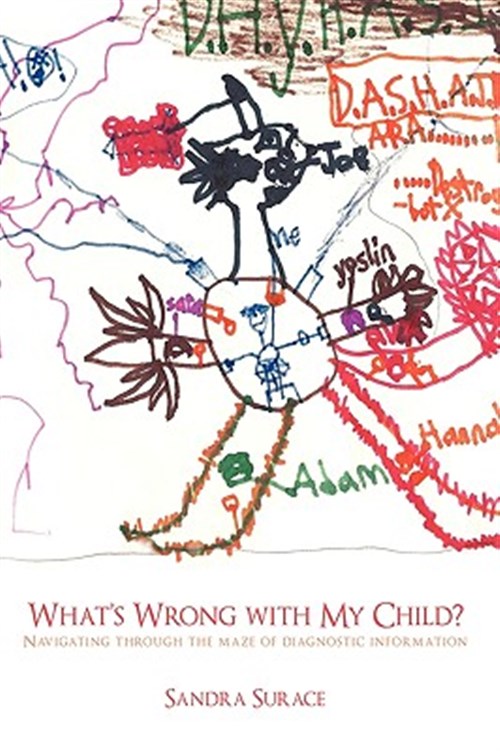
What's Wrong with My Child?
Navigating through the maze of diagnostic information.By Sandra SuraceAuthorHouse
Copyright © 2010 Sandra Surace
All right reserved.ISBN: 978-1-4520-1073-1 Contents
Preface......................................................................XIIIBackground on a Child with Mental Disorder...................................1What You Should Know About The Diagnostic Process............................13Consider All the Facts.......................................................27Have Confidence in What You Know to be True..................................32Be an Independent and Skeptical Observer.....................................38Psychiatry versus Psychology.................................................45Triangulation of Beliefs.....................................................48How Psychiatry, Psychology, and Neurology View Disorders.....................57The Battle of The Sciences...................................................62Two Different Approaches.....................................................67The Impact of Environmental Factors..........................................68Neurology and Mental Illness.................................................76The Autistic Child...........................................................79Behavioral Indicators of Neurological Impairment.............................87Why Is This Important?.......................................................106Distribution of Medication...................................................111When to Medicate?............................................................116Every Parents Worst Nightmare................................................123Drug Addiction On The Rise...................................................130Drugs Approved by the FDA and Off-Label Prescriptions........................138The Role of Insurance Companies in Treatment.................................139Alternatives to Medication...................................................145Working with Symptoms of Autistic Spectrum Disorder..........................155Working with Symptoms of ADHD................................................168Working with Symptoms of Bipolar Disorder....................................178Working with Symptoms of Schizophrenia.......................................183Working with Conduct Disorder................................................186Working with Symptoms of Intermittent Explosive Disorder.....................189Working with Reactive Attachment and Adjustment Disorder.....................192Tips for Finding a Good Therapist............................................194Working with the School System...............................................197The School Experience........................................................206What Steps Can Parents Take?.................................................225Get a Full Explanation of Behaviors..........................................234Behavioral Modifications.....................................................237When the School Goes Too Far.................................................242Freestyle High: Academy of Communication.....................................246Rights of Parents and Children...............................................248Parental Concerns............................................................266How Parents Can Create Change................................................278Indexed References...........................................................283References...................................................................285
Chapter One
Background on a Child with Mental Disorder Families and communities, working together, can help children and adolescents with mental disorders. A broad range of services is often necessary to meet the needs of these young people and their families.
United Stated Department of Health and Human Services
Despite the fact that David had symptoms from birth of pervasive developmental delays, in 2003 ADHD was the easiest diagnosis to treat, and was readily covered by insurance. My concerns for his developmental delays were brushed off as neurotic and exaggerated. Despite the fact that he never crawled, did not like to be held, and was socially awkward, the pediatrician did not share my concerns. David's head developed abnormally and he had to be trained to speak using a speech pathologist. His gate was unbalanced and he fell often. His pediatrician never recommended physical occupational therapy for his motor impairments. However, as soon as the school complained about his behavior, the pediatrician was more than happy to prescribe medication.
Often it is the mom who has a concern, because her son, or daughter, is not going through the developmental milestones at the usual pace, and so she is more likely to discuss it with the pediatrician. If the pediatrician is not very knowledgeable about autism, he may tell mom to wait a few months and come back, saying that boys don't always develop as quickly as girls. What ASD's looks like at the different ages and different places on the spectrum is variable. Thus, choosing the right professional is important.
Although all my earlier concerns were ignored, the pediatrician jumped at the chance to treat David's apparent ADHD. The number and dosage of medications changed more than 20 times over the first 18 months and David's behavior only got worse. He began to exhibit additional (iatrongenic) symptoms as a result of the medication that resulted in additional diagnoses. Despite the obvious signs that there were other factors contributing to his behavior, we journeyed down a rabbit hole, chasing medical remedies that never panned out.
David still talks about how traumatized he was by what he experienced during the four-year period during which he was improperly diagnosed and treated. He recounts how he was forced to take medication, he was made to feel abnormal, and blamed for things he had no control over. My experience of him was different than others. He was disorganized, but he would play a game he enjoyed for hours, well after others walked away. He loved a good challenge and enjoyed conversations about very complicated subject matter. He fixated on topics he knew well, so he could actively participate. He was dependent on schedules and highly resistant to change. He required 'exact' answers and did not respond well to abstract thought. He was resistant to alternative viewpoints. He could be too rough and too direct at times. Simply adhering to his needs was exhausting.
The Criteria for Clinical Diagnosis of AD/HD From DSM requested a 4-scale rating of the "degree to which" the following applied without medication:
Lack of attention
Doesn't seem to listen
Doesn't seem to understand and follow instructions
Unorganized
Figdets/squirms/restless
Often talks excessively
Unable to play quietly
Blurts out answers before question is finished
The assumption was that these problems existed at some level distorts and manipulates normal developmental characteristics. Therefore, the developmental delays that I had complained about, such as lack of fine motor skills, were disregarded in favor of normal developmental characteristics. This realization struck me like a rock. How could normal childhood activities be considered so destructive to society that
I had to put my son on drugs that had the potential to dictate my son's entire future, and ultimately deprive him of 4 years of his life? I had recommended the teacher use other tactics to indicate it was time to start a test, such as ringing a bell, or other auditory or visual cue. Having tests start at the same time, such as 1:00 every day would have provided David with the structure he needed to "pay attention," but the teacher insisted she could not accommodate one child. So, I had to accommodate her by putting David on medication that ultimately induced psychosis and manic behaviors. Inconceivable!!!
The questionnaire given to the teacher for the purpose of "diagnosing" David's behavior was only slightly different. It was so simplified that these factors were not distinguishable from normal behavior and I realized that I would qualify for 90% of them. The options for answering were Not At All; Just a Little; Pretty Much; and Very Much. Questions like:
Makes inappropriate noises when he shouldn't (note the questionnaire state HE, not he or she). I sometimes snort when I laugh ! Do I qualify?
Overly sensitive to criticism (I hate being told I am wrong)
Daydreams (Pretty Much - especially at work)
Excitable, impulsive (I love getting gifts, and sometimes buy something I don't need when I see it)
Childish and immature (most men I know who are very successful)
Easily frustrated in efforts (I do not like making mistakes)
I was convinced that I needed medication too!! Despite that the teacher responded that David did not have difficulty learning, was accepted by others, did not lack leadership, and that he was submissive to authority, he qualified for medication that required triplicate forms for government monitoring. I could not help but feel that something was desperately wrong with the diagnostic process.
Once a child is diagnosed with behavioral difficulties life becomes challenging. Experts deemed to advise on what a child needs will instantly bombard parents with conflicting information. After parents and teachers fill out a short questionnaire the child is assessed and diagnosed with mental illness. DONE! Sometimes a diagnosis is made in less than 10 minutes. But what does the diagnosis mean? What is the GAF score, or the measure of dysfunction? The severity of dysfunction is intended to determine what treatment would befit the child's needs. The diagnostic manual and National Institute of Mental Health require that "There must be clear evidence of clinically significant impairment in social, academic, or physical/occupational functioning." David was not significantly impaired. He was challenged!! The medication did nothing to improve his ability to get along with children his age, or his motor impairments.
Treatment methods adhere to the diagnoses, so an improper diagnosis can be life altering. Determining the right treatment method is impaired when the diagnosis is inaccurate. An incorrect diagnosis can mean that a child does not get the services he or she needs. It can also mean that a child starts on a medication regimen that has serious, possibly deadly, side effects.
The most recent NY Times article titled "Revising Book on Disorders of the Mind" comments on the upcoming revision to the DSM manual. In the article they discuss the ramifications of getting the information wrong.
"Anything you put in that book, any little change you make, has huge implications not only for psychiatry but for pharmaceutical marketing, research, for the legal system, for who's considered to be normal or not, for who's considered disabled," said Dr. Michael First, a professor of psychiatry at Columbia University who edited the fourth edition of the manual but is not involved in the fifth.
"I completely understand the idea of trying to catch something early," Dr. First said, "but there's a huge potential that many unusual, semi-deviant, creative kids could fall under this umbrella and carry this label for the rest of their lives."
Other psychiatrists admit that the system is imperfect:
"The treatment of bipolar disorder is meds first, meds second and meds third," said Dr. Jack McClellan, a psychiatrist at the University of Washington who is not working on the manual. "Whereas if these kids have a behavior disorder, then behavioral treatment should be considered the primary treatment."
The reality of the diagnostic process is that a group of psychologists, psychiatrists, and neurologists have attempted to categorize, label, and define human behavior that is often individual and non-scripted. The purpose of a diagnosis is to allow patients access to services; legal, medical, and therapeutic. Unfortunately, not all behavior can be so easily defined - and services are hard to come by, rendering the diagnosis irrelevant - expect for the purpose of prescribing medication.
David's behavior gradually changed from not sitting still in class to having hallucinations, delusions, and banging his head against the wall. He was given a combination of stimulants to reduce fidgety behaviors; an anti-depressant to improve his poor self-image; and an anti-psychotic to reduce the onset of schizophrenic symptoms. He lost weight at a rapid weight. The anti-psychotic medication attempted to off-set the decrease in appetite brought on by the stimulants. He was given an anti-seizure medication to reduce ticks and improve cooperation.
Seizures are brought on when cellular activity cannot self-regulate and spend a significant period of time in the 'active' state. This extended period of activity exhausts the system and the victim and they collapse until threshold level of activity is again achieved. The seizures described in John Travolta's interview with Larry King makes sense when you look at the autistic brain. Excessive stimulation can overload the neural network, causing an over-active epileptic- like neural loop.
The fact that they were consistent and that each one lasted approximately the same amount of time demonstrates the brain's "potential" threshold for variation and correction. For neurological scientists, the threshold represents the non-symptomatic state in electrical brain activity. When the "action potential" reaches a certain level the brain is designed to halt activity until homeostasis, or the threshold, is established. The fact that Jett would sleep for extended periods following his seizures explains the brain's need to shut down after crossing under the excitation threshold. After David was placed on medication he began to exhibit similar symptoms. In a manner similar to epilepsy David would "cycle up his emotional excitation" to an uncontrollable level that would last for about 25 minutes, then collapse in exhaustion! Occasionally, during these episodes we would hold him down to prevent him from hurting himself or someone else. The cycles would last approximately 25 minutes, after which he could not remember what happened. I jokingly began calling this activity "emotional epilepsy," because it differed slightly from the standard epileptic seizure. In comparison to the challenges he faced, sitting still in class was not at the top of my list of concerns.
The treatment method used to treat David seemed ridiculous for an 8-year old boy, but for many children, like my son, it is a normal treatment regimen. It took a number of years to gather all the information I needed to understand what had happened, and what should have happened differently. Throughout this book I will share David's story and those of others who have shared similar experiences in an effort to provide support and understanding to parents struggling with similar challenges. It is a truly maddening experience that can be avoided if precautions are taken early enough. I have included what I have learned in this book to prevent parents from traveling through the inescapable horror of watching their child slip away into the decline of over-medication and to hold professionals responsible for their actions. It is not intended to be overly critical of those who truly adhere to the ethical standards assigned by their professional peers.
The NY Times reported that one child "has had almost as many psychiatric diagnoses as birthdays." The child's mother reported that after a screaming match with a school counselor she sought help for her son. Following a string of office visits with psychologists, social workers, and psychiatrists, the diagnoses received varied with each "expert." The diagnoses included Compulsive tendencies, oppositional defiant disorder, pervasive developmental disorder, bipolar disorder, and a combination of two or more. The mother reported that:
With each diagnosis was accompanied by a different regimen of drug treatments. ... They kept throwing things at us ... and nothing is really sticking.
The diagnostic process is often more of an art than a science and provides very few real answers for desperate parents seeking help. To believe that medication solves all behavioral problems suggests that if parents "go home and take two aspirin" the problem will just go away. It will not go away.
The alphabet soup of labels assigned to behavioral challenges keeps the pharmaceutical companies and psychiatrists in profitable businesses and labels children as the problem with no empathy for what may be causing the problem. The list of criteria that qualifies a child for a mental health diagnosis are often standard developmental issues, such as "argues with adults" or "often losses temper."
In the article, Dr. Costello, professor of psychiatry and behavioral sciences at Duke University states that:
If a family can find some combination of treatments that help a child improve, then the diagnosis may not matter much at all.
Children with developmental and environmental difficulties often act out against oppression of natural instincts in ways that resemble symptoms defined in the diagnostic manual. Telling a child to sit still and not talk for an entire school day is oppressive, and not supportive of natural human tendencies. Dr. Costello also suggests that children who are given diagnostic labels often adopt the psychiatric jargon in describing themselves, such as cycling, and mania. The question is: What exactly are the children's behaviors expressing. Is it a form of mania, or extreme anger due to something else?
Another parent described how a neurologist tried to convince her that her child had bipolar disorder by slamming down on the table a copy of Time magazine that described the disorders' prevalence. She stated that she was able to get the services her child needed with the diagnosis, but never felt that it was an appropriate fit.
Children are still learning how to cope with life challenges and will not always do so in a socially appropriate manner. They may be argumentative after being bullied at school. They may be temperamental because they are struggling with an academic subject that frustrates them. They may be depressed because they got into a fight with a friend. This type of investigative effort is rarely made in the psychiatrists office, and kids won't always tell parents what is going on in their life because they are ashamed, or don't want to appear weak. However, to get their hands on some pretty serious drugs all they have to do is have a couple of outbursts at school or home.
Dr. King, a practioner in Detroit, states "the most important thing is to observe them closely and get a complete history, starting from birth and straight through every single developmental milestone." This was never part of my experience with David. Even his pediatrician ignored the developmental milestones that challenged him from infancy and never factored them in to a diagnosis. Neither did the other 4 "specialists" who attempted to "cure" him of his behavioral maladies. Parents who don't listen to their children or pay attention to their needs are more likely to 'settle' for a quick fix solution to avoid taking responsibility for changes in nurturing. Parents who care deeply for their children, unfortunately, face an uphill battle against all the 'experts' who declare they have the answers for what is wrong with their child!!
(Continues...)
Excerpted from What's Wrong with My Child?by Sandra Surace Copyright © 2010 by Sandra Surace. Excerpted by permission.
All rights reserved. No part of this excerpt may be reproduced or reprinted without permission in writing from the publisher.
Excerpts are provided by Dial-A-Book Inc. solely for the personal use of visitors to this web site.