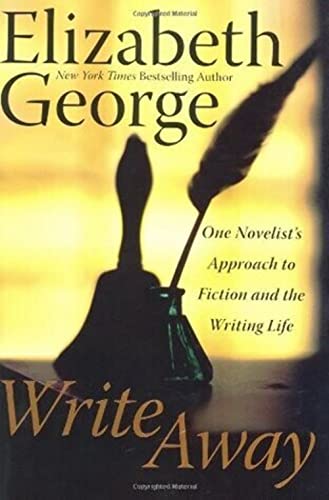
Here's what I tell my students on the first day when I teach one of my creative writing courses: You will be published if you possess three qualities -- talent, passion, and discipline.
In Write Away, New York Times bestselling author Elizabeth George offers would-be writers exactly what they need to know about how to construct a novel. She provides a detailed overview of the craft and gives helpful instruction on all elements of writing, from setting and plot to technique and process. To illustrate her points, George presents excerpts from a number of well-known writers, including Barbara Kingsolver, Harper Lee, E. M. Forster, John Irving, Toni Morrison, Stephen King, Ernest Hemingway, and Alice Hoffman.
In addition to being a clear and concise guide to fiction writing, Write Away also opens a window into the life of Elizabeth George. It reveals the inspiring personal story of how the distinguished author came to be published and how she meticulously researches and crafts her novels.
I have a love-hate relationship with the writing life. I wouldn't wish to have any other kind of life . . . and on the other hand, I wish it were easier. And it never is. The reward comes sentence by sentence. The reward comes in the unexpected inspiration. The reward comes from creating a character who lives and breathes and is perfectly real. But such effort it takes to attain the reward! I would never have believed it would take such effort.
Elizabeth George started her career as a teacher and has spent several years teaching creative writing. She has a solid understanding of the craft and a storyteller's enticing way of passing along helpful information, all of which comes through marvelously in this informative book.
Write Away
By George, ElizabethHarperCollins Publishers
ISBN: 0060560428Chapter One
Story Is Character
Am I kidding myself about being a "creative artist"? Can I possibly be a creative artist if I approach this effort in so methodical and left-brained a fashion?
Journal of a Novel,
June 25,1997
A large piece of Plexiglas covers the top of my desk. Beneath this shield, I keep bits and pieces to serve as inspiration or to cheer me up in those moments of bleak despair when I'm wondering why I've taken on onedifficult project or another. Among these items I have a copy of John Steinbeck's letter to Herbert Sturz on the subject of The Grapes of Wrath -- I find his comments about critics particularly smile-producing -- as wellas pictures of my dog, of myself grinning inanely alongside a wax effigy ofRichard III from Madame Tussaud's waxworks in London, and severalquotations from writers on one subject or another. One of those writersis Isaac Bashevis Singer who, in an interview with Richard Burgis in 1978, said the following:
When people come together -- let's say they come to a littleparty or something -- you always hear them discuss character. They will say this one has a bad character, this one has a goodcharacter, this one is a fool, this one is a miser. Gossip makesthe conversation. They all analyze character. It seems that theanalysis of character is the highest human entertainment. Andliterature does it, unlike gossip, without mentioning realnames.
The writers who don't discuss character but problems --social problems or any problems -- take away from literature itsvery essence. They stop being entertaining. We, for some reason, always love to discuss and discover character. This isbecause each character is different and human character is thegreatest of puzzles.
That's where I want to begin, then, in laying the foundation for myexploration of craft: with character.
Not with idea? you may ask, aghast. Not with where a writer getsideas? What a writer does with ideas? How a writer molds ideas into prose?
We will get to that. But if you don't understand that story is character and not just idea, you will not be able to breathe life into even the most intriguing flash of inspiration.
What we take away from our reading of a good novel mainly is thememory of character. This is because events -- both in real life and infiction -- take on greater meaning once we know the people who areinvolved in them. Put a human face on a disaster and you touch peoplemore deeply; you may even move them inexorably toward taking anaction they might have only idly contemplated before that disaster wasgiven a human face. Munich '72, the Achille Lauro, Pan Am 103, OklahomaCity, 9/11 ... When these tragedies become human by connecting themto the real people who lived through them or died in them, they becomeimprinted indelibly on the collective consciousness of a society. We startwith an event as news, but we almost immediately begin asking Who? about it.
It's no different with fiction. The trial of Tom Robinson is maddening, disturbing, and heartbreaking in its injustice, but we remember the triallong after it's over because of Tom Robinson's quiet dignity and because ofAtticus Finch's heroic representation of the man, knowing all along that hisclient is doomed because of the time, the place, and the society in whichthey both live. To Kill a Mockingbird thus rises to the level of timeless, classicliterature not because of its idea -- the innocence of childhood set into anugly landscape of prejudice and brutality -- but because of its characters. This is true of every great book, and the names of those men, women, andchildren shine more brightly in the firmament of literary history than do the stories in which they operated. Elizabeth Bennet and Mr. Darcy, Jemand Scout Finch, Captain Ahab, Hester Prynne, Sherlock Holmes, Heathcliff, Ebenezer Scrooge, Huckleberry Finn, Jack-Ralph-and-Piggy, Hercule Poirot, Inspector Morse, George Smiley, Anne Shirley, LauraIngalls ... The list can stretch from here to forever. With the exceptionof the last, not a single character is a real person. Yet all of them are, becausethe writers made them so.
Once we have begun it, we continue reading a novel largelybecause we care about what happens to the characters. But for us actually to care about these actors in the drama on those printed pages, they must become real people to us. An event alone cannot hold a storytogether. Nor can a series of events. Only characters effecting events andevents affecting characters can do that.
I try to keep some basic guidelines in mind when I'm creating mycharacters. First, I try to remember that real people have flaws. We'reall works in progress on planet Earth, and not one of us possesses physical, emotional, spiritual, and psychological perfection. This should betrue of our characters as well. No one wants to read about perfect characters. Since no reader is perfect, there is nothing more disagreeablethan spending free time immersed in a story about an individual wholeaps tall buildings of emotion, psyche, body, and spirit in a singlebound. Would anyone want a person like that as a friend, tediouslyperfect in every way? Probably not. Thus, a character possessing perfection in one area should possess imperfection in another area.
Sir Arthur Conan Doyle understood this, which is one of the reasons that his Sherlock Holmes has stood the test of time for more thanone hundred years and counting. Holmes has the perfect intellect. Theman is a virtual machine of cogitation. But he's an emotional black holeincapable of a sustained relationship with anyone except Dr. Watson, and on top of that, he abuses drugs ...
Continues...Excerpted from Write Awayby George, Elizabeth Excerpted by permission.
All rights reserved. No part of this excerpt may be reproduced or reprinted without permission in writing from the publisher.
Excerpts are provided by Dial-A-Book Inc. solely for the personal use of visitors to this web site.