
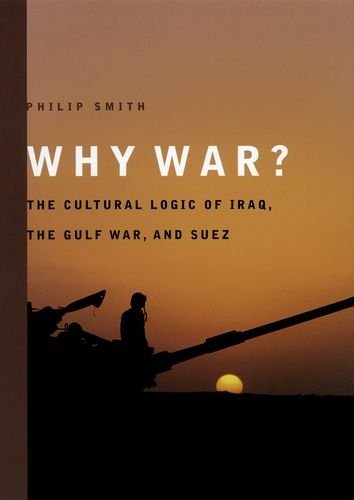
Why War?: The Cultural Logic of Iraq, the Gulf War, and Suez
Smith, Philip
ISBN 10: 0226763889 ISBN 13: 9780226763880
Published by University of Chicago Press, 2005
Used
hardcover
From
POQUETTE'S BOOKS, DEWITT, MI, U.S.A.
Seller rating 4 out of 5 stars

AbeBooks Seller since 11 March 2020
This specific item is no longer available.
About this Item
Description:
EX LIBRARY BOOK. Seller Inventory # mon0000201714
Synopsis:
Why did America invade Iraq? Why do nations choose to fight certain wars and not others? How do we bring ourselves to believe that the sacrifice of our troops is acceptable? For most, the answers to these questions are tied to struggles for power or resources and the machinations of particular interest groups. Philip Smith argues that this realist answer to the age-old "why war?" question is insufficient. Instead, Smith suggests that every war has its roots in the ways we tell and interpret stories. Comprised of case studies of the War in Iraq, the Gulf War, and the Suez Crisis, "Why War?" decodes the cultural logic of the narratives that justify military action. Each nation, Smith argues, makes use of binary codes - good and evil, sacred and profane, rational and irrational, to name a few. These codes, in the hands of political leaders, activists, and the media, are deployed within four different types of narratives - mundane, tragic, romantic, or apocalyptic. With this cultural system, Smith is able to radically recast our "war stories" and show how nations can have vastly different understandings of crises as each identifies the relevant protagonists and antagonists, objects of struggle, and threats and dangers. The large-scale sacrifice of human lives necessary in modern war, according to Smith, requires an apocalyptic vision of world events. In the case of the War in Iraq, for example, he argues that the United States and Britain replicated a narrative of impending global doom from the Gulf War. But in their apocalyptic account they mistakenly made the now seemingly toothless Saddam Hussein once again a symbol of evil by writing him into the story alongside al Qaeda, resulting in the war's contestation in the United States, Britain, and abroad. Offering a completely innovative approach to understanding how major wars are packaged, sold, and understood, "Why War?" will be applauded by anyone with an interest in military history, political science, cultural studies, and communication.
About the Author: Philip Smith is assistant professor of sociology at Yale University. He is the author or coauthor of several books, including the widely praised Cultural Theory: An Introduction.
"About this title" may belong to another edition of this title.
Bibliographic Details
Title: Why War?: The Cultural Logic of Iraq, the ...
Publisher: University of Chicago Press
Publication Date: 2005
Binding: hardcover
Condition: Good