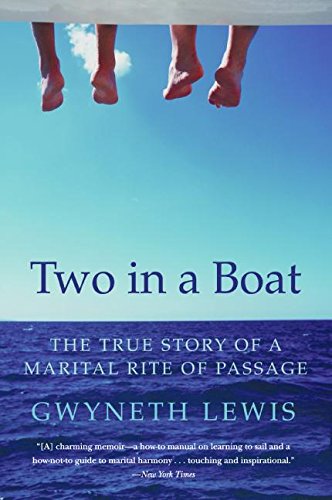
When she was in her forties, recovering from depression and alcoholism, Gwyneth Lewis, the National Poet of Wales, decided to trade in her landlubber existence—a house in Cardiff and a responsible job at the BBC—for life at sea with her husband, Leighton, a former bosun with the Merchant Navy. After buying a small yacht (called Jameeleh) and teaching themselves to sail it (a process not without its fair share of disasters), they set out to cross the Atlantic. But Gwyneth's seasickness and Leighton's astonishing transformation into Captain Bligh were just the beginning in a series of outrageous catastrophes, both maritime and marital.
A truly unique memoir, both witty and wise, Two in a Boat is Gwyneth Lewis's strange, stirring, and often hilarious account of their voyage—at once a wholly original, relentlessly entertaining beginner's guide to the art of sailing and an unforgettable portrait of a marriage under pressure.
Two in a Boat
The True Story of a Marital Rite of PassageBy Gwyneth LewisHarper Perennial
Copyright © 2007 Gwyneth Lewis
All right reserved.ISBN: 9780060823245Chapter One
Call me Sea Bitch
We purchased our first sailing boat by accident.
I could blame it all on Mrs Rubenstein. She lived in Cardiff, a short way down the hill from us, had a hedgehog shelter in her front garden and was known for reading tarot cards. I was restless, just about to return to work after over a year of being seriously ill with depression. I phoned.
'Come down, my dear. All I ask is a donation for the animals.'
I sat with her and her pungent white Westie dog on the sofa as she read my tarot and chain-smoked. Mrs Rubenstein told me many things about work and love and what I should do about my health. She also gave free tax advice between cards. The main thrust of her reading was that I wasn't living my life to the full. My ears pricked up at one particular aside.
'And by the way, dear, you should buy a boat.'
Then she moved on swiftly to tell me what we should do for my husband's lower back pain.
Leighton, my husband, was full of scorn when I told him where I'd been. 'What a load of rubbish, I don't believe a word of it,' he said. 'And I haven't even got a bad back.'
By the end of the week he did. But, even more surprisingly for a tarot atheist, he came home from work the following day and announced, 'I've found a boat!' She was a twenty-three-foot racing boat called Nitro, had a yellow hull and was totally unsuitable for beginners, so we bought her and started to learn how to sail in the Bristol Channel. Not long afterwards we were talking about renting out the house and sailing round the world.
Less than a month after I'd seen Mrs Rubenstein, I applied for voluntary redundancy from my job. I went to see a financial adviser, who made the usual suggestions. Rather than investing my pay-off and remortgaging the house, I decided to pay cash for a thirty-year-old Nicholson 35 yacht called Jameeleh. Having jumped from my job without a parachute, and with no gainful employment, we were soon astonished to find that the prospect of being able to sail away had become financially viable. A book contract and a fellowship meant that I would be able to work as a freelance writer even if we were away from home. We put our house in the hands of a letting agent, placed our belongings in storage, and went to live on the boat. We planned to spend the first year travelling in Europe and then, when we were more experienced sailors, to cross the Atlantic to Brazil and on into the Pacific through the Panama Canal. This was a dream journey for both of us, our reward for having come through a difficult couple of years together and for having been such good troupers.
In my mind's eye, I had a dear image of what a true seaman or -woman should be. The sea dog (or sea bitch, as I wanted to be called) always had blue eyes, feet planted firmly on the ground and a calm grip on his internal horizon. The seaman had faced many terrors but was a person of few words. He or she had the same taciturnity as monks or nuns, a quality that comes from knowing that words won't help you to ride out your worst fears or to survive contact with forces much stronger than yourself. Speech had been superseded by faith in countless tiny acts of seamanship and discipline, which may be the closest we can ever come to real safety. I was ready to varnish wood, splice ropes or grease winches - anything that might help me change from a messy depressive, often overwhelmed by my own emotions, into one of these self-contained sailors. I wanted to be cool, unaffected by tumult, unbowed by internal or external storms. I wanted a glint of the sea in my eyes.
Unfortunately, whenever we sailed in the Bristol Channel, I was either asleep or seasick. When we first started going out into the tea-coloured waters of the Severn Estuary, I was still so lethargic from prolonged clinical depression that the rocking of the boat sent me instantly to sleep. I completely understood why Marcel Proust had fantasised about living on a yacht, so that he could travel the world without having to get out of bed. I'd crawl under a duvet in one of the bunks below and be lulled by the white noise of water against the boat's hull and the swell underneath her. Leighton learned how to sail virtually single-handed, although he'd always wake me when he was ready to come in.
The Bristol Channel is a challenging place to learn to sail because the estuary has one of the largest tidal ranges in the world. Every six hours a huge body of water shoulders its way up into the mouth of the Severn and then, after a short period of slack, rushes back down to the open sea. The difference between the level of the water at high and low tide in Cardiff can be as much as forty feet, so particular care needs to be taken in reading the Bristol Channel tide tables. One day, Leighton and I found ourselves alone in the Cardiff Barrage lock. This was unusual, but we congratulated ourselves on our good luck at not having to avoid other boats in the confined space. In the sunlight above us a couple of weekday spectators were staring down at us from the barrage wall. The sluices opened, the pontoons groaned and we fell into shadow. We sank further still and, surrounded by dripping walls at the bottom, watched the friendly faces above us gradually disappear, bored with waiting for the lock to empty. Finally, the huge gates opened. We were expecting water but instead saw gulls walking on exposed mudbanks in the estuary. . . .
Continues...Excerpted from Two in a Boatby Gwyneth Lewis Copyright © 2007 by Gwyneth Lewis. Excerpted by permission.
All rights reserved. No part of this excerpt may be reproduced or reprinted without permission in writing from the publisher.
Excerpts are provided by Dial-A-Book Inc. solely for the personal use of visitors to this web site.