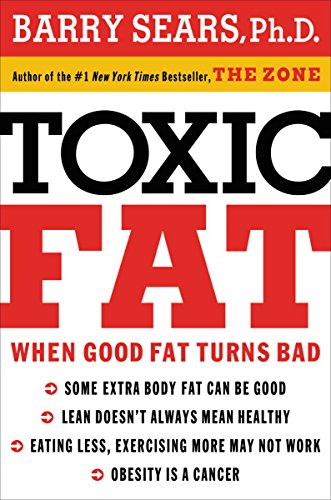
TOXIC FAT
WHEN GOOD FAT TURNS BADBy Barry SearsThomas Nelson
Copyright © 2008 Barry Sears
All right reserved.ISBN: 978-1-4016-0429-5 Contents
Introduction...............................................................................................viiChapter 1: The Real Epidemic Behind the Obesity Crisis.....................................................1Chapter 2: The Perfect Nutritional Storm...................................................................5Chapter 3: How Inflammation Helps Us-and Hurts Us..........................................................12Chapter 4: Why Getting Fat May Not Be Your Fault...........................................................26Chapter 5: Good Fat May Be Protective......................................................................49Chapter 6: Malignant Toxic Fat.............................................................................59Chapter 7: Do You Have Toxic Fat Syndrome?.................................................................72Chapter 8: The Zone Diet: Your Primary Defense in Fighting Toxic Fat.......................................85Chapter 9: Super Fish Oil: Your Final Defense in Fighting Toxic Fat........................................102Chapter 10: Putting It All Together........................................................................121Chapter 11: Overcoming Obstacles to Your Success...........................................................135Chapter 12: The Coming Reckoning...........................................................................150Chapter 13: Anti-Inflammatory Meals to Reverse Toxic Fat Syndrome in Less Than 30 Days.....................155AppendicesA. Continuing Support......................................................................................239B. Blood Testing for Silent Inflammation...................................................................241C. Hormones: The Keys to Your Biological Internet..........................................................243D. Eicosanoids: Hormones of Mystery........................................................................254E. Everything You Ever Wanted to Know About Fish Oil But Were Afraid to Ask................................269F. Insulin Resistance: It All Starts in Your Adipose Tissue................................................281G. Nutrigenomics: How Diet Affects the Expression of Your Genes............................................291H. Zone Food Blocks........................................................................................298Glossary...................................................................................................312Bibliography...............................................................................................316
Chapter One
The Real Epidemic Behind the Obesity Crisis
DIRE WARNINGS APPEAR EVERY DAY. GOVERNMENT OFFICIALS make impressive speeches about its dangers. Task forces are being assembled. Massive funds are promised. What is the cause of this grave concern? Are we going to war again? Yes, we are, and the enemy is obesity.
Many of us have battled extra pounds, and it hasn't been a particularly successful battle. People without weight problems seem to think the cause of obesity is simply sloth and gluttony. I believe the root cause is something far more insidious, which I liken to a cancer that threatens every organ in the body. And in many people, accumulation of excess body fat initially represents a biological defense response trying to protect our bodies from this potential "cancer."
This means that all of our efforts to follow the advice of simple slogans such as "eat less and exercise more" may be meaningless, and our current obesity crisis will continue unabated, if not accelerate-unless we attack the problem from a different perspective.
What we see as our current obesity epidemic is only the tip of a vastly more dangerous epidemic of inflammation-not the type of inflammation we can feel, but inflammation that lies below the perception of pain. I call this silent inflammation. It is this type of inflammation that is driving our obesity epidemic and a wide number of other chronic diseases. The underlying cause of chronic disease comes from the increased production of a natural fatty acid called arachidonic acid (AA), which can be incredibly toxic at high enough concentrations. This is the toxic fat that is key to not only understanding our obesity epidemic but also providing the linkage between obesity and chronic disease. Oddly enough, accumulation of excess body fat is initially your body's attempt to protect you, by encapsulating or trapping this toxic fat in your fat cells so it doesn't attack your other organs. The problem is that the toxic fat doesn't stay trapped in your fat cells forever. Once it begins to spill over into the blood, you have Toxic Fat Syndrome. The resulting health problems associated with Toxic Fat Syndrome are relentless.
Toxic Fat Syndrome is the real epidemic that threatens our health. After years of inflammatory assaults caused by toxic fat, enough damage occurs to a particular organ that we call it chronic disease. That chronic disease might be heart disease, diabetes, cancer, or even Alzheimer's, but it had its start as Toxic Fat Syndrome.
Toxic Fat Syndrome has similarities to Toxic Shock Syndrome, which showed up in 1980, apparently caused by super-absorbent tampons. Both syndromes cause the body's normal immune system to go into overdrive attacking itself. But Toxic Fat Syndrome causes organ damage at a much slower rate. The vast majority of Americans suffer from Toxic Fat Syndrome and don't know it-and it is all caused by what you eat.
If the flow of toxic fat into the bloodstream is left unchecked, the result is a checklist of the chronic diseases that represent the bulk of our current health-care expenditures, such as:
* Allergies 2
* Asthma 2
* Autoimmune diseases (arthritis, lupus, and others) 2
* Cancer 2
* Heart disease 2
* Inflammatory diseases (Crohn's disease, ulcerative colitis, 2 and others)
* Neurological disorders (Alzheimer's, depression, ADHD, 2 and others)
* Type 2 diabetes 2
The appearance of each of these chronic diseases can be viewed as different manifestations of Toxic Fat Syndrome. Your genetics determine which organ in your body is affected first. But if you have one chronic condition associated with Toxic Fat Syndrome, the others are probably not too far behind.
You can't tell if people have Toxic Fat Syndrome just by looking at them. Only the blood will reveal it because the appearance of toxic fat in the bloodstream is the first sign you are no longer well and are headed more rapidly toward any one of many chronic conditions associated with Toxic Fat Syndrome. But don't despair; you can begin to reverse Toxic Fat Syndrome in less than thirty days if you follow the easy dietary prescriptions I describe in this book. The Real Epidemic Behind the Obesity Crisis
Even though an increase in obesity may initially be your body's way to try to prevent the spread of toxic fat to other organs, these storage sites for toxic fat can also be staging areas for its future malignant spread throughout the body. The sooner you realize that you have circulating toxic fat, the more easily it can be reversed before there is too much organ damage. The solution to Toxic Fat Syndrome is the same factor that caused it in the first place-your diet. What is required is an antiinflammatory diet to combat the effects of a growing Perfect Nutritional Storm. The dietary solution to the Perfect Nutritional Storm is simple, and it can be followed for a lifetime. The end result will be a longer and better life.
Chapter Two
The Perfect Nutritional Storm
Toxic fat syndrome in America didn't appear overnight-and no one single dietary factor was the cause. This health crisis was generated only when three distinct dietary factors came together simultaneously, creating the Perfect Nutritional Storm. The three food factors needed for this Perfect Nutritional Storm are:
* Cheap refined carbohydrates 2
* Cheap vegetable oil 2
* Decreased consumption of fish oil 2
This occurred first in America in the 1980s and now is spreading worldwide through growing use of cheap bulk-food commodities that are the foundation of all processed foods. Nowhere in the world is the know-how of making and marketing cheap, palatable processed foods more concentrated than in America, and that's why Toxic Fat Syndrome first appeared here.
When all three of these factors occur together, you have the ingredients for an epidemic of inflammation driven by increasing levels of toxic fat in the blood. It's this increased inflammation that has caused our current twin epidemics of obesity and type 2 diabetes. But these two diseases are only the most obvious initial consequences of Toxic Fat Syndrome. Other conditions associated with Toxic Fat Syndrome are heart disease, cancer, neurological disorders, autoimmune disorders, asthma, allergies, and many more. These conditions are appearing at earlier ages in Americans, in spite of the massive level of fiscal resources we spend on health care.
So let's examine these three components of the Perfect Nutritional Storm, because each appears innocuous until they all come together.
Cheap Carbohydrates
Why are cheap carbohydrates, such as grains, a problem? After all, isn't bread considered the "staff of life"? The rapid rise of industrialized farming in the 1970s made grains one of the most inexpensive sources of calories known. Unfortunately, eating too many of these cheap carbohydrates can actually shorten our lifespan. The reason is that consumption of excess amounts of these high glycemic-load carbohydrates (especially refined carbohydrates) causes the body to produce excess insulin. As I explained in one of my earlier books, The Anti-Aging Zone, excess levels of insulin speed up the aging process as well as increase the potential production of more toxic fat.
An excess supply of food (even carbohydrates) has been a relatively new phenomenon in human history. In the past, it took a lot of effort to grow food; even more effort was needed to cook and prepare it, and food was perishable. All of this began to change in the twentieth century with the introduction of processed foods.
The first of these industrially processed foods was breakfast cereal. Just add milk, and instantaneously you have a meal. (Of course, you had to have access to milk.) Next were the highly portable sources of calories, such as sugar-laden soft drinks and candy bars, that again relied on relatively cheap carbohydrates, both with a long shelf life (pretty important if you didn't have a refrigerator). But the trend really picked up after World War II, when food processing began to take off as people had less time to prepare meals at home.
The American food-processing industry remains the world leader in making an amazing variety of highly palatable junk foods composed primarily of cheap carbohydrates. The emergence of fast-food restaurants meant you no longer needed to eat your meals at home. These meals included lots of cheap carbohydrates. Even food items such as breakfast cereals, bread, and pasta are nothing more than simple forms of processed foods made possible by the advent of cheap refined carbohydrates.
But this agricultural transformation that increased the levels of insulin that resulted from increased carbohydrate consumption was not sufficient in itself to cause a rapid rise in the formation of toxic fat. For that you needed the other shoe to drop, and that was accomplished through another recent food phenomenon-cheap seed oils, rich in omega-6 fatty acids.
Cheap Vegetable Oils
In the past, vegetable seed oils were very expensive to produce. Throughout history most fats came from lard, butter, or olive oil. None of these traditional fats had much impact on inflammation because they contain very limited amounts of omega-6 fatty acids. However, by the 1920s the industrial processing of vegetable seeds, such as soybeans and corn (basically using gasoline as an extracting solvent), began to make vegetable oil production much less expensive. And those vegetable oils (primarily corn and soybean) are rich in certain types of polyunsaturated fatty acids known as omega-6 fatty acids-which are the building blocks for the potential production of increased amounts of toxic fat. However, it is only when you begin to mix excess insulin (coming from cheap carbohydrates) with excess omega-6 fatty acids (coming from cheap vegetable oils) that you get increased production of toxic fat.
If this story has a pivotal character, it is Earl Butz, who headed the Department of Agriculture during the Nixon administration. He did more to unleash the tsunami of cheap carbohydrates and cheap vegetable oils than any other person in history. Before Butz, if American farmers produced too much food, they were paid subsidies to remove parts of their acreage from production until the prices went back up. This was a tactic left over from the Depression when overfarming was destroying croplands. Butz took the opposite approach-he wanted American farmers to put the pedal to the metal to maximize food production for export sales to help support a weakening dollar caused by the first oil shock in the early 1970s. New genetic strains of food that had a higher carbohydrate content were now available. Unfortunately, they required high levels of fertilizers and herbicides to maintain the increased output. This was the birth of agribusiness as the farmers became dependent on the chemical companies to increase their productivity to service new export markets. Now grain production could be pushed to the maximum. If farmers produced too much, the government would now pay them a subsidy based on a set market price, no matter how low the real crop price dropped.
It turned out that only crops that could produce the most calories per acre of land would benefit from this program. That left out fruits and vegetables, but it was ideally suited for two crops that could be produced with ruthless abandon by applying industrial farming techniques: corn and soybeans.
Not only were these crops extremely efficient for industrial-sized farms, but with the growing sophistication of the food-processing industry, these crops provided a wide variety of different components that could be used to make hundreds of new, more valuable ingredients. From corn came corn syrup (and its biotechnology cousin, high-fructose corn syrup), corn oil, industrial chemicals, and alcohol as a gasoline replacement. Soybeans were even more abundant, producing not only soybean oil and protein but also even more useful industrial chemicals.
By combining increasingly cheap corn and soybeans as feedlot ingredients, you can produce less-expensive beef, pork, and chicken. These traditional farm animals were now becoming industrial manufacturing factories to convert cheap corn and soybeans (all supported by governmental subsidies) into inexpensive meat products for the fast-food and restaurant business. In 2007, the subsidies for corn and soybeans were nearly $20 billion per year while government support for fruits and vegetables was virtually zero.
One of the first recipients of this government largesse was the processed food industry, which could now convert ever-increasingly inexpensive raw materials into highly portable, convenient, palatable, and incredibly cheap foods. In a very short period of time, traditional American agriculture became an industrial complex that was the foremost low-cost producer in the world. Just as manufacturing is moving to China because of its low labor costs, America has become the low-cost producer of the key raw materials necessary to make processed foods for the world. And nowhere in the world is the technological expertise more sophisticated to make processed foods than in the United States.
While neither cheap carbohydrates nor cheap vegetable oils alone were sufficient to make the current epidemic of inflammation possible, combining them in processed foods was like adding a lighted match to a vat of gasoline. All grains and starches are composed of pure glucose held together by very weak chemical bonds that are rapidly broken during digestion. The released glucose rapidly enters the bloodstream to cause the release of the hormone insulin. Increasing levels of insulin drive omega-6 fatty acids from vegetable oils to make more arachidonic acid (toxic fat)-the building block for incredibly powerful inflammatory hormones known as eicosanoids. In other words, bad things begin to happen.
But one more change in our food supply had to occur before the full impact of the epidemic of silent inflammation could emerge.
Decrease in Fish Oil Consumption
Mankind has always had a trump card against diet-induced inflammation: high consumption of long-chain polyunsaturated omega-3 fatty acids from fish and fish oils. Although very close in structure to omega-6 fatty acids, these omega-3 fatty acids in high enough concentrations are powerful anti-inflammatory agents. So even with the growing consumption of cheap carbohydrates and cheap vegetable oils, adequate intake of these omega-3 fatty acids could keep diet-induced inflammation in check. Unfortunately in America, just as the intake of cheap carbohydrates and cheap vegetable oils was increasing, the consumption of long-chain omega-3 was dramatically decreasing.
Once the last nutritional barrier (fish oil rich in omega-3 fatty acids) to prevent a rapid rise in inflammation was removed, all the pieces to generate the Perfect Nutritional Storm were in place to create the current epidemic of Toxic Fat Syndrome in the United States.
The first sign of this diet-induced inflammation that started twenty-five years ago was the rapid rise of obesity and its fellow traveler, type 2 diabetes. These two diseases have become epidemic in America and are now spreading throughout the world. To understand why, it helps to understand the complex nature of inflammation.
Excerpted from TOXIC FAT by Barry Sears Copyright © 2008 by Barry Sears. Excerpted by permission.
All rights reserved. No part of this excerpt may be reproduced or reprinted without permission in writing from the publisher.
Excerpts are provided by Dial-A-Book Inc. solely for the personal use of visitors to this web site.