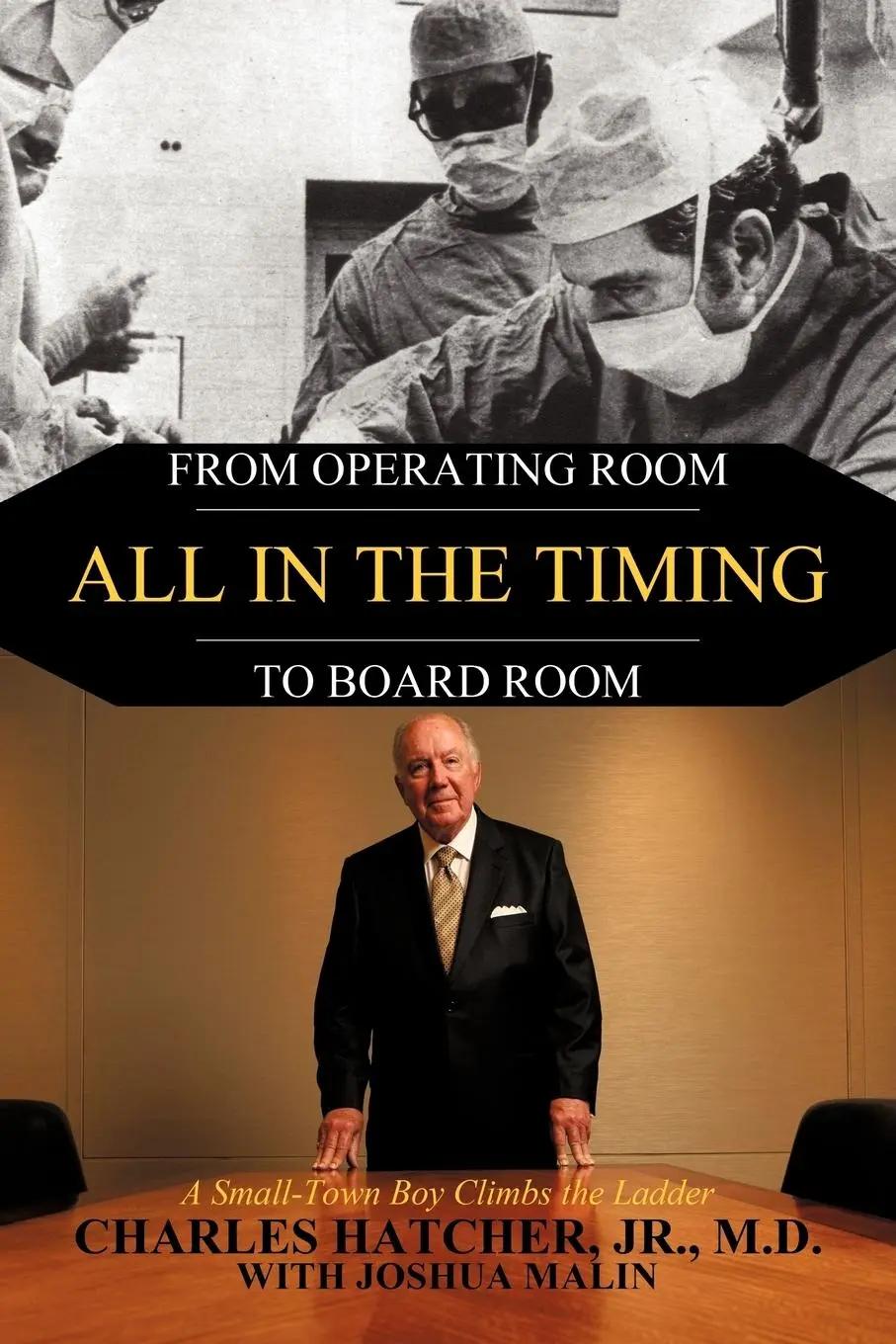
In 1984, when Charles Hatcher took leadership of Emory’s heath sciences center, he had some reservations. As Emory Clinic director, he had known real power, generating millions of dollars to power medical school growth. As chief of cardiothoracic surgery, he had turned Emory’s open-heart surgery program into one of the nation’s largest and most respected. The health sciences center, on the other hand, was a loose confederation of three schools, two hospitals, and a primate center. Despite the reservations, Hatcher took the job and in essence became Atlanta’s first health czar. Eloquent, always prepared, he made it look so easy—even when it wasn’t.
All In the Timing
From Operating Room to Board RoomBy Charles Hatcher, Jr. Joshua MalinAuthorHouse
Copyright © 2011 Charles Hatcher, Jr., M.D.
All right reserved.ISBN: 978-1-4567-4461-8Contents
Foreword...........................................................................ixAcknowledgements: Indispensable Support............................................xiIntroduction: Rooted in the South..................................................xixSection One: Couture and Culture: Growing a Man....................................1Section Two: Athens, Marriage, and Major Decisions.................................39Section Three: From Baltimore to Boston; to The Dunes and Back.....................63Section Four: Halsted Finally!.....................................................99Section Five: Back Home to Georgia and My Early Years at Emory.....................127Section Six: Leadership, Recruitment, and the Next Right Thing.....................177Section Seven: No Scepters, Only Hard Work.........................................245Section Eight: A Happily Ever After Ending.........................................311
Chapter One
Section One: Couture and Culture: Growing a Man
A Personal Word
I was a young boy during the Great Depression. Talk about timing, I was conceived the month the stock market crashed and was born amidst the country's epic slide into the Great Depression. As a boy I worked on a local tobacco plantation and quickly realized how little money my fellow workers earned. I didn't want to grow up to be a tobacco farmer. My parents emphasized a strong work ethic, consideration and respect for other people, black or white, honesty and integrity, and performance consistent with my abilities. Though my first ten years were marked by the Great Depression and the next five by World War II, my memories are happy ones.
The Conception and The Crash
About 400 people live in Attapulgus now, and about 400 people lived there in 1930, the year I was born. Back then, forty or fifty shade tobacco plantations encircled the little town, and they defined the culture of the community. The only other business in town was a Fuller's earth mine. Fuller's earth is clay similar to kaolin. The clay mined in Attapulgus is called Attapulgite, after the town. The clay is used in the refining of petroleum, in face powder and other cosmetics, and up until recently, it was the active ingredient in Kaopectate. The mine is still active today. The tobacco fields of the plantations have long since grown over.
Shade tobacco was a lucrative crop prior to World War II, but then cigarettes replaced cigars as the smoke of choice for most Americans. Shade tobacco was used to wrap hand-rolled cigars, and up until World War II it was one of the most profitable agricultural products in the country. Another reason that shade tobacco fell out of favor is that production of the crop is very labor intensive. On a typical tobacco plantation there was a white owner or an overseer (on the larger corporate plantations) and a couple hundred black workers, a demographic fact that would have profound political implications in the wake of the Civil Rights Movement. The shade tobacco industry withered after the war, and by the late-1950s the crop was no longer grown in southwest Georgia.
The mine on the other hand is still quite active. When I was a child, Standard Oil owned the site. Today BASF owns the mine and the company is the largest employer and taxpayer in Decatur County. I was a young boy during the great depression, and from beginning to end the mine remained open, albeit with limited production. The workers were not laid off; instead they were asked to accept shortened work weeks. Families in Attapulgus survived the Great Depression this way. Folks were able to supplant their incomes by working on the shade tobacco plantations come harvest time.
* * *
My father was born in Wilkinson County, Georgia, and upon graduating from High School he went to work for the Johnson Brothers Mercantile Company in Irwinton. He worked in a country store patronized by the men and women who worked the kaolin mines in Gordon and McIntyre, two nearby towns. News spread that a Fuller's Earth mine was going to open in southwest Georgia and the Johnson Brothers decided to expand. My father came to Attapulgus to establish and operate the new store. He quickly realized that the store was going to be successful and that it would make for a good investment. He saved up as much money as he could and then he bought out the Johnson Brothers. Around this time he was courting my mother, who was from a large, local family. He knew that she wouldn't want to leave Attapulgus, so he purchased a small frame house near the store. Earning an income and in possession of a home, he considered himself in a position to propose, which he did. My mother accepted and they were married in 1928. My father was 24-years-old and my mother was a year younger.
I was conceived in October, 1929, the month the stock market crashed on Wall Street. I was born on June 28, 1930, amidst the country's epic slide into the Great Depression. The pregnancy was my mother's first, and it proved uneventful until the onset of delivery. My mother went into labor early on a Friday afternoon and my father drove her to the Riverside Hospital in Bainbridge, to be delivered by Dr. R. F. Wheat. Dr. Wheat was not an obstetrician, rather a family practitioner who was well regarded in our community. Labor persisted through that afternoon and evening, and into the early hours of the morning. There was an abnormal presentation. A cesarean section was an extremely uncommon procedure then, and I doubt anyone in the rural hospital was an expert with forceps, so the labor went on. The protracted experience weakened my mother. The hours ticked by and she grew very fatigued. Dr. Wheat whispered to my father that she might not survive the delivery. In the prayers that followed, my father promised God that he wouldn't attempt another pregnancy if he spared my mother from this delivery.
I was ultimately delivered late Saturday afternoon, healthy in every way. Unfortunately my mother experienced significant pelvic damage. An adequate episiotomy had not been performed and she sustained a pelvic laceration, which produced urinary difficulties. Those difficulties would persist for many years until they were finally corrected by surgery.
* * *
My father's store in Attapulgus sold everything from tuxedos to wagon-wheels. It was an old-fashioned general store and it was an integral part of the local tobacco culture; the place served as a commissary for the farm workers. This was partly because of the depression, which kept wages low, even on the more prosperous tobacco plantations.
I went to work on a local tobacco plantation when I was five. We arrived at dawn, worked under the hot sun, left at dusk, ate dinner, bathed, and collapsed into bed. In the morning, when it was still dark, we started all over again. Times were hard, and I knew that life was not easy for anyone, my parents included. The full-time workers on these plantations were usually black, but come harvest time white children would augment the labor force. I was only five but I can still remember those long, hard days. I also remember the camaraderie. I felt proud to produce something during the depression, even if all I took home was a small pay envelope. It made a good student out of me though—I didn't want to grow up to be a tobacco farmer.
The most productive male workers were paid 90 cents a day. Women not involved in piece work in the barns were paid 65 cents a day. Children and teenagers could expect to take home 40 to 50 cents a day, depending on their task. For my first job at the age of five I was paid 35 cents a day.
Being so young, the overseer had me 'mind the gate,' an undemanding task. My job required that I remain at the gate and open it each time the wagon loaded with tobacco barges arrived from the fields. I would open the gate, make certain that no livestock escaped, and then close the gate as fast as I could. The wagons proceeded on to the barns, where the piece work was done. I took up camp at the gate at sunrise, and left with the other workers at sunset. There was a short break for lunch and sometimes I would join the other kids who worked in the barn, but I usually ate by myself. It only took me a few days to realize that my lunch stood out. The black children ate leftovers in a tin can, dressed in syrup, which often led to hookworm and anemia. My mother prepared sandwiches for me. She would put an apple or an orange in my bag, and sometimes a slice of cake. To do this for me, she got up before dawn. My father used to get on my mother about those lunches. I would listen to him tell her that it was ridiculous to inconvenience the family so, preparing me a lunch that usually cost as much or more than I made for the day's work. My mother knew that I was working at a loss in economic terms, but she insisted that I had to learn the value of a dollar, and that I had to learn the value of hard work. She won that argument, and, aided by the mood of the depression, they instilled that sense of hard work in me.
My job minding the gate was not the only job I had on the plantations. Another task I performed earned me the title of stick boy.
During the tobacco harvest the women were largely employed in piece work. They would string the tobacco leaves with needle and thread onto a tobacco slat that would then be hung up in the rafters of the barn, where the tobacco would be cured. Sticks were supplied to the stringers in bundles of fifty. With each lot, a punch would be made in the stringer's ticket, which hung by her stall. The women then sewed thirty-or-so leaves to each stick, back-to-back, belly-to-belly, one after the other. When they were done they would place them up on the rack. Workers called rackers would carry them down to someone who passed them up to men in the rafters, who then hung the sticks. Then the process would start all over again and the women would get their cards punched another time.
Everyone was anxious to make as much money as they could during those lean years, and good stringers could make four or five dollars a day. The women would wait outside the barn at dawn, and they went to work as soon as there was enough light so see. They worked through the day, standing on little grass mats, stringing as fast as they could, and they only stopped when the sun set and the darkness made further stringing impossible. I was the stick boy in more than one barn, handing out the bundles and punching the women's cards. I quickly learned that fifty-one sticks in a bundle could create quite a bit of trouble between you and a stringer. Every additional stick in a bundle was an extra hardship and I double-counted my bundles to make certain that no one was called upon to string one more stick than they should. The necessity of performing this piece work as much as possible was brought home to me one day when a young pregnant woman came to work. She was there at dawn, like everyone else, and she strung tobacco until mid-morning. She then rushed home to deliver her baby. But she returned to the barn in the steamy late afternoon, anxious to get back to her stringing. I was only twelve then, but I knew that I did not want her on her feet working. So, as soon as she assumed her position on the line, I dropped by and punched her ticket several times and said, "Go home!" She walked out of that barn with a smile on her face.
I took a second job when I turned six. There were two newspapers delivered in Attapulgus—The Atlanta Constitution and The Atlanta Journal. Previously, two different individuals had delivered the papers. Through a bit of luck I wound up winning both routes. I combined them and held something of a monopoly on the newspaper delivery business, which I maintained until my senior year of high school. My parents thought this experience—delivering papers, collecting subscriptions, keeping proper records, and remitting to Atlanta on a timely basis—a meaningful and valuable use of my time. Until I could drive a car myself, my dad drove me through my route. I would jump out and hand-deliver each newspaper. During the week, people picked up their own newspapers at the post office, so it was only on Sundays that he would drive me, which he would do after we attended church.
As a young businessman of six, I grew to need a checkbook, so my father carried me to the bank in Bainbridge, some twelve miles away. Bainbridge was a substantial town, with a population edging toward 10,000 back then. Because Bainbridge was (and continues to be) so much larger than Attapulgus we drove there to patronize a number of different businesses.
In Bainbridge, there is a nice-sized square downtown and one and two-story businesses ring the park. Like most traditional southern towns, cars pull into diagonal parking spaces on the downtown streets. There are grand old oaks in the park, and hidden beneath the hanging Spanish moss there is an elegant white gazebo. Around the park there are two historical markers. One will tell you that Hernando de Soto and his army marched through the neighborhood in March of 1540. The Flint River runs just to the west of downtown and de Soto and his men crossed the river there, downing a few of the tall oaks to construct piraguas, a primitive sort of flat-hulled boat. The second marker notes the town's presence on El Camino Real, the Spanish Royal Road that cuts across the American south, through the southwestern desert, all the way down to the Vice-regal Capital in Mexico City.
In the Bainbridge bank, a slim white and gray marble building, I signed a card permitting me to write checks that would draw on my father's account. On the one hand I was the envy of my peers. None of them could write checks whenever they wanted to. My father, however, made clear to me that this was a privilege never to be abused. Most of my friends' parents gave them spending money every week. This spending money never amounted to much, but they could use those dimes and quarters as they wished. My pleas for spending money always fell on deaf ears. My parents told me to ask if I needed something, or to write a check. The money always had to be for a good purpose. Like this they made sure that I knew we didn't have money to waste on frivolous expenditures. I should say that we were not destitute, and we were better off than most families in Attapulgus. Nevertheless, we were in the midst of the Great Depression, and though my parents might have described our family as living comfortably, this certainly was a relative term.
Comic Books were new and they were popular among my friends. I was eight when Superman first appeared in Action Comics #1. Batman arrived a year later in Detective Comics #27, and a later entry in this series was the first comic book that I ever purchased. Comic Books cost a dime, and my dad allowed me to buy them from time to time, but always only one. My friends often bought three or four comic books at a time, since we had to travel to nearby towns to purchase them. I was frustrated, and I asked him once, "Dad, you know we're not over there all the time, why can't I buy more than one?"
He looked at me and said, "No, no, no. You boys need to each buy one and then trade 'em around."
"I don't understand this at all," I said. "I know you got more money than so-and-so's daddy, and he buys five comic books at a time."
"Well Charles," he said, "we don't waste any money, and one day you'll want to go to college, and one day you'll want a car, and one day you'll want to make sure you've got the right kind of clothes, and you'll have all that, because you haven't bought five comic books at a time. So-and-so may not ever go to college, and he's not ever gonna have your advantages, but you'll have them, because we don't waste money."
* * *
My mother and father had very different personalities, and in many ways, they were opposites. Perhaps opposites attract. At any rate, it was a happy marriage, and they were inseparable for sixty years. My father was a reserved man, a man of few words, but one who always saw the best in other people. My mother was vivacious and extremely energetic. She was quite outspoken, but very cautious in all of her relationships. They were active parents who took the responsibility of raising me quite seriously. My mother resigned from her bridge club when I was an infant so that I would not grow up with playing cards in the house. Similarly, I never once saw a bottle of alcohol in the house until I left for college.
Back from college one weekend, I remember asking my mother if I might have a couple of friends from Thomasville over for dinner. She said, "Of course," and we sat down to plan a menu. I was amazed when she mentioned that it would be nice to serve cocktails before dinner.
"Cocktails!" I exclaimed. "We've never had cocktails."
"No," she said, "your father and I didn't want to have drinks in front of you until you were grown, but it'll be perfectly alright for you to serve cocktails to your guests now that you're an adult."
From then on, there was always a very nice selection of liquors in a cabinet in the living room. My parents frowned upon beer and we only drank wine on special occasions. I never once saw my parents make a drink for themselves, but when I came home, if I asked if they would like to have a drink with me, the answer was invariably yes. Mother never took more than one drink, but dad always shared a second with me. Every now and then my parents would surprise me like that, but those stories are for later.
(Continues...)
Excerpted from All In the Timingby Charles Hatcher, Jr. Joshua Malin Copyright © 2011 by Charles Hatcher, Jr., M.D.. Excerpted by permission of AuthorHouse. All rights reserved. No part of this excerpt may be reproduced or reprinted without permission in writing from the publisher.
Excerpts are provided by Dial-A-Book Inc. solely for the personal use of visitors to this web site.