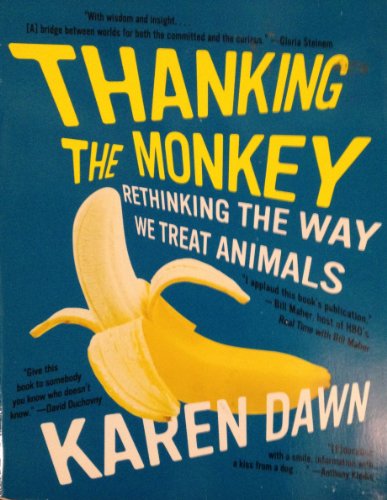
The animal rights movement has reached a tipping point. No longer a fringe extremist cause, it has become a social concern that leading members of society endorse and young people embrace. From Michael Vick's dog fighting scandal to CNN’s airing of the eye-opening film Blackfish, animal rights issues have hit the headlines—and are being championed by students and senators, pop stars and producers, and actors and activists.
Don't you want to be part of the conversation? In Thanking the Monkey, Karen Dawn covers pets, fur, fashion, food, animal testing, activism, and more. But as the title playfully suggests, this isn't like any previous animal rights book. Thanking the Monkey is light on lectures meant to make you feel guilty if you're not yet a leather-eschewing vegan. It lets you have fun as you learn why so many of your favorite actors and musicians won't eat or wear animals. And you'll laugh over scores of cartoons by Dan Piraro'sBizzaro and other animal-friendly comics.
This fun primer for a smart and socially committed generation delivers some serious surprises in the form of facts and figures about the treatment of animals. Yes, it will shock you with tales of primates still used in animal testing on nicotine or killed for oven cleaner. But it will also let you lighten up and laugh a little as we work out how to do a better job of thanking the monkey.
Thanking the Monkey
Rethinking the Way We Treat AnimalsBy Karen DawnHarperCollins Publishers, Inc.
Copyright © 2008 Karen Dawn
All right reserved.ISBN: 9780061351853Chapter One
Welcome to the World of Animal Rights
Welcome to the world of animal rights. When I tell people I work full-time as an animal rights activist, many of them have questions. Am I vegan? If so, why—aren't California's "Happy Cows" really happy? Do activists who target medical research like mice more than men? And who belongs in the zoo—are the animals there good ambassadors for their species? After spending eight years fully immersed in animal rights issues monitoring the media for DawnWatch.com, I decided I was ready to tackle those questions and wanted to do so in as friendly and fun a manner as possible—and so we have this book. In it, I hope to help dispel the myth that animal rights activism is radical and unreasonable. In fact, as you read of the cruelty we offer animals as thanks for what we take from them you may see radical departures from your own standards of reasonable decency.
Animal Rights vs. Human Rights
Let's start by addressing some common questions animal rights activists get asked.
Why worry about animal rights when there is so much human suffering in the world?
Animal rights activists are asked that constantly. And you wonder why we tend to be feisty! Why don't people ask human rights activists how they can do their work when there is so much animal suffering in the world? Seriously, though, part of the answer is in the question. Even somebody who does nothing to end human hunger wouldn't justify his apathy by telling relief workers that there are more important things to worry about. That's because society as a whole acknowledges that human suffering matters. Animal suffering, however, is treated as trivial, even as billions of beings endure unimaginable institutionalized cruelty. To those touched by the suffering of animals, the injustice of the suggestion that animals just don't matter is a call to action.
The question, moreover, is based on a faulty premise. It suggests that compassion is like a pie we must divide into parts, and that if we offer big pieces to some, others will get left with slivers. But compassion is not some sort of finite substance that might run out. It is more like a habit we get better at as we practice, and the animals are a good place to start exercising it—for their sake and for ours. George Angell, the founder of the Massachusetts Society for the Prevention of Cruelty to Animals, put it well when asked why he focused on kindness to animals when there is so much cruelty to people in the world. He said, "I am working at the roots."1
Before I extended my own efforts toward animals, I worked every Sunday, for six years, in a soup kitchen for New York's homeless people. I worked alongside many fellow vegetarians. And when I saw the film Amazing Grace,2 I was not surprised to learn that William Wilberforce, who led the parliamentary campaign against the British slave trade, was also one of the founders of the Society for the Prevention of Cruelty to Animals. That's because compassion and cruelty are not species-specific. Most of us have heard that serial killers usually start by killing animals. The same compulsion drives the killers' behavior when they move on to humans; the urge to hurt just becomes so strong that it outweighs societal norms and fears of legal retribution. So it is with less active cruelty, with the closing of our hearts that has us sit by as others suffer. The compassion shutdown switch that allows us to chew pieces of veal while blocking out thoughts of baby calves alone in crates is the same switch that guides us to change TV channels away from news of children starving in Darfur. We don't want the images to hamper the taste of the meat or our enjoyment of the wine we are drinking, a bottle of which costs more than it costs to feed a child in Darfur for a month. When we disengage that switch, when we get out of the habit of closing our hearts, the world will be better for the calves and the kids.
Animal What?
What exactly do you mean by animal rights?
Funny you should ask—I will surely be challenged to a duel or two over the heading of this chapter, for I use the term "animal rights" more loosely than some would like. I use it to refer to what is commonly known as the animal rights movement—those who devote themselves to advancing the interests of animals and who discourage the use of animals as objects of commerce. For some activists the term "animal rights" is literal; those activists seek legal rights for members of other species. Though they do not wish to earn nonhuman animals the right to vote—any more than they wish to see that right given to human children—they do wish to see animals granted the right, as it is put by the animal rights lawyer Steve Wise, to "bodily liberty and bodily integrity."3 That means no cages, no knives, and no scalpels.
Political conservatives in our movement generally hold that animals don't have rights at all, but that we have responsibilities toward them. One of the leading proponents of that view is Matthew Scully, who was a senior speechwriter for President George W. Bush. He argues that our basic responsibility to other animals is to treat them with mercy.4 Scully is now vegan, which means he believes his responsibility to animals includes abstaining from eating them or the products of their common abuse, while living in a society with so many other alternatives.5 If he were to persuade the world to follow his lead, would it matter, at least to the animals, whether or not he spoke about rights?
Continues...Excerpted from Thanking the Monkeyby Karen Dawn Copyright © 2008 by Karen Dawn. Excerpted by permission.
All rights reserved. No part of this excerpt may be reproduced or reprinted without permission in writing from the publisher.
Excerpts are provided by Dial-A-Book Inc. solely for the personal use of visitors to this web site.