
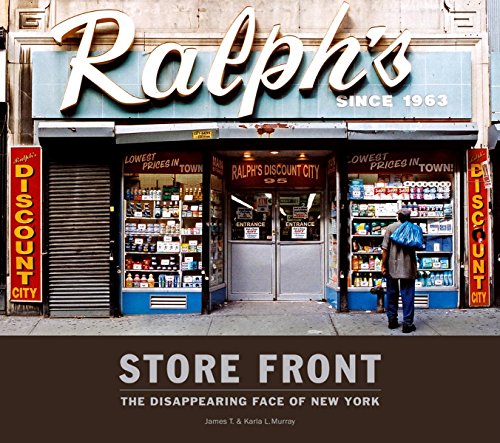
Store Front: The Disappearing Face of New York
Murray, James T.; Murray, Karla L.
ISBN 10: 1584232277 ISBN 13: 9781584232278
Published by Gingko Press, 2009
Used
Hardcover
From
ThriftBooks-Atlanta, AUSTELL, GA, U.S.A.
Seller rating 5 out of 5 stars

AbeBooks Seller since 24 March 2009
This specific item is no longer available.
About this Item
Description:
Former library book; May have limited writing in cover pages. Pages are unmarked. ~ ThriftBooks: Read More, Spend Less. Seller Inventory # G1584232277I4N10
Synopsis:
This is a visual tour so saturated with realism that you can smell the knishes neatly displayed in the window of the Yonah Schimmel Knish Bakery, a visual tour comprised of hundreds of images of unique 19th and 20th century retail graphics and neon signs still in use and inspiring us to purchase to this very day. But for how long?
Are New York City's local merchants a dying breed or an enduring group of diehards hell bent on retaining the traditions of a glorious past? According to Jim and Karla Murray the influx of big box retailers and chain stores pose a serious threat to these humble institutions, and neighborhood modernization and the anonymity it brings are replacing the unique appearance and character of what were once incredibly colorful streets.
Store Front: The Disappearing Face of New York is a visual guide to New York City's timeworn storefronts, a collection of powerful images that capture the neighborhood spirit, familiarity, comfort and warmth that these shops once embodied.
Review: "One of the period's most successful New York books- an evergreen subgenre- STORE FRONT demonstrated the paradoxical power of digital photo editing to alter actual views in order for us to see more clearly what is actually there."
-Bookforum"The Murrays' photographs, however, do not romanticize these not very picturesque locales. The images are bright and crisp, though most of what the authors photographed was dingy and covered with graffiti; quite a few fronts and signs were falling apart or grungy to begin with. Yet it is in this state of decay that the stores hold a curious fascination indeed, a raw beauty for anyone concerned with vernacular design. I was particularly taken with the Lower East Side remnants that are slowly being squeezed out by hip restaurants and shops. Zelig Blumenthal s religious articles store, on Essex Street, appears not to have changed since my grandparents lived nearby. The Hebrew lettering on the window is as clean as it was back then. Meanwhile, at Rabbi M. Eisenbach's shop, the painted signs seem to be fading. Beny s Authorized Sales and Service, which sells fine jewelry, electric shavers, lighters, pens, is not just a throwback; it also exhibits a totally alien aesthetic compared with that of most stores today. Store Front is not mired in nostalgia....The book is also a study of urban migration." - Steven Heller for The New York Times Book Review
"Overly affectionate accounts of days gone by make up an entire genre in America these days, part of the general shift in the past generation from future-focused optimism to nostalgia-laced longing. You see it in paeans to roadside America, to lost highways and long-forgotten attractions. Most of it is unabashed ode. Rarely, though, do you see an account that zooms in on a chunk of the American landscape what was, what is and the hint of what may be and manages to be both lyrical and documentarian, elegant and decidedly anthropological. That's exactly what awaits when you crack open "Store Front," which at nearly 7 pounds is a mighty volume that functions as a visual catalog of New York City retail architecture and all the stories behind it. This is an appealing, unmatched tale of individualism and the tapestry of entrepreneurial zeal, all wrapped up in brick, mortar and colorful signage." -The Associated Press
"New York's storefronts constitute the city's vernacular architecture, shaping the look and feel of the five boroughs no less than more celebrated elements of the skyline. These unfussy, elegant, and richly colored photographs of butcher shops, bakeries, fabric wholesalers, cuchifritos stands, stationery and sporting-goods stores, laundromats, groceries, and dive bars give connoisseurs of signage, folk typography, and ambient erosion much to pour over. Shops that opened in the 1970s now look as ancient as those dating back to the twenties. The tone is elegiac as much as it is celebratory; interviews with shop owners make it clear how close to extinction many of them stand, and the photographers report that nearly a third of these businesses have gone under in the time that it took to make the book." - The New Yorker Copyright (c)2008
"About this title" may belong to another edition of this title.
Bibliographic Details
Title: Store Front: The Disappearing Face of New ...
Publisher: Gingko Press
Publication Date: 2009
Binding: Hardcover
Condition: Very Good
Dust Jacket Condition: No Jacket