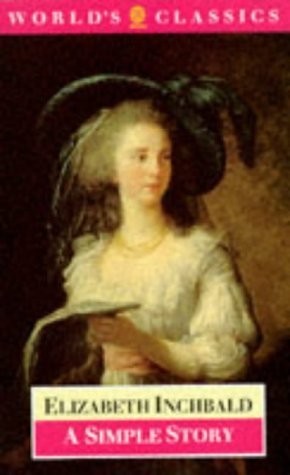
This novel by Inchbald (1753-1821) follows the original 1791 edition, edited by Tompkins in 1967 for the Oxford English novels series and with a new introduction by Spencer. It is concerned with the question of a woman's "proper education and behaviour", introducing Miss Milner, who announces her passion for her guardian, a Catholic priest. The conflict they begin can only be resolved in the next generation. Spencer has also written "The Rise of the Woman Novelist: from Aphra Behn to Jane Austen".
"This is an ideal teaching edition. The full and lucid introduction considers both biographical and formal elements. Particularly welcome and valuable is the generous set of appendices; the first, providing extracts from Inchbald's own critical and dramatic writing, as well as from her pocket diaries, gives us a rounded and sympathetic view of the impressive variety of Inchbald's achievements as a writer, while the contemporary reviews contained in the second appendix give a good sense of the prevailing understanding of the novel as genre."--Aileen Douglas
"By situating A Simple Story against theatrical texts, Lott evokes the complexities of Inchbald's life--as woman, actor, novelist, playwright, and eventually critic--and thus challenges us to understand the work as an 'attempt to merge two forms, the novel and the play.' Examples of conduct literature demonstrate that Inchbald was an astute reader of gender construction, while accounts of divorce proceedings illustrate the reality of social consequences facing women who balked at the double standard for female behavior. Excerpts from period debates over the politics of authority remind us that the novel was completed as the French Revolution was beginning and that many of Inchbald's friends were shortly to be labeled Jacobin. This edition of Inchbald's most famous novel will prompt revisions in many an eighteenth-century syllabus."--Katherine Green
“This is an ideal teaching edition. The full and lucid introduction considers both biographical and formal elements. Particularly welcome and valuable is the generous set of appendices; the first, providing extracts from Inchbald’s own critical and dramatic writing, as well as from her pocket diaries, gives us a rounded and sympathetic view of the impressive variety of Inchbald’s achievements as a writer, while the contemporary reviews contained in the second appendix give a good sense of the prevailing understanding of the novel as genre.” — Aileen Douglas, Trinity College Dublin
“By situating A Simple Story against theatrical texts, Lott evokes the complexities of Inchbald’s life—as woman, actor, novelist, playwright, and eventually critic—and thus challenges us to understand the work as an ‘attempt to merge two forms, the novel and the play.’ Examples of conduct literature demonstrate that Inchbald was an astute reader of gender construction, while accounts of divorce proceedings illustrate the reality of social consequences facing women who balked at the double standard for female behavior. Excerpts from period debates over the politics of authority remind us that the novel was completed as the French Revolution was beginning and that many of Inchbald’s friends were shortly to be labeled Jacobin. This edition of Inchbald’s most famous novel will prompt revisions in many an eighteenth-century syllabus.” — Katherine Green, Western Kentucky University
"This is an ideal teaching edition. The full and lucid introduction considers both biographical and formal elements. Particularly welcome and valuable is the generous set of appendices; the first, providing extracts from Inchbald's own critical and dramatic writing, as well as from her pocket diaries, gives us a rounded and sympathetic view of the impressive variety of Inchbald's achievements as a writer, while the contemporary reviews contained in the second appendix give a good sense of the prevailing understanding of the novel as genre." -- Aileen Douglas, Trinity College Dublin
"By situating A Simple Story against theatrical texts, Lott evokes the complexities of Inchbald's life--as woman, actor, novelist, playwright, and eventually critic--and thus challenges us to understand the work as an 'attempt to merge two forms, the novel and the play.' Examples of conduct literature demonstrate that Inchbald was an astute reader of gender construction, while accounts of divorce proceedings illustrate the reality of social consequences facing women who balked at the double standard for female behavior. Excerpts from period debates over the politics of authority remind us that the novel was completed as the French Revolution was beginning and that many of Inchbald's friends were shortly to be labeled Jacobin. This edition of Inchbald's most famous novel will prompt revisions in many an eighteenth-century syllabus." -- Katherine Green, Western Kentucky University
"This is an ideal teaching edition. The full and lucid introduction considers both biographical and formal elements. Particularly welcome and valuable is the generous set of appendices; the first, providing extracts from Inchbald's own critical and dramatic writing, as well as from her pocket diaries, gives us a rounded and sympathetic view of the impressive variety of Inchbald's achievements as a writer, while the contemporary reviews contained in the second appendix give a good sense of the prevailing understanding of the novel as genre." -- Aileen Douglas, Trinity College Dublin
"By situating A Simple Story against theatrical texts, Lott evokes the complexities of Inchbald's life--as woman, actor, novelist, playwright, and eventually critic--and thus challenges us to understand the work as an 'attempt to merge two forms, the novel and the play.' Examples of conduct literature demonstrate that Inchbald was an astute reader of gender construction, while accounts of divorce proceedings illustrate the reality of social consequences facing women who balked at the double standard for female behavior. Excerpts from period debates over the politics of authority remind us that the novel was completed as the French Revolution was beginning and that many of Inchbald's friends were shortly to be labeled Jacobin. This edition of Inchbald's most famous novel will prompt revisions in many an eighteenth-century syllabus." -- Katherine Green, Western Kentucky University