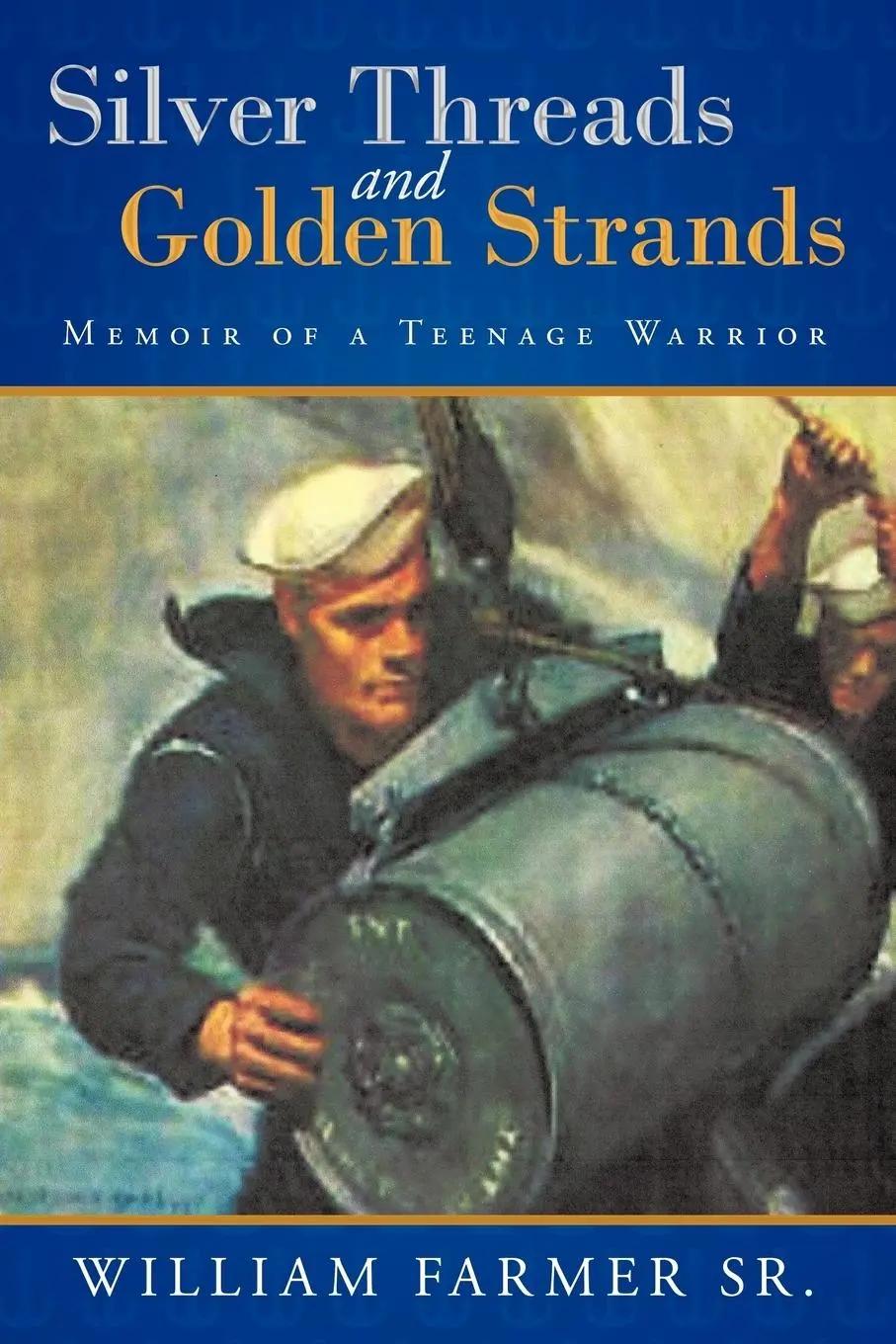
Teenage Warrior is primarily about the effect WWII had on "baby brothers" who watched older brothers leave home to serve their country. Being left behind, feeling useless, and all the normal frustrations of early teens. Bill became a "teenage delinquent" before the term was coined. He wrangled his way into the Navy at 15 and soon had doubts that he could handle it. Remembering his Dad's words, "I'll help you get in but won't help you get out", he served 32 months during the war. 26 months were spent at sea and 12 months were spent in combat zones. The WWII tales in this book vary from "serious" to humorous. Bill survived the explosion of the Chicago Naval Ammunition Depot, hurricane Cobra, a surprise Japanese "Betty" bombing of B29's at Tinian, and a "psycho ward" on Roi Namur Island. The book is full of surprises as Bill remembers some of the good times he had even in the face of battle. Bill became a WWII Veteran, same as his four older brothers.
Silver Threads and Golden Strands
Memoir of a Teenage WarriorBy William Farmer Sr.AuthorHouse
Copyright © 2011 William Farmer Sr.
All right reserved.ISBN: 978-1-4567-6594-1Chapter One
Searching For Truth And Peace
TRY NOT TO BE OFFENSIVE, A PEACEFUL life is better for everyone's sake. In my way of thinking, "Politically Correct", seems to be a way to spin fiction into truth to fit their goals. "The Golden Rule" has stood the test of time, and has served me quite well. It has a better overall return than Wall Street.
Based on my calculations, Mississippi's population was about 51% African American, 47% "White" and 2% "Indian" when I was born. This mix allowed us to understand and appreciate other people's values, and respect their rights. Our community had a mutual respect and concern for one another. People survived because we knew who was most needy, had true concern, and everyone gave whatever they could spare to keep the oldest and weakest alive. Death was never far away in the 1930s. Don't get me wrong, I know several rural counties in Mississippi were not that way; just like side of beef, there are choice/prime cuts, and then many tough cuts. We lived in a good community. Humans, like animals, respond in kind, to the way in which they are treated.
Faith, Then Religion
Regardless of race or ethnic differences, people in my neighborhood had "Christian Love" for the people they knew. On the other hand, all of us were skeptical of strangers until we were satisfied that they were trustworthy. Their status was earned or lost by their behavior.
My family tree has produced and nourished strong faith for centuries, but the variety of religions has been a source of many disputes. Some misguided people put their religion first. Every denomination thinks, absolutely, that they are the "Right Church". I will argue about many things, but not religion. To me, spirituality means "Strong Faith and Righteous Living".
Farmer Family History
The Farmer Family has been traced back to England. They moved to Scotland to find work and more freedom. The English Parliament tolerated a Roman Catholic king until his wife gave him a male heir. Then, Parliament invited "William of Orange" over from The Netherlands, in a bloodless coup, to be King of England. His mother was an English princess. That was early in the 1600s.
A war between England and Scotland came along soon thereafter and the Farmer boys, with many other Scotsmen, fought for the Queen of Scots; they ultimately lost. As recompense, the cocky, young King of England went to a village in Scotland and demanded that the Scots pay allegiance to him. Being "HARD HEADED", the Scots refused to kiss his ring. The vengeful King had every man, woman, and child in that village massacred. In a 1972 visit to Scotland, I found no locals who loved the "Brits". Over 350 years, have passed and very little has changed in Scots' attitudes toward the British.
Our family tree is hard to trace because our ancestors had a price on their heads when they left Scotland and went to Ireland. They took the first available ship to America and laid low for hundreds of years because they were afraid of being turned in as English traitors. They settled in Carolina Colony, blended in quietly for almost two centuries.
My daughter-in-law found that the territory of the colony extended from the present southern line of Virginia to the St. Johns, in Florida. The first permanent settlement was Charles Town, on the St Johns River. It was established by the English in 1670. This historic site is preserved to this day, a few miles outside of present day Charleston, South Carolina.
Eventually, those families split out to different places. For many years, my forefathers lived in Wilkes County, Georgia. During General Sherman's march to the sea, his troops left court houses and our family records burned to ashes. It has been said that later, after the ratification in 1831 of the Treaty of Dancing Rabbit Creek, two brothers and their families set out for a Choctaw reservation in Scott County, Mississippi. It may have been there that a Choctaw Maiden entered our family and added that great heritage to our bloodline.
As these families traveled, they kept track of their mileage in a very unique fashion. I've been told that one spoke in a rear wheel of the wagons was painted white; so, the children could take turns counting the turn of the wheel each day. The circumference of the wheel was 21 feet. It would take the following calculation to determine the number of miles covered in a day: Turns X 21' = Total feet divided by 5,280. Hey, it gave the kids something to do that was useful and kept them occupied on a long trip. As a father of five, I can see the need to keep the "are we there yet" questions to a minimum.
One family decided to stay at a small Creek Village with an assortment of log cabins near the fall line of the Black Warrior River. It was a village named in honor of the legendary Indian, Chief Tuscaloosa. Today it is the home of the University of Alabama.
My great grandfather, Perry de Layfette Farmer, and family continued to Harperville in Mississippi. Harperville was a small community that centered its economy on a flour mill that was built and ran by George Harper in 1868. My granddad, Joseph Bonaparte Farmer, Sr., was one of Perry's sons. I don't know for sure; but, he may have been named after Napoleon Bonaparte's brother, the King of Naples, who later came to America to start a new life just as our family had.
Grampa Farmer was about a quarter Choctaw, as best we know. His mother, Nancy Elizabeth Wheelus Farmer, taught him to speak the Choctaw language. He was a kind, peaceful and loving man. He had many traits that reflected Native American culture.
Grampa was an Ecologist before that name was created. He loved his land and tried to leave it better than it was when he received it. He was a deputy sheriff at one time and his job was collecting back taxes. Houses owned by poor African Americans were old and valued low; but, often they could not pay their taxes. Grampa paid for a few elderly couples when he had enough money. He was repaid in some cases. People did the best they could; everyone was just surviving.
Grampa was born in April 1866. He never learned to drive a car. He had a buggy and an old horse named Frank. Grampa liked bananas. When he ate one in his buggy, he tossed the peeling to Frank. I never knew if Frank liked banana peelings, or if he was just hungry enough to eat anything. Frank died in 1937. Digging a grave for a horse with pick and shovel is a massive undertaking.
I want to pause here for a "word from my Sponsor". In my view, there actually is only one race, "The Human Race". We are all equal in the sight of God. If you are a person who does not believe there is a God, you can see the "Creator" in His Creation. If you can't see that, join the Marines, volunteer for Afghanistan, serve in combat, and you will see more clearly!
On Mother's side, The Matheneys were French Huguenots. They moved to England four hundred years ago to escape death threats. In 1620, Cardinal Richelieu was the "Head of Church and State" in France. He persecuted non-Catholics, as Saul of Tarsus did the Christians at the beginning of the early church. Eventually, that situation was the reason our forefathers cited the need for "Separation of Church and State". The "French problem" was fresh on their minds when our nation was being formed.
We have separation between church and state now; but, the reasoning and actions by current advocates for separation of Church and State are as phony as a three dollar bill. What they want and are trying to do is to get rid of God, Jesus Christ, and Christians. That is what I see and hear; it's a bad idea, and they better repent soon.
Pockets Of Evil
There were many pockets of evil in Mississippi. As late as 1964, three young men were murdered and buried under a dam that was under construction. This crime may never have been solved if not for a person who still had a conscience. She had inside knowledge of this terrible crime, and defying death threats, gave critical leads to lawmen which broke this case. Her bravery also was the spark that began a healing process in this dark side of Noxabee County, Mississippi.
I was a widower at that time, living at Scott AFB in Illinois. I was driving my son, Bill Jr., and two of his friends to Forkland, Alabama. We were in a big Buick, with Illinois license plates, so the Law official thought we were "troublemakers from up north". We were pulled over about half a mile inside the Mississippi state line. My United States Air Force uniform hanging in the left rear window helped shorten our inspection.
That was my firsthand experience, as an adult, with the attitudes at that time in history. I was too young in the 1930s to be aware of the "DARK SIDE" of our state. I never saw Ku Klux Klan in their white sheets. Before television, it was easy to control the news media. In 1930, our radio was our connection to the "outside world"; a world limited to a 40 mile radius of Meridian, Mississippi. Our radio was played very sparingly, to conserve the batteries. People walked a mile to our house to hear a Joe Louis fight, or listen to "The Grand Ole Opry". That was the limit of our information highway in "The Good Ole Days".
From the dark side to the white side, was "sorta" gray. If we had any neighbors in the Klan, I never knew it or heard about it. We had two "white" families that lived within a mile of us. One was Miss Matt, Dad's cruel step-mother. I remember because she was the Step-Grandma who spit snuff on our new fireplace. The other family was known for their homemade moonshine whiskey. Miss Matt bothered us all the time, but the other family only bothered us one time; when, they dumped used "mash" too close to our property. It ran under our fence; then, our milk cow, "Baby", ate a belly full and was too drunk to walk home. I wonder if this is why Charles always went berserk if he didn't get his daily dose of milk.
I can still remember the beautiful music that came across two wooded hollows; it offset all the evil in our neighborhood. One thing I shared with Elvis was the love of African American Gospel Music. Mount Moriah Church was on the third ridge, about a quarter of a mile away. Those folks sang with their heart and soul in it. The songs were heard best on crisp, cold winter Sundays. I guess it was clearer because leaves had fallen, so there was nothing to muffle the sound waves as they floated across one ridge and two hollows.
Out in the Central Pacific, years later, I often hit the "Replay Button" in my memory bank, and enjoyed those warm memories on long, lonely nights. In the heat of battle, troops in the military were too busy to think of home, and good times we had there. But in slack time, Good Memories were pure Blessings. Now that I am older and have more time for contemplation they still are blessings to me.
One Kind, Brave Soul
Ned Gales, an elderly African American, who lived his entire life in Forkland, Greene County, Alabama, was loved and respected by everyone. He was a blacksmith and his shop was at the crossroads in this small community. Ned's shop was a favorite spot for kids to stop and visit after school. Ned was a kind, patient and lovable man. I am glad that I knew him. Memories of Ned have lived through four generations of our family.
On July 27, 2009, I called Betty Jo (Reeves) Gormley in Tulsa to find out Ned's last name. Her voice rose to an endearing tone, as she told me what a kind person Ned was. Jo's sister was my first wife, Loyce, who passed away in May 1963. Jo and I still share a bond of love and friendship that will continue as long as we do.
Jo told me something about Ned that I had never heard. During the darkest days of race relations in Alabama, probably the late 1950s or early '60s, a meeting was held by the black community in a local African American church to discuss boycotting the three ancient general stores in Forkland. Mr. and Mrs. Walter Reeves, my wife's parents, owned one of those stores.
Ned Gales stood up in that meeting and told how Mrs. Reeves' mother, Flora Ann Shearer, had fed him and nursed him back from near death. Then others remembered similar kindness, and shared their stories. Shortly afterward, the group prayed before taking the boycott vote.
Although Governor Wallace was "burning bridges", and giving African Americans reason to boycott, they voted against it in Forkland. Their old friendships were genuine and were not lost in the political fervor of the time, mostly due to Ned Gales testimony. Ned was honest and widely respected in Forkland.
That really moved me, because I had heard more bad stories than good about that area near Dollarhide Swamp and Rosemont. Rosemont was an antebellum mansion two miles from Forkland; it is also known as the Grand Mansion of Alabama. It was built in stages, between 1832 and 1850, on the old LeGree Plantation, maybe they were kin to Simon Legree?
I don't know nor care. What matters is that my son's mother, grandmother, great grandmother and Ned have died, but warm memories of Ned Gales still lives in Bill Jr.'s heart, in his Aunt Jo's and my heart as well. Ned was small in frame, but a giant man of character.
The Great Depression
The 1930s were very hard times for most folks. There were very few jobs and almost no income for many families. The depression was hard, and no end was in sight. Years of suffering marked many people for life; they would hold on to whatever they had, even if it was really worn out.
I saw the pain and suffering all around us' but, was saved from living in poverty. My father had a job throughout the depression. Mackie and Bailey Farmer were wonderful parents. They taught us by Word and example, to appreciate what we had, take care of it, and share with others. We had a good life growing up in the country. We learned to create our toys and entertainment. We had lots of fun and stored up enough good memories to last us through hard days in WWII. My childhood was a great blessing.
Today, many people have more than they need. That is evident in thousands of storage lockers and sheds in back yards. I wonder, "Why not give your excesses to the needy?"
Millions of share croppers existed before WWII. They were good hard working farmers who did not own land. They had to farm land owned by their landlord. When the crops were harvested, the proceeds were divided according to their agreement with the land owner.
Even when the tenant received his fair share, their life was very hard. They lived in whatever shack was available. Cracks, in old lap siding, were not unusual and were not so bad in the summer; but, they were terrible in winter. To survive the cold, families would tack paper on the inside of the walls for insulation. Thank God winters were milder down south for some folks.
Some evil landlords cheated their tenants. Many tenants had to go into debt to their landlord for basics to survive the winter. Prices were high; and often, their share of the harvest would not pay their debt. When this legal robbery continued for years, the sharecropper virtually became a slave. This accepted form of slavery happened to both black and white families alike. It was basically a matter of "GREED" on the land owners' part. Blacks tended to suffer more often; because, they had less land with poorer soil resulting in smaller yields. No share cropper could live well when half of all their labor went to the landlord.
(Continues...)
Excerpted from Silver Threads and Golden Strandsby William Farmer Sr. Copyright © 2011 by William Farmer Sr.. Excerpted by permission of AuthorHouse. All rights reserved. No part of this excerpt may be reproduced or reprinted without permission in writing from the publisher.
Excerpts are provided by Dial-A-Book Inc. solely for the personal use of visitors to this web site.