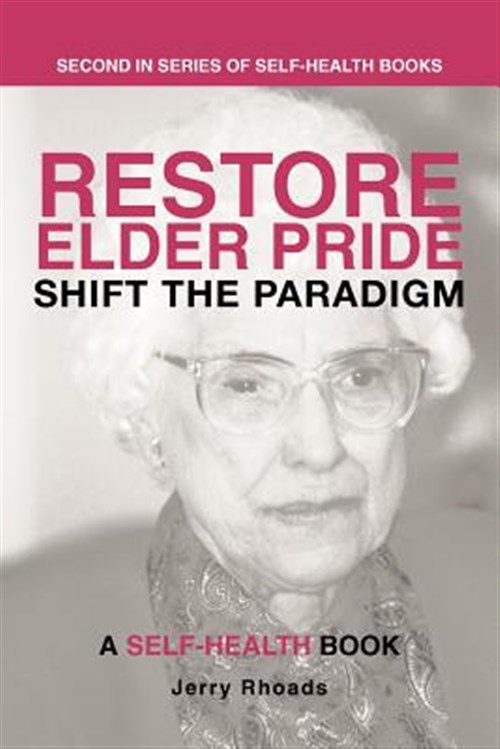
In 2006, seventy-seven million baby boomers-people who worked hard all their lives-will begin to turn sixty. They have a right to expect the best of everything, but if the nursing home industry doesn't change dramatically and soon, they can only expect the worst. Today, nearly two million people are institutionalized in nursing homes, and millions more will face the possibility of one day joining the ranks of system victims. Every American has a personal, vested interest in shifting the paradigm of a struggling industry that is on the verge of collapse and that ends patients' lives prematurely. Author and CPA Jerry L. Rhoads is a fellow of the American College of Health Care Administrators fellow, a licensed nursing home administrator, and the CEO of All-American Care, Inc. In Restore Elder Pride, he shares an educated insider's look at a system in crisis-and how each person can be a part of the solution. He outlines the three prevailing principles that make this problem solvable: Embrace the restorative care model as a necessary transition between the current medical and social models. Use computer technology and case management to customize care plans for each patient in order to manage interventions for positive outcomes. Pay for performance based on outcomes attained. He calls his approach restorative care, and that involves changing the approach to elder care to embrace more humane and productive outcomes. By restoring function of the mind, body, emotion, and spirit, Rhoads believes that the industry can be saved.
Restore Elder Pride
Shift the ParadigmBy Jerry RhoadsiUniverse, Inc.
Copyright © 2013 Jerry Rhoads
All right reserved.ISBN: 978-1-4759-6388-5Contents
Foreword..........................................................................xvAcknowledgments...................................................................xxiIntroduction......................................................................xxiiiPart 1. Elder Pride: An Idea Is Born..............................................1Chapter 1. Eldercide: A Personal History..........................................3Chapter 2. A Divine Intervention..................................................13Chapter 3. Eldercide vs Elder Pride...............................................19Part 2. Eldercide: A System in Crisis.............................................27Chapter 4. Eldercide by the Numbers...............................................29Chapter 5. Barriers to Nursing Home Quality.......................................47Chapter 6. The Legacy of Eldercide................................................55Chapter 7. Government Reports.....................................................69Chapter 8. What's Wrong with the Nursing Home Industry Today?.....................81Chapter 9. Prospective Payment: A Broken System...................................103Chapter 10. Warehouses versus Care Houses.........................................119Chapter 11. Needs of the Elderly—Patient-Centered Care.......................131Part 3. Elder Pride: Defining the New Paradigm....................................141Chapter 12. What Is Elder Pride?..................................................143Chapter 13. Eliminating Wasted Resources..........................................151Chapter 14. Incentives for Quality and Cost-Effectiveness.........................159Part 4. Making It Work: Building the New Paradigm.................................175Chapter 15. Stakeholders: The "New Paradigm" Team.................................177Chapter 16. Employer/Employee Mandate.............................................183Chapter 17. Regulatory Mandate....................................................191Chapter 18. Healthcare Policy Mandate.............................................211Chapter 19. Congressional Mandate.................................................223Chapter 20. Provider Mandate......................................................231Chapter 21. Build a Flagship and They Will Come...................................243Chapter 22. Back to the Future....................................................255Chapter 23. Front of the Line Quality.............................................263Chapter 24. Realigning Workflow and Workload......................................273Chapter 25. Focus on Savings......................................................285Chapter 26. PHR and EHR for Long-Term Care Facilities.............................295Chapter 27. National Plan of Action...............................................305An Epilogue to Elder Pride........................................................335Appendix A........................................................................337Appendix B........................................................................345Appendix C........................................................................355Appendix D........................................................................357Appendix E........................................................................365Endnotes..........................................................................373Bibliography......................................................................379Books Written by Jerry L. Rhoads..................................................383Afterword.........................................................................385Open Letter to President Obama....................................................387
Chapter One
Eldercide: A Personal History
In Hoffman Estates I prepared to take my 2 year old grandson to visit the nursing home I was running in Elgin. It was a 207 bed skilled nursing facility that I took over on a management contract May 1, 1987. It was troubled when I got there, having failed surveys and was decertified for payment by Medicare and Medicaid. And things got worse with a drowning in the whirlpool when the Filipino Physical Therapist left the side of a 93 year old male put there in a Hoyer lift.
It was 7:00pm in the evening of May 5, 1987 and an Ambulance pulled up in from of the facility. I was in my Offi ce interviewing a replacement for the Director of Nursing job that had just vacated when I showed up. I was walking her to her car, with plans of hiring her, when my Nurse consultant rushes out the door informing me that there had been a drowning in the therapy whirlpool. When I got downstairs the EMT's had the elderly man on the floor administering CPR to no avail. He was receiving hydro treatment for contractures and had a history of seizures. Eventually the County Coroner established drowning as the cause of death.
The Department of Public Health, the Illinois Attorney General, TV stations, were all there the next day wanting someone to blame. The President of the Therapy company fired the therapist for leaving the side of the patient in the whirlpool to chart and for providing treatment after business hours. I was put in front of the TV cameras and made the case for a terrible accident and that all parties would be interviewed and an investigation done in conjunction with the State Officials. I fired the therapy company immediately, called the family in Seattle Washington, who were saddened but receptive to the fact that he was miserable and better of ... they neither sued nor made it harder for us to pull ourselves out of the mess we had.
The State issued a conditional license, a $5,000 fine and required that I personally inspect the therapy operation daily and document that the policies and procedures were being followed by the therapists I had hired. The guilty therapist lost her license to practice and her employer disappeared from the Chicago area market.
Back to my grandson Alec and his visit. My wife and Alec's grandmother was not a fan of my taking over management of this nursing home. She had been there when it was my accounting client and she did not like the despicable conditions that I inherited. However, I assured her that things had changed over the last six months since the snow storm.... that snow storm enabled me to realize the mission I had which was to turn a facility that had 175 patients that did not want to be there, 175 employees who did not want to work there and 175 families that did not want to come there into just the opposite.
The snow storm intervention was divine ... for 72 hours only half the staff got to work (the other half didn't want to get there) and focused on the patients' needs ... this was an epiphany that I was to realize later. (I will expound on this experience in complete detail in Chapter Two).
So when my daughter was confronted by me wanting to take her son to "that nursing home" and my wife saying "no way was she going to let me do it alone" ... she and my daughter accompanied me to that nursing home.... when we got there with Alec in hand the residents were ecstatic and my daughter was saying to my wife "this place is nice and everyone seems happy and clean". My wife to this day tells that story with tears in her eyes because the change had been so dramatic and so pervasive.
In affect what happened between November 16, 1987 and March 20, 1988 was a paradigm and cultural shift away from institutional-departmental management to teams and patient centered care. During that time the census rose to an average of 197 patients (34 being paid by Medicare and 125 by Medicaid) per day, the 175 staff members took care of those additional patients and liked their jobs so much that the turnover rate went below 20% and the revenue stream rose over $1 million dollars per year. But more importantly the families came back and volunteers go involved to make Fox Valley a five star facility.
It worked so well that my boss, the General Partner for the holders of the lease, was able to exercise the option in the lease and sell the facility for twice what it was worth when they leased it. And I was terminated and had to find another facility to manage. The purchaser of Fox Valley, in all their money driven methods, was able to turn it back into the warehouse for the elderly ... not caring that we had turned it into a reputable care house for those who wanted to get restore and go home, if possible. Many of the staff members eventually left and followed me to the next project in Glendale Heights Illinois.
December 31, 1989 Glendale heights, Illinois—NEW YEARS EVE
On New Year's eve I told my wife that we needed to stop by the nursing home because I had promised the residents that I would be there to wish them a happy 1990. She was upset because we were going to Morton Illinois to visit our daughter and we were getting a late start. But she relented and we went in the dining room where all of the 200 residents were in their regalia singing songs and waiting for me to show up. I could not believe the response from them and the staff ... we were truly a family and my wife again turns to tears to explain the feeling that we got from that scene.
I had taken over management of Carington Living Center in August 1988 for the Adventist Health Systems. I was hired to turn around a facility that had a low census of 167 patients out of 206 beds with a decertification for survey deficiencies and staffing problems. It had 4 Medicare patients, over 140 Medicaid patients and a $100,000 per month loss. Turnover was rampant, as was theft of patient valuables and the use of agency nurses and aides was killing the goose. The problems were similar to my previous assignment ... poor care and low staff morale and deficient revenue had to be fixed.
Since I now knew how to fix it we reorganized, standardized the work flow into teams that specialized in restoring patients. We instituted a full psycho/social and restorative programming system using my computerized library of reimbursable outcomes. We went from de-certification to receiving 6 of the 6 stars of quality within the next two years. The revenue went from $65,000 per year from Medicare to $1.5 million with a $600,000 increase in the Medicaid revenue due to increased rates for restorative programming and quality improvement. The profits increased to $100,000 per month. The facility got sold to another warehouser. Again I worked myself out of a job.
But more importantly my wife and son now were involved in the business and we began to form a consulting business to help others implement patient centered care using our computerized care plans based on a Restorative Model of care replacing the traditional treatment driven Medical Model or the Activities driven Social Model.
The snowstorm and the New Year's Eve party were the defining moments for our Family's mission to eventually own and operate skilled nursing facilities not just for the money but for the happiness it can bring to us, the aging American, their families and a downtrodden industry that seems destined to self-destruct.
To some, I sound like a man with a mission. I am. My drive to pre-form the American nursing home industry is a direct result of my personal experience in this problematic business. You will read about my personal experience throughout the book. At this juncture in my career, I want to make a difference in the lives of others: the people in my family and in the nursing homes that I have run, and those baby boomers who are about to enter nursing homes in record numbers.
Grandma White
Grandma White entered Lexington Care Center in July 2004 because she had a short-term memory problem. She couldn't remember to take her medications and was prone to forget how to turn the gas stove on and off. She had a hard time navigating the stairs in our house and had fallen number of times. My wife and I moved her into our home in Schaumburg in 2002, because of her deteriorating memory. After we moved to Lake Zurich, however, we found we needed to travel more on business and could no longer provide for Grandma White's needs. Shari chose to place her at Lexington because of its proximity and reputation. The facility appeared clean, and state surveys had declared it "deficiency free."
Dorotha C. White met an untimely death on May 17, 2004, due to neglect and abuse in a nursing home. It was, for me, a very personal case of Eldercide. The guilt that Shari felt for putting her mother in a nursing home in the first place now came home to roost after this calamity. Shari's mother was a dynamic ninety-two years of age and was likely to live to be one hundred, since she had an aunt that lived to one hundred nine and an uncle that lived to one hundred two years of age. But Dorotha, due to her short-term memory problem, could not be left at home alone. Shari's sister and brother were not well and could not take on the responsibility, so shopping for a nursing home was the only alternative.
Lexington Care Center in Lake Zurich was just down the highway from where we lived. It looked outstanding from the street and had good credentials and no record of deficiencies in their latest surveys. Unfortunately, appearance did not reflect reality. The quality was only superficial, we were to discover, over the next seven months, that the care was substandard and responses to our concerns were nonexistent. We spent those seven months trying to get the facility to respond to Grandma White's limited needs. Their solution was to incarcerate her on the third floor as an Alzheimer's patient. She never was and never would be an Alzheimer's case. The medical director, who became her attending physician, made that designation to justify placing her in the locked unit and increasing her medications from eight per day to eighteen per day.
It was a Saturday in April, and we wanted to take Mom to a restaurant for breakfast, which we did quite often. Shari called and asked if Mom was up and if we could take her out. Their response was, "Oh sure, come and get her." When we got to the nursing home and went to the third floor, we found Mom at the nursing station in her wheelchair, barely responsive. She was only partially dressed, and she could not reach the floor, because the foot pedals had been removed from her wheelchair. She appeared to be ill. We asked the nurse at the desk if she had eaten, but the nurse did not know. We took her to her room to clean her up and asked an aide if she had been eating; the aide said she didn't think so. I tried to give her water, then asked for some ice cream, but she would not swallow. I then told Shari that we were going to get her to the hospital and called our doctor. After getting her admitted, we found out that she was terribly dehydrated and quite possibly had had a heart attack sometime that week. We also found out that the medical director had given her a psychotropic medication the night before and that she had refused her diabetic medication 118 times in the previous 3 months.
The following is the statement that Shari wrote regarding the incident that eventually took her mother's life. This document was prepared in accordance with the federal guidelines for filing complaints against nursing home operators, hence the formality of the language.
A Written Statement By Shari Rhoads
Lexington of Lake Zurich knowingly and willfully deprived Dorotha White of her civil rights and the care for which they were being paid that ultimately caused her death on May 17, 2004.
Following are excerpts from the investigator's report submitted to the Illinois Department of Public Health by Paula Brennan and later published in the Public Health's notice of violations (the full text of the findings is included in appendix A):
On April 25, 2004, Dorotha was found by family to be lethargic, confused, and in need of medical attention. Dorotha was transferred to the emergency room at family's request and admitted directly from the ER into the ICU with diagnoses of acute renal failure, congestive heart failure, hypotension, and lethargy. Per interview with Dorotha's primary physician and cardiologist, Dr. Percival Bigol, Dorotha was severely dehydrated upon admission to ER on April 25, 2004. Dr. Bigol stated that Dorotha had also suffered a heart attack prior to admission to the hospital and that her renal failure was secondary to the heart attack and dehydration.
Denial of payment for new admissions, effective July 1, 2004, and remedied through the accepted plan of correction. The facility failed to notify the physician regarding Dorotha's change in physical condition and mental status, high frequency of refusal to take medications, and multiple low blood sugar readings. The facility neglected Dorotha and failed to accurately assess and monitor fluid intake, did not meet estimated needs, failed to reassess hydration risk after a change in condition was identified, failed to have a hydration plan in place and document alternative attempts to provide fluid, and failed to assess rising blood urea nitrogen (BUN) levels in relation to hydration status. The effective date of the remedy is June 3, 2004. The total amount of the civil money penalty shall be $9,150.
Termination effective December 3, 2004. All imposed remedies will be effective until the facility achieves "substantial compliance" with all federal certification regulations. Before a revisit will be considered, the facility must provide an acceptable Plan of Correction for all deficiencies documented during the survey at the "B thru L" levels of "Scope and Severity."
We were told the civil penalty would be assessed at $10,000 per day per violation (three immediate jeopardy violations were found), but obviously this was dramatically reduced in the course of the bureaucratic influence game. Instead of a two-million-dollar fine and loss of Medicare and Medicaid certification, the facility received a slap on the wrist and a fine of only $9,150. We appealed the judgment and were told that the family had no standing in contesting the degree of the fine or the facility's retention of its certification or license. We were then awarded a settlement in a wrongful death action, but that did not come close to being a remedy for negligence, abuse, and the violation of Grandma White's right to receive the care being paid for by Medicare and Medicaid.
George and Velma Rhoads
I have two other very personal reasons for my life's work: both of my parents were incarcerated in nursing homes and met untimely deaths due to poor care and unnatural causes.
George and Velma Rhoads were born in Missouri during the Depression and worked all their lives for a comfortable retirement that never came. They were neither particularly healthy nor wealthy. In their later years, chronic maladies took their toll.
George had worked in the factory at Firestone and contracted respiratory problems, specifically emphysema, from working around asbestos. He had looked forward to turning sixty-four so he could get away from the drudgery of work. At the age of eighty-two, he died in a nursing home where he had been for the better part of four years. Prior to going to the nursing home, he had a stroke that impaired his functioning. But his respiratory problems remained the larger issue. During the time he was in the nursing home, he fractured his ankle and his wrist in staff-related accidents. While in the latter stages of emphysema, he was put on continuous oxygen. This was the beginning of the end. He built up a dependence on continuous oxygen during the day, and then he did not get that same level during the night. This made him delirious, so he was given sedatives to quiet him. Not only was this protocol harmful, it eventually killed him. At no time did a doctor see him more often than every ninety days. During that time, he received on average five telephone orders for lab tests, medications, and other doctor-ordered tests that led to furthering his demise.
Velma, my mother, had heart problems related to the blood thinners that were prescribed for her as she aged. But the real problem was her digestive system. She developed diverticulitis and had to have a portion of her colon removed and a colostomy bag inserted. Because she had to go off blood thinners prior to the operation, she developed a blood clot during surgery and had a stroke. From that point on, she could not walk, talk, or move her right side. She appeared to be in a vegetative state. Her mind was still there, but she could not communicate. She followed my father in death, at the age of eighty-four, in the very same nursing home. In an effort to ease her suffering, I was forced to make a decision to take her off of life support. There was no hope of recovery. I made that decision, and she subsequently starved to death over a ten-day period.
On numerous occasions, I voiced concern and unhappiness about the lack of staff and the misuse of my father and mother's Medicare benefits. The care was sub par, and there was never any staff available on the weekends. It was inevitable that their passing would be inhumane.
That's my story. They are Dorotha's and George's and Velma's stories. Sadly, there are hundreds of thousands of stories just like these. Perhaps some of them are your stories or stories about people you knew and loved who were victims of Eldercide.
(Continues...)
Excerpted from Restore Elder Prideby Jerry Rhoads Copyright © 2013 by Jerry Rhoads. Excerpted by permission of iUniverse, Inc.. All rights reserved. No part of this excerpt may be reproduced or reprinted without permission in writing from the publisher.
Excerpts are provided by Dial-A-Book Inc. solely for the personal use of visitors to this web site.