
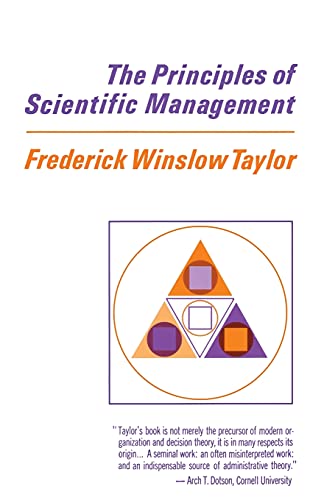
The Principles of Scientific Management
Taylor, Frederick Winslow
ISBN 10: 0393003981 ISBN 13: 9780393003987
Published by W. W. Norton & Company, 1967
Used
Soft cover
From
World of Books (was SecondSale), Montgomery, IL, U.S.A.
Seller rating 5 out of 5 stars

AbeBooks Seller since 20 December 2007
This specific item is no longer available.
About this Item
Description:
Item in good condition. Textbooks may not include supplemental items i.e. CDs, access codes etc. Seller Inventory # 00097019169
Synopsis:
This brief essay by the founder of scientific management has served for nearly a century as a primer for administrators and for students of managerial techniques. Although scientific management was developed primarily as a system for increasing productivity in industry, its principles have been applied to all kinds of large-scale enterprises, including operations with departments and agencies of the federal government. It is in this volume that Frederick Winslow Taylor gave the theory of scientific management its clearest airing. Born in 1856, Taylor began work at age eighteen as an apprentice to a pattern-maker and as a machinist. A few years later he joined the Midvale Steel Company as a laborer, and in eight years rose to chief engineer. During this time he developed and tested what he called the "task system," which became known as the Taylor System and eventually as scientific management. He made careful experiments to determine the best way of performing each operation and the amount of time it required, analyzing the materials, tools, and work sequence, and establishing a clear division of labor between management and workers. His experiments laid the groundwork for the principles that are expounded in this essay, which was first published in 1911.
From the Back Cover:
For more than 80 years, this influential work by Frederick Winslow Taylor--the pioneer of scientific management studies--has inspired administrators and students of managerial techniques to adopt productivity-increasing procedures. Indeed, this book laid the groundwork for modern organization and decision theory.
As an engineer for a steel company, Taylor made careful experiments to determine the best way of performing each operation and the amount of time it required, analyzing the materials, tools, and work sequence, and establishing a clear division of labor between management and workers. His experiments resulted in the formulation of the principles expounded in this remarkable essay, first published in 1911.
Taylor advocated a scientific management system that develops leaders by organizing workers for efficient cooperation, rather than curtailing inefficiency by searching for exceptional leaders someone else has trained. The whole system rests upon a foundation of clearly defined laws and rules. Moreover, the fundamental principles of scientific management apply to all kinds of human activities, from the simplest individual acts to the most elaborate cooperative efforts of mighty corporations. Correct application of these principles, according to Taylor, will yield truly astonishing results.
Unabridged Dover (1998) republication of the work published by Harper & Brothers Publishers, New York, 1911.
"About this title" may belong to another edition of this title.
Bibliographic Details
Title: The Principles of Scientific Management
Publisher: W. W. Norton & Company
Publication Date: 1967
Binding: Soft cover
Condition: Good