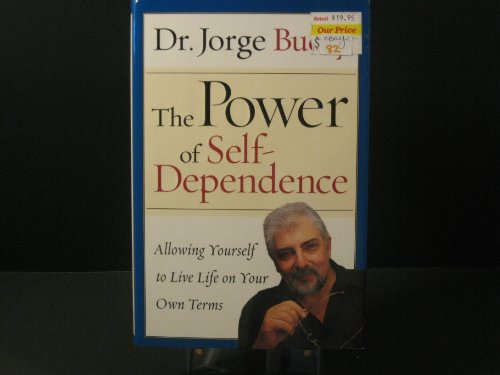
World-renowned therapist Dr. Jorge Bucay's wisdom is finally available in America, helping to change lives in the United States, in the same powerful manner he has done so for countless people throughout the world.
In an easy-to-read format, with engaging stories and thoughtful anecdotes drawn from a multitude of sources -- folktales, the Bible, eastern philosophy, and the Talmud -- The Power of Self-Dependence leads us beyond our commonplace notion of independence to the more profound concept of self-dependence.
Dr. Jorge Bucay, taking on the role of Life-Coach, proposes that in order for us all to attain balance in our lives and to achieve inner peace, we must acknowledge our dependence on those around us -- whether they are friends, family, or even coworkers. We can't, Bucay firmly establishes, go it alone.
With his unique blend of spirituality and practical wisdom, Bucay explains why independence proves to be an illusion and demonstrates how understanding this allows us to transform ourselves into healthy, enlightened individuals.
Without ignoring our own need for independence, Bucay shows us that as people, we are social creatures who must learn to trust and embrace one another. Before we can seek happiness, says Bucay,we must first learn to be self-dependent -- on our own instincts and of those closest to us.
Once we have attained this delicate balance between trusting ourselves and trusting those we love and depend upon, we clear the path toward the ultimate goal: personal happiness.
Excerpt
Chapter One
Situation
The Argentinian poet Hamlet Lima Quintana writes:
It all depends on light,
on the way light reveals things.
It all depends on form,
on contours,
on interpolations and
on doubts.
It all depends as well
on our being marked by time,
on the spaces giving us the headlines.
The true problem is choosing whether
to pursue the shadows
or to let ourselves be pursued by them.
There is a strange "To be or not to be"
in this half being,
in this half not being:
To emerge from the shadows
or to perpetuate them.
And at the deepest level of the abyss,
after liberating others,
all those who are others,
to remember
without urgency,
that we are the prisoners.
And thereby ...
to liberate ourselves.
In order to understand dependence, it is helpful to begin thinking of ourselves as being in some way liberated and in many ways prisoners. In the "half being" and "half not being" evoked by the poet, let us think of ourselves as faced with this question: What meaning and what importance would it have for each of us to be dependent, or not dependent, on others?
I return here to an idea I once abandoned, which I had defined with an invented word: Self-dependence. Weren't there enough words already that included the same root?
Dependence
Co-dependence
Inter-dependence
In-dependence
Did we need one more?
I think so.
The word dependent derives from pendent, which literally means "hanging" (from the Latin pendere), that is, suspended from above, without a base, in the air. Pending (also pendant or pendent) means "waiting for a decision, unresolved, unfinished, unpaid." A pendant is an ornament, a drop earring or a piece of jewelry, like a gem, suspended from a necklace. Pendulous means "unable to hold its own weight; marked by vacillation or indecision."
With all of these meanings and derivations, it is not surprising that the word de-pendence evokes these images that we use as definition.
A dependent is one who hangs from another, who lives as if suspended in the air, without a base, like an ornament worn by another. It is someone who is hanging, permanently incomplete, forever unresolved.
There was once a man who suffered from an absurd fear. He was afraid of getting lost among people. It all began one night, when he was very young, at a costume party. Someone had taken a photo of all the guests in a row. But when he saw it, he couldn't recognize himself. He had chosen a pirate costume, with a patch over one eye and a kerchief on his head, but there were many others who had chosen a similar costume. His makeup consisted of rouge on his cheeks and some soot for a mustache, but there were several in costume who also had rosy cheeks and a painted mustache. He had a lot of fun at the party, but in the photo everybody seemed to be having a great time. Finally he remembered that when the photo was taken, he had locked arms with a blonde, so then he tried to find her, using that as a reference; but it was no help: more than half the women there were blond, and quite a few were arm in arm with pirates.
This experience had a strong impact on him, and, because of it, for years he didn't attend any gathering for fear of losing himself again.
One day he thought of a solution: no matter what kind of event it was, from then on he would always dress in brown. Brown shirt, brown pants, brown jacket, brown socks and shoes. "If anyone takes a picture, I will always know that I'll be the one in brown," he told himself.
As time went by, our hero had countless opportunities to affirm his shrewdness: when he came across a mirror in a big store and saw himself reflected together with others walking around, he would reassuringly repeat to himself: "I am the man in brown." During the following winter, some friends gave him a free pass to enjoy an afternoon at a steam bathhouse. The man accepted gladly, for he had never been in a place like that, and he had heard his friends talk about the benefits of the Scottish bath, the Finnish steam bath, and the aromatic sauna.
When he got there, he was given two big towels ...
(Continues...)
Excerpted from The Power of Self-Dependenceby Bucay, Jorge Excerpted by permission.
All rights reserved. No part of this excerpt may be reproduced or reprinted without permission in writing from the publisher.
Excerpts are provided by Dial-A-Book Inc. solely for the personal use of visitors to this web site.Copyright © 2003 Joanne Harris
All right reserved.