
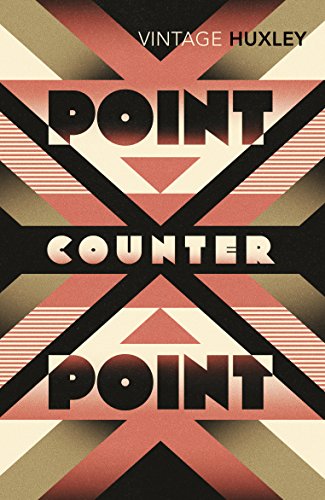
Point Counter Point
Huxley, Aldous
ISBN 10: 0099458195 ISBN 13: 9780099458197
Published by Dalkey Archive Press, 2004
Used
Soft cover
From
World of Books (was SecondSale), Montgomery, IL, U.S.A.
Seller rating 5 out of 5 stars

AbeBooks Seller since 20 December 2007
This specific item is no longer available.
About this Item
Description:
Item in good condition. Textbooks may not include supplemental items i.e. CDs, access codes etc. Seller Inventory # 00104355191
Synopsis:
WITH AN INTRODUCTION BY DAVID BRADSHAW
The dilettantes who frequent Lady Tantamount's society parties are determined to push forward the moral frontiers of the age. Marjorie has left her family to live with Walter; Walter is in love with the luscious but cold-hearted Lucy; Maurice deflowers young girls for the sake of entertainment, while the withdrawn writer, Philip, finds himself drawn to the dangerous political charm of Everard. As they all engage in dazzling and witty conversation, the din of the age - its ideas and idiocies - grows deafening.
About the Author: Aldous Huxley was born on 26 July 1894 near Godalming, Surrey. He began writing poetry and short stories in his early 20s, but it was his first novel, Crome Yellow (1921), which established his literary reputation. This was swiftly followed by Antic Hay (1923), Those Barren Leaves (1925) and Point Counter Point (1928) – bright, brilliant satires in which Huxley wittily but ruthlessly passed judgement on the shortcomings of contemporary society. For most of the 1920s Huxley lived in Italy and an account of his experiences there can be found in Along the Road (1925). The great novels of ideas, including his most famous work Brave New World (published in 1932, this warned against the dehumanising aspects of scientific and material 'progress') and the pacifist novel Eyeless in Gaza (1936) were accompanied by a series of wise and brilliant essays, collected in volume form under titles such as Music at Night (1931) and Ends and Means (1937). In 1937, at the height of his fame, Huxley left Europe to live in California, working for a time as a screenwriter in Hollywood. As the West braced itself for war, Huxley came increasingly to believe that the key to solving the world's problems lay in changing the individual through mystical enlightenment. The exploration of the inner life through mysticism and hallucinogenic drugs was to dominate his work for the rest of his life. His beliefs found expression in both fiction (Time Must Have a Stop,1944, and Island, 1962) and non-fiction (The Perennial Philosophy, 1945; Grey Eminence, 1941; and the account of his first mescaline experience, The Doors of Perception, 1954). Huxley died in California on 22 November 1963.
"About this title" may belong to another edition of this title.
Bibliographic Details
Title: Point Counter Point
Publisher: Dalkey Archive Press
Publication Date: 2004
Binding: Soft cover
Condition: Good