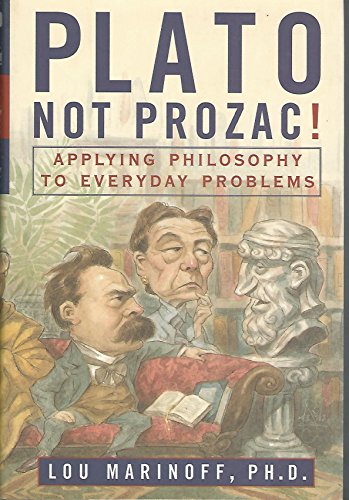
Students will discover that when facing a dilemma—whether it’s handling a relationship, living ethically, dealing with a career change, or finding meaning in life—the world’s most important thinkers from centuries past will guide them toward a solution compatible with their own individual beliefs.
From Kirkegaard’s thoughts on coping with death to the I Ching’s guidelines on adapting to change, Plato, Not Prozac! makes philosophy accessible and shows how to use it to solve everyday problems.
There was a time when philosophy meant something to ordinary people and philosophers' ideas were put to good use. Socrates spent his days debating vital issues in the marketplace, and Lao Tzu applied his own advice on following the subtle path to personal happiness and social harmony. Now, as a new millennium dawns, a unique movement called Philosophical Counseling has emerged to return philosophy to its classical roots by combining wisdom and practice to help people solve their most common everyday problems. Call it therapy for the sane. As the leading proponent of this field, philosopher Lou Marinoff, Ph.D., shows us that the road to a successful, fulfilling life begins with a simple choice: Plato, Not Procac!
When people come to see Dr. Marinoff they do not get endless discussions about their childhoods, quick prescriptions for antidepressants, or tedious analyses of their behavior patterns. Instead they learn how the ideas of the world's greatest thinkers can shed light on the way they live, from Kierkegaard's thoughts on coping with death and Kant's theory of obligation to the I Ching's guidelines on adapting to change and Aristotle's advice to pursue reason and moderation. Dr. Marinoff brings philosophy out of the ivory tower and directly into our lives and the dilemmas we all face. including handling love relationships. living ethically, dealing with career changes, being a good parent, coping with loss, and finding meaning and purpose.
Plato, Not Prozac! explains how insights from diverse wisdom traditions can be used to help you help yourself to a better life. The issue is not just how you live, but how well you live. With the right philosophy at the right time, you can enhance or regain that wellness. The book is filled with case studies drawn from the experiences of leading philosophical counselors that demonstrate the effectiveness of philosophy in helping people feel better, think better, and live better. Dr. Marinoffs signature five-step PEACE process shows you how to: identify your problem (P), express your emotions constructively (H). analyze your options (A), contemplate a philosophy that helps you choose and live with your best option (C), and renew your personal equilibrium (E).
A wonderful resource tool, Plato, Not Prozac! also offers an extensive list of philosophical practitioners and organizations as well as a detailed hit parade featuring sixty of the more important and influential philosophers. Dr. Marinoff also gives you a glimpse of the rapid growth of this movement in describing philosophers' cafés. the coporate philosopher, and other ways in which philosophy--the world's second-oldest profession--is making a global comeback and influencing people everywhere. Intelligent, accessible, and utterly persuasive, Plato, Not Prozac! is a groundbreaking alternative to traditional therapies and an indispensable guide to living a healthy, rewarding life. It's available over the counter; no prescription necessary.
"Everyone has a philosophy of life, but few of us have the privilege or leisure to sit around and puzzle out the fine points. We tend to make it up as we go along. Experience is a great teacher, but we also need to reason about our experiences. We need to think critically, looking for patterns and putting everything together into the big picture to make our way through life. Understanding our own philosophy can help prevent, resolve, or manage many problems. Our philosophies can also underlie the problems we experience, so we must evaluate the ideas we hold to craft an outlook that works for us, not against us. You can change what you believe in order to work out a problem, and this book will show you how."
-- from Plato, Not Prozac!
Plato, Not Prozac!
Applying Philosophy to Everyday ProblemsBy Lou MarinoffHarperCollins Publishers
Copyright © 1999 Lou Marinoff
All right reserved.ISBN: 006019328XWhat Went Wrong With Philosophy -- and What's Going Right With It Lately
"As for Diseases of the Mind, against them Philosophyis provided of Remedies; being, in that respect, justlyaccounted the Medicine of the Mind."--Epicurus
"To be a philosopher is not merely to have subtle thoughts, noreven to found a school... It is to solve some of the problems oflife, not theoretically, but practically."--Henry David Thoreau
A young woman confronts her mother's terminal breast cancer. A man contemplates a midlife career change. A Protestant woman whose daughter is engaged to a Jewish man and whose son is married to a Muslim woman fears potential religious conflicts. A successful business executive struggles over whether to leave his wife of over twenty years. A woman is happily living with her partner, but only one of them wants children. An engineer and single father supporting four children is afraid that blowing the whistle on a design flaw in a high-pressure project could cost him his job. A woman who has everything she thought she wanted -- loving husband and children, beautiful house, high-paying career -- struggles with meaninglessness: when she looks at her life she thinks, "Is this all there is?"
All of these people have sought professional help in managing theproblems they feel overwhelming them. ln another day, they might have found their way to the offices of a psychologist, psychiatrist, social worker, marriage counselor, or even their general practitioner for help with "mental illness." Or they might have consulted a spiritual adviser or turned to religion for moral instruction and guidance. And some of them may have been helped in those places. They may also have endured discussions about their childhoods, analysis of their behavior patterns, prescriptions for antidepressants, or arguments about their sinful nature or God's forgiveness, none of which got to the heart of their struggle. And they may well have been signed up for a lengthy and open-ended course of treatment, with a focus on diagnosing the illness as though it were a tumor to be excised or a symptom to be controlled with drugs.
But now there's another option for people unsatisfied by or opposed to psychological or psychiatric therapy: philosophical counseling. What the people described above did was seek out a different kind of assistance. They consulted a philosophical practitioner, looking for insight from the world's great wisdom traditions. As established religious institutions lose their authority with more and more people, and as psychology and psychiatry exceed the limits of their usefulness in people's lives (and begin to do more harm than good), many people are coming to the realization that philosophical expertise encompasses logic, ethics, values, meaning, rationality, decision-making in situations of conflict or risk, and all the vast complexities that characterize human life.
People facing these situations need to talk in terms deep and broad enough to address their concerns. By getting a handle on their personal philosophies of life, sometimes with the help of the great thinkers of the past, they can build a framework for managing whatever they face and go into the next situation more solidly grounded and spiritually or philosophically whole. They need dialogue, not diagnosis.
You can apply this process in your own life. You can work on your own, though sometimes it helps to have a partner to converse with who can make sure you're not overlooking something or settling for rationalization over rationality. With the guidance and examples in this book, you'll be ready to discover the benefits of an examined life, including peace of mind, stability, and integrity. You don't need any experience in philosophy, and you don't have to read Plato's Republic or any other philosophy text (unless you want to). All you need is a philosophical turn of mind, which, since you've picked up this book and read this far, I'd say you have.
A Philosophy Of One's OwnEveryone has a philosophy of life, but few of us have the privilege or leisure to sit around and puzzle out the fine points. We tend to make it up as we go along. Experience is a great teacher, but we also need to reason about our experiences. We need to think critically, looking for patterns and putting everything together into the big picture to make our way through life. Understanding our own philosophy can help prevent, resolve, or manage many problems. Our philosophies can also underlie the problems we experience, so we must evaluate the ideas we hold to craft an outlook that works for us, not against us. You can change what you believe in order to work out a problem, and this book will show you how.
Despite its current reputation, philosophy doesn't have to be intimidating, boring, or incomprehensible. Much of what's been written on the subject over the years certainly falls into one or more of those categories, but at its heart, philosophy examines the questions we all ask: What is a good life? What is good? What is life about? Why am I here? Why should I do the right thing? What is the right thing? These are not easy questions, and there are no easy answers or we wouldn't still be mulling them over. No two people will automatically arrive at the same answers. But we all have a set of operating principles we work from, whether or not we are conscious of them and can enumerate them.
The great thing about having thousands of years of thinking to draw on is that many of history's wisest minds have weighed in on these subjects and have left insights and guidelines for us to use. But philosophy is also personal -- you are your own philosopher too. Take what you can learn from other sources, but to arrive at a way of approaching the world that works for you, you'll have to do the thoughtful work yourself The good news is that with the proper encouragement, you can think effectively for yourself.
And where do you find such encouragement? Here in this book, for starters. Plato, Not Prozac! offers you some of the fruits of philosophical practice. My fellow practitioners and I are not philosophers in the academic sense alone. Although many of us have Ph.D.s, teach in universities, and publish specialized articles, we do more than that: we also offer client counseling, group facilitation, and organizational consulting. We take philosophy out of purely theoretical or hypothetical contexts and apply it to everyday personal, social, and professional problems...
Continues...Continues...Excerpted from Plato, Not Prozac!by Lou Marinoff Copyright © 1999 by Lou Marinoff. Excerpted by permission.
All rights reserved. No part of this excerpt may be reproduced or reprinted without permission in writing from the publisher.
Excerpts are provided by Dial-A-Book Inc. solely for the personal use of visitors to this web site.