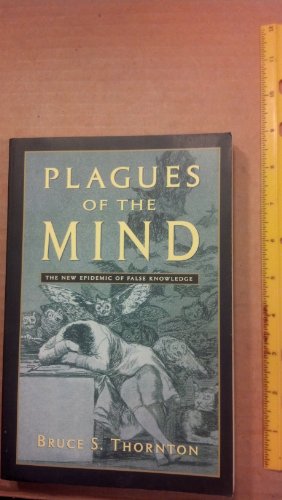
Classicist Bruce Thornton's Plagues of the Mind is a forceful vindication of the West's tradition of rational, critical inquirya legacy now largely jettisoned in favor of a host of new deitiesenvironmentalism, feminism, primitivism, New Age, and the cult of the therapeutic among them. Providence Sunday Journal Plagues of the Mind should make people question their unquestioned beliefsand this is as true for knee-jerk liberals as it is for overly smug conservatives. More Reviews and Recommendations Biography Bruce Thornton grew up on a cattle ranch in Fresno, California. His father was a cowboy and a barber who never attended high school, his mother the child of Italian immigrants. From an early age, Thornton worked on the ranch, and from the experience he acquired a practical realism, a clear-eyed acceptance of the concrete, harsh realities sometimes overlooked or ignored in the ivory-tower academy. He received his B.A. in Latin and Ph.D. in Comparative Literature from UCLA and is currently professor of Classics and Humanities and chairman of the Department of Foreign Languages at California State University in Fresno. Thornton's books include Eros: The Myth of Ancient Greek Sexuality (Westview, 1997) Greek Ways: How the Greeks Created Western Civilization (Encounter, 2000), and Bonfire of the Humanities (ISI Books, 2001).
Plagues of the Mind
The New Epidemic of False KnowledgeBy Bruce S. ThorntonISI Books
Copyright © 2007 Bruce S. Thornton
All right reserved.ISBN: 978-1-882926-89-3Preface
The terrorist attacks of September 2001 are a defining event in American history, one that has accelerated a long-needed reevaluation of our society's received ideas and comfortable orthodoxies, some of which are examined in this book. Whether the attacks and the subsequent war against terrorism will ultimately discredit this false knowledge is as yet an open question, but we should take every opportunity to rethink the petrified dogmas of the media and university elites.
The events of September have many causes, but surely the unexamined orthodoxies and bad mental habits reflected in much of our foreign and domestic policies for the last few decades must share some of the blame. The therapeutic view of human existence and the debased Enlightenment faith in the ability of rational technique to solve all human problems have created an unrealistic view of international relations and America's place in the world. We refuse to admit what Thucydides long ago recognized, that the irrational forces innate to human nature can drive states to conflict as much as, or even more than, do material ones.
In contrast, we believe that conflict arises out of material demands and inequities that lower self-esteem, and thus these wants can be eliminated by rational processes of diplomacy, negotiation, and discussion addressing such demands. We saw this assumption at work in the aftermath of 9/11, when many pundits and academics told us that poverty and despair, both the fruits of the sins of Western colonialism and economic globalization, had in fact created terrorism rather than anything inherent in the culture and religion of Islam. Thus the West bore some responsibility for not addressing the inequities and misery that made terrorism an understandable act of desperation for those shut out of material prosperity.
The truth, of course, is a bit different. The terrorists in the main came from comfortable families, and were murdering not for a higher GNP or more cable channels or better nutrition but for Allah and Islam, a civilization they deemed superior to the decadent, materialist, and secular civilization of the West-indeed, superior enough to justify the murder of innocents. The therapeutic vision, however, sees religion, along with its atavistic "superstitions" such as good and evil, as neuroses to be cured through education and the improvement of the depressed material conditions in which, by default, such superstition flourishes. In this view, material comfort and freedom and leisure are the true engines of human behavior, and must be achieved in order to eliminate destructive acts on the part of men and nations. The tragic vision of unmotivated human evil and various delusions, gratifying no matter how destructive to their possessors and others, is unthinkable in the therapeutic worldview. The therapeutic recognizes only material causes, for these admit of material solutions and rational techniques that ultimately will make everybody happy-if only the enlightened experts are given the power to apply those solutions.
The therapeutic unwillingness to accept the tragic costs and limitations of human action has been evident as well in the media coverage of the war in Iraq and its transformation into a democracy. The unrealistic demand that no civilians die as a result of U.S. military action, the impatience with the astonishishingly low numbers of U. S. dead, and the discomfort over the inadvertent civilian casualties and the brutality that are a tragic reality of warfare, were both daily evident in the media throughout the bombing campaign and military operations in Iraq, and continue to drive the coverage of the insurgents and terrorists attacking coalition forces and their fellow Iraqis. The continuing uproar over the detainees in Cuba-most of whom are fanatical murderers who have made it plain that they would kill their guards, given an opportunity-was particularly revealing of the therapeutic myopia that afflicts the international aid agencies and squishy American liberals, who refuse to accept the fundamental tragic truth that, as Aeschylus put it, "the doer suffers," that pain and suffering are frequently the just wages of evil acts. So too with many of the issues that have arisen in the two-and- a-half years since September 11, from increased airport security to the Patriot Act. In each instance the mainstream media and many liberal academics reveal their strange belief that nothing-not even the lives and safety of our citizens-is worth making anybody feel bad.
Another bit of false knowledge addressed in this book also bears some responsibility for the terrorist attack-the cultural relativism preached by multiculturalism. The canard that no culture is better than another, and the logically inconsistent corollary that the West is uniquely evil and responsible for the misery of the planet, helped create the climate of opinion that kept us from responding forcefully to the first Islamic terrorist assault on our interests, the kidnapping of the American embassy staff during the Iranian revolution of 1979.
For years previous we had been crippled by self-doubt about the validity of our own civilization and its superiority, a failure of nerve made famous in President Carter's speech about America's "malaise." We were guilty about our presumed crimes against the non-Western "other," deluded by noble-savage myths about the superiority of the non-West, and unsure that what we believe is superior to what our enemies believe. This toxic self-doubt, as much as geopolitical considerations, made it easy for us in 1979 to ignore the assault on American territory and citizens by a rag-tag mob in a nation that was militarily a pygmy.
Was it any accident, then, that subsequent years saw more slaughter of our soldiers and citizens abroad, murders unpunished by Republicans and Democrats alike, until the horrible, but logical, fulfillment of our failure of nerve led to the murder on our own soil of 3,000 of our fellow citizens? A society that does not believe that its principles, values, and ideals are better than their enemies', and so are worth dying and killing for, will always be vulnerable, particularly to an enemy that does believe passionately that its beliefs are better. This doubt and guilt, more apparent among the intellectual elites than among normal Americans, were both fostered by the multicultural melodrama of Western and American evil that for years has saturated educational curricula and popular culture alike.
The false knowledge of the therapeutic vision and multiculturalism explored in this book has created people peculiarly unsuited for defending this nation's interests and security in a dangerous, unpredictable, and irrational world. Such people are utopians: unless actions are guaranteed success and come with a very small cost, they'd rather pass and hope for the best. They are therapeutic: if action will make even our enemies, let alone ourselves, suffer physically or emotionally, then action is better avoided. They are cultural relativists: who are we to say our culture is better than another, that the West is better than Islam, they ask-but always from Berkeley or Manhattan, never from Damascus or Teheran. And they are self-loathing: because we Americans are not angels, we cannot go and kill devils.
Worst of all, they no longer seem to believe in the unique values of our civilization, the goods of rule by law and material prosperity-and especially freedom-that these critics scorn even as they enjoy them. They have forgotten Thucydides' simple wisdom: "Happiness depends on being free, and freedom depends on courage." And courage comes from truly believing that freedom is better than slavery, and that a culture that promotes freedom simply is better than-not just "different" from-one that doesn't.
This false knowledge, in short, has turned too many of our intellectual and political leaders into smug Hamlets-without Hamlet's agonizing insight into the dangerous consequences of a paralyzing fear of action: "Thus conscience [self-consciousness] does make cowards of us all, and thus the native hue of resolution is sicklied o'er with the pale cast of thought, and enterprises of great pitch and moment with this regard their currents turn awry, and lose the name of action." It remains to be seen if the renewed confidence in America and Western values, apparent among the ordinary citizens who support the current efforts against terrorism and approve of the toppling of Hussein's brutal regime, can offset the reflexive moral and cultural relativism and the institutionalized failure of nerve that define too many of our intellectual elites. I hope that this book's examination of the historical roots and manifestations of false knowledge contributes to that renewal.
(Continues...)
Excerpted from Plagues of the Mindby Bruce S. Thornton Copyright © 2007 by Bruce S. Thornton. Excerpted by permission.
All rights reserved. No part of this excerpt may be reproduced or reprinted without permission in writing from the publisher.
Excerpts are provided by Dial-A-Book Inc. solely for the personal use of visitors to this web site.