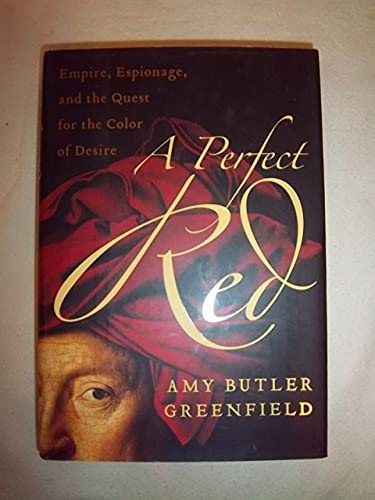
A Perfect Red recounts the colorful history of cochineal, a legendary red dye that was once one of the world's most precious commodities. Treasured by the ancient Mexicans, cochineal was sold in the great Aztec marketplaces, where it attracted the attention of the Spanish conquistadors in 1519. Shipped to Europe, the dye created a sensation, producing the brightest, strongest red the world had ever seen. Soon Spain's cochineal monopoly was worth a fortune.
Desperate to find their own sources of the elusive dye, the English, French, Dutch, and other Europeans tried to crack the enigma of cochineal. Did it come from a worm, a berry, a seed? Could it be stolen from Mexico and transplanted to their own colonies? Pirates, explorers, alchemists, scientists, and spies -- all joined the chase for cochineal, a chase that lasted more than three centuries. A Perfect Red tells their stories -- true-life tales of mystery, empire, and adventure, in pursuit of the most desirable color on earth.
A Perfect Red
Empire, Espionage, and the Quest for the Color of DesireBy Greenfield, Amy ButlerHarperCollins Publishers
ISBN: 0060522755Chapter One
The Dryer's Lot
Forty miles west of Florence, in a fertile Tuscan valley not far from the Mediterranean Sea, lies the serene and sunlit city of Lucca. Known throughout the region for its trade in olive oil, flour, and wine, modern-day Lucca is not much more than a provincial market town, but its great piazzas,Romanesque churches, and medieval towers bear mute witness to amore illustrious past. Eight hundred years ago, Lucca was a powerto be reckoned with: its luminous silks, dyed in jewel-like tones,were one of the wonders of the thirteenth century. No one on theContinent could equal them, though many tried. Sold only byEurope's most exclusive merchants, Lucchese silks includedsmooth taffetas, intricate damasks, and elaborate brocades figuredwith fleur-de-lis, griffins, dragons, peacocks, and even entire huntingscenes. All were fabrics fit for noblemen, princes, and kings.
Advantageously situated on a major road between Rome andnorthern Europe, Lucca enjoyed peace and prosperity for manyyears. Like most Tuscan towns, however, it had its share of long-standing family feuds. These quarrels blazed into open warfare in1300, intertwining with a larger struggle that was raging throughoutmuch of Tuscany, forcing many people, including the poetDante, to flee the region. A rich prize in a troubled land, Luccafound itself under frequent attack from both without and within.The violence culminated in 1314, when a band of Lucchese exilesjoined a Pisan army and sacked the city, robbing, raping, and murderingtheir enemies.
Fearing for their lives, many of Lucca's dyers and silk workersfled to Venice, a neutral city a hundred miles away. The Councilof Venice offered the refugees generous loans, but to no one's surprisethere was a catch to the deal; the Venetians, after all, hadn'tcreated an empire out of their swampy archipelago by giving theirmoney away. Eager to learn the secrets of Lucchese silks, theyrequired the refugees to repay the loans, not in cash but inLucchese goods and tools.
Destitute, many refugees accepted these terms. In doing so,however, they betrayed their city and put their own lives in peril.They would spend the rest of their days with a bounty on theirheads, because Lucca's guild laws prescribed death for anyLucchese practicing the silk trade outside the city. According tostatute, the men were to be strangled, the women burned.
Lucca's draconian guild laws were a sign of the times, for textileswere a matter of life and death in Renaissance Europe. Inmany ways, they were to the Renaissance what computing andbiotech are to our own time: a high-stakes industry rife withintense rivalries and cutthroat competition -- an industry with thepower to transform society.
With textiles, the transformation began in medieval timesand accelerated after 1350. Aristocrats who survived the BlackDeath had inheritances to spend, and rising merchants andlawyers were eager to ape their fashionable ways. As each tried tooutdo the other, they insisted on wardrobes far larger and fancierthan their grandparents had known; their houses, too, were more extravagantly furnished. People of lesser station were also buyingcloth at market stalls and clothier's shops -- and buying more of itas the decades wore on. Bolt by bolt, their purchases helped fuelthe rise of Europe.
Like the spice trade, the textile industry created new marketsand trade networks, but its importance did not end there. Spiceswere usually grown and processed in the Far East, but textileswere something Europeans could produce for themselves, and forthis reason their impact on Europe was more profound. Textilesspurred the invention of new technologies -- new types of spinningmachines, new methods for bleaching -- and shaped thevery pattern of work itself.
By the fifteenth century, hundreds of thousands of Europeans,from humble shepherds to great merchants, made a living from textiles,and many a nobleman depended on the wealth they created.Because each step in the cloth-making process was handled by differentcraftsmen, more than a dozen people could be involved infashioning a single piece of fabric. The silk workers of Lucca, forexample, included in their ranks a host of specialized workers: reelersto unwrap the cocoons, throwers to twist the thread, boilers toclean it, dyers to color it, and warpers and weavers to turn thethread into cloth.
Wool, the most common fiber in Europe, required evenmore specialization. After shepherds raised the sheep and shearersfleeced them, washers cleaned the raw wool and carderspulled the fibers apart with bristles. Spinners spun those fibersinto yarn with distaffs and spindles and passed the yarn to theweavers, who wove it into cloth. Wool cloth then had to be "finished,"a process that involved fullers or "walkers" who washedthe fabric in troughs of water treated with fuller's earth, a mineralcompound that promoted absorption. (Many walkers trampledthe mixture into the cloth with their bare feet, but prosperousfullers kept their boots on and used a millwheel and hammersinstead.) The soaking-wet cloth was then hung out on wooden frames called tenters; tenterhooks held the fabric fast andstretched it to the right dimensions as it dried. While still damp,the cloth could be brushed and sheared several times for a finer,softer nap. The fabric was then handed to the dyers. Althoughdyers usually worked with finished cloth, sometimes they treatedthe unspun wool instead, a costly practice that yielded the mostintense and enduring colors and gave us the expression "dyed inthe wool."
No matter what fiber was used, the textile industry requiredimmense amounts of skilled labor, which is why textiles were alifeline for many communities. A thriving cloth business meantjobs, and jobs meant coins in the purse and food on the table. Ifthe business faltered or failed, people went hungry and lost theirhomes ...
Continues...Excerpted from A Perfect Redby Greenfield, Amy Butler Excerpted by permission.
All rights reserved. No part of this excerpt may be reproduced or reprinted without permission in writing from the publisher.
Excerpts are provided by Dial-A-Book Inc. solely for the personal use of visitors to this web site.