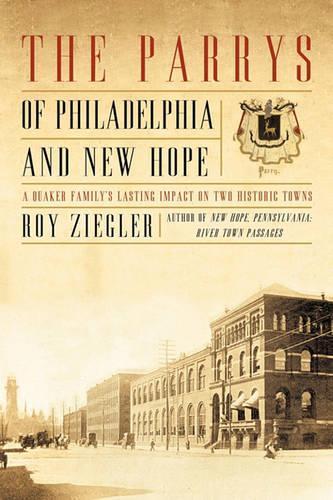
The Parrys of Philadelphia and New Hope
A Quaker Family's Lasting Impact on Two Historic TownsBy Roy ZiegleriUniverse, Inc.
Copyright © 2011 Roy Ziegler
All right reserved.ISBN: 978-1-4502-8579-7 Contents
List of Illustrations..................................................................................xiAcknowledgments........................................................................................xiiiIntroduction...........................................................................................xvChapter 1 The Parry Heritage..........................................................................1Chapter 2 Benjamin Parry, Father of New Hope..........................................................9Chapter 3 The Old York Road Connection................................................................41Chapter 4 Oliver Parry—Pioneer of Philadelphia's Spring Garden Neighborhood.....................53Chapter 5 The Parry Legacy............................................................................93Notes..................................................................................................107Index..................................................................................................113
Chapter One
The Parry Heritage
Hope, ambition, persistence, and dedication seem to have dominated the Parry family's genetic code. Those strong character traits had an impact on their societies and cultures for centuries. The Parrys boasted a long-standing, honorable lineage beginning in Caernarvonshire, North Wales, in the United Kingdom. The Parry family sprang from those early powerful tribes or clans that existed in North Wales in the twelfth century. Their ranks include magistrates, lieutenants of the county, and a sheriff. Thomas Parry was treasurer to Queen Elizabeth I of England. Lord Richard Parry was Bishop of St. Asaph in 1604. Sir Love P. J. Parry, a member of the British Parliament, was severely wounded and lost a leg at the epic Battle of Waterloo, and Sir Edward Parry was an important Arctic explorer.
The Parry coat of arms vividly depicted them as sportsmen and warriors in ancient times. The crest was a war charger's head with a stag trippant—walking with its right leg raised—on a shield. That was a far cry from the peaceful Quakers who settled in Pennsylvania many centuries later to play their prominent roles in the early development of the two historic towns of Philadelphia and New Hope. The spark that kindled the Parry drive for sport and the battlefield early on in their history continued to drive the family's competitive quest for community leadership and industrial enterprise well into the twentieth century.
Caernarvonshire is located in the northwest corner of Wales and is one of the most beautiful and scenic places in the United Kingdom. It is a land of great castles, lofty headlands, and picturesque valleys along a surging sea. The English biographer Dr. Samuel Johnson once remarked that one of the castles in Wales could contain all of the castles he had seen in Scotland. The county was created in 1284 and was known as Caernarvonshire for nearly eight centuries until it was abolished in 1974 when it became part of the nonmetropolitan county of Gwynedd. Then in 1996 the former territory of Caernarvonshire was divided between the unitary authorities of Gwynedd and Conwy. Today it is known as Gwynedd.
Love Parry's son—Thomas Parry, born in 1680 in Caernarvonshire, North Wales—was the first generation of the Quaker family to settle in the United States. In 1700 he moved to a part of Philadelphia County that is now known as Upper Moreland Township in Montgomery County, Pennsylvania. Thomas Parry, the grandfather of Benjamin Parry, settled in the old Manor of Moreland, in the beautiful Huntingdon Valley. Indeed, the rolling green hills and sparkling waterways of Montgomery County must truly have given the Parry settlers a warm feeling of home when they arrived there more than three centuries ago.
The Parrys were Quakers who sought to leave England because of the increasingly apparent irreconcilable differences that had developed between them and their more traditional Englishmen. The Quakers were plain and simple people but were not tied to old customs. They would not seek religious advice from clergymen and refused to use secular titles. Their belief that God inspired them through direct communication with their inner spirit or light ran contrary to the submission to authority that the Anglican Church had demanded. Even though the Quakers were Christians and did not become members of the Church, they were required to pay taxes to the institution. It is little wonder why so many Quakers strove to leave England for the new land that promised freedom from the authority that they did not recognize and from which they were experiencing growing animosity and persecution. Even the prospect of becoming indentured servants, as many of them were for years until the cost of their transport to America was paid, did not deter them from their inexorable flight to freedom.
King Charles II gave William Penn, a Quaker, the authority to establish vast estates of land that were called "manors" in America as payment for a huge debt that the king had owed to Penn's deceased father. Of the six manors that Penn established, all but one of them were set aside for his family. The exception was the Manor of Moreland. The manor dates back to 1682 when William Penn deeded about ten thousand acres to Dr. Nicholas More for one shilling silver for every one hundred acres, annually, forever. Dr. More was president of the Free Society of Traders, an English land-trading organization, and later Penn appointed Dr. More to be the first chief justice of Pennsylvania.
The Manor of Moreland
After Dr. More's death in 1687, the land was divided and sold. The Manor of Moreland was located on a strip of land in Montgomery County, Pennsylvania, separated by the boundary of Philadelphia County. Visitors to that area are almost certain to be surprised to discover a gigantic, modern shopping complex that includes scores of shops and a Bloomingdale's department store. One can easily imagine the amazement of the members of Dr. More's old Society of Traders if they could see their land today.
Thomas Parry bought about three hundred acres of the Manor of Moreland. He quickly expanded a gristmill on the land in 1731 that Sampson Davis had originally established. It later became known as Morgan's Mill after the Parry family sold it to Benjamin Morgan. Later, William F. Morgan ran an ice mill there. Interestingly, the land had once been owned by James Cooper, grandfather of the legendary author James Fenimore Cooper, whose book The Last of the Mohicans is a classic in early American literature. Thomas Parry eventually owned about one thousand acres of land. Five hundred acres were located in nearby Upper Dublin Township. He sold that land in 1726 and deeded the remaining five hundred acres to his oldest son, Thomas.
Records indicate that a typical mill village called Morganville, consisting of the mill and about ten houses, sprang up around the intersection of Parry's Road (now Davisville Road) and Mill Road (now Terwood Road). In the late twentieth century, Davisville Road became a major four-lane traffic artery connecting Montgomery and Bucks Counties. Today, the location of Parry's old mill is a bustling intersection. The Parrys could never have imagined that, 250 years later, the Pennsylvania Turnpike would carry thousands of gas-powered vehicles at unheard-of speeds high above the road named for them. The modern, sprawling Upper Moreland High School is situated on the edge of what had been for many decades the property of the Parry family. Their mill was located about a half mile from the legendary Old York Road.
Unfortunately, the mill that Thomas Parry built and expanded in 1731 was demolished in the 1960s. The site is memorialized by a historic marker that the Upper Moreland Historical Association had placed on the southwest corner of Terwood and Davisville Roads, the location of the original mill. The mill appears on tax records in 1776 indicating that John Parry, Thomas's son, was the owner of 106 acres. A partial wooden drive gear from the mill has survived to the twenty-first century and is currently on display at the Upper Moreland Historical Association. The area had once been known as Round Meadow, but according to the Upper Moreland Historical Association, the name was lost when a cartographer, Reading Howell, while traveling in the vicinity, noticed a man planting willow trees. Howell designated the area on his map as Willow Grove, and the name was permanently established around 1792.
As Thomas Parry was establishing his family and business at the Manor of Moreland, a new community was forming just twenty miles east that would, two generations later, be dominated by his grandson Benjamin Parry, who would become known as the "father of New Hope." That town's history began when William Penn sold one thousand acres in what is now the borough of New Hope to Robert Heath, with the understanding that Heath would build a corn or flour mill that would become the center of a new town. Heath's son, Richard, fulfilled that promise, and the community now known as New Hope, Pennsylvania, was born. Ironically, neither Robert nor his son, Richard, ever settled in the community they had created. Both father and son continued to live in Bristol Township, Pennsylvania, some thirty miles south of New Hope.
By 1725, the original part of Old York Road that had opened around 1711 was under construction, albeit rough and primitive. It eventually linked Philadelphia to the town that Richard Heath had established. Old York Road was completed between Philadelphia and Wells Ferry (later New Hope) around 1737, and by 1764 it had become a major route between the city of Philadelphia and New York City. A young speculator, John Wells, purchased half of the one thousand acres that Penn had sold to Heath from Heath's heirs, and the town received its first name, "Wells Ferry," in 1715. Wells proceeded to open a ferry boat operation to carry travelers from the Philadelphia area across the Delaware River to continue their trip to New York.
Thomas Parry's son, John, owned and operated the mill at the Manor of Moreland at Round Meadow Run. John's young son, Benjamin Parry, most probably served his apprenticeship there. John Parry was a neighbor and close friend of Dr. Joseph Todd and his wife, Martha. Young Benjamin most probably spent his summers working in Todd's mill learning the business at an early age.
Dr. and Mrs. Todd moved from Montgomery County to Coryell's Ferry, formerly Wells Ferry, in Bucks County around 1767. Several years later, in 1771, they purchased sixteen acres of farmland in the mill tract and one of the largest gristmills, in what is now the center of the New Hope community. The mill had been constructed by Philip Atkinson in 1763. The purchase included water rights on the Delaware River. When the mill became unmanageable for the ailing Dr. Todd around 1782, John Parry sent Benjamin, then about twenty-five years old, to Coryell's Ferry to help manage it. Within a period of ten years, Benjamin and his brother, Thomas, had acquired the Todds' property and most of what was then known as Coryell's Ferry.
Benjamin Parry had arrived.
Chapter Two
Benjamin Parry, Father of New Hope
By the time that Benjamin Parry first set foot in what is now New Hope, Pennsylvania, around 1782 with his brothers, Thomas and Daniel, the gritty little town was already into its third generation and had been known by three different names. It was common in those times for towns to be named for the person who owned the major industry.
After Richard Heath's death in 1717, Thomas Canby and his Philadelphia partners purchased the old Heath Mill and nearly half of the town's one thousand acres. Canby was a strong-willed, active entrepreneur and a newly elected member of the Pennsylvania Assembly. He had been an early ferryman who operated Baker's Ferry that later in the nation's history would serve as the site of General George Washington's epic crossing of the Delaware River. The village, then known as McConkey's Ferry, is now Washington Crossing, Pennsylvania, and is located just seven miles south of New Hope. But with all of his drive and influence, Thomas Canby failed in his long and bitter struggle with John Wells to purchase the ferry site along the Delaware River in the town that is known today as New Hope.
John Wells, a carpenter from Lower Dublin Township, Pennsylvania, had purchased another large portion of the town's one thousand acres from the heirs of Richard Heath. In 1719 he obtained a license from the province of Pennsylvania to operate a ferry across the Delaware River and to establish the first inn. He became the first recorded person to hold rights to operate a ferry on the Pennsylvania side of the Delaware River, and the town of Wells Ferry was born.
Wells was prominent in the fight to have Old York Road in Philadelphia redirected from its original terminus at Reading's Ferry in what is now Center Bridge to its new destination at Wells Ferry. The horses that drew the heavily laden carriages no doubt had the winning argument, since the steep hills out of Reading's Ferry were taking their toll on the dependable but not indestructible animals. The change in the direction of Old York Road vastly advanced the development of Wells Ferry. The Ferry House, built by Wells in 1727, continues to host travelers and local residents today as the Logan Inn more than 275 years later. Wells also served as justice of the peace for ten years.
Wells befriended a young lad, William Kitchen, an unemployed and distraught weaver by trade, whom he had met along a roadside in his travels around Bucks County. Kitchen later married Wells's niece, Rebecca Norton. Kitchen became a very important part of Wells's business operations, and he and his young bride moved in with John Wells. Kitchen later purchased a parcel of land from his mentor along the Delaware River near the ferry operation, where he built his first home.
When the opportunity arose in 1748, Benjamin Canby, Thomas's son, wasted no time purchasing the ferry and the inn in addition to one hundred acres from John Wells, thereby avenging one of the few unsuccessful business ventures that his celebrated father had experienced. Canby also constructed one of the first iron forges in the area on a ten-acre lot that he had also purchased from Wells's family. Benjamin Canby operated the ferry in what became known as Canby's Ferry for the next twenty years until it was purchased by John Coryell and became known as Coryell's Ferry, Pennsylvania.
John Coryell was one of the most colorful figures in the town's early history. In the early 1700s his father, Emmanuel Coryell, perceived the growing value of the area now known as Lambertville, New Jersey, located directly across the Delaware River from the fledgling Wells Ferry. He purchased land along the old Indian trails leading from New York City to the Delaware River. There he developed his ferry operations between New Jersey and Pennsylvania. His town became known as Coryell's Ferry, New Jersey.
Emmanuel had a very short life and died before he was fifty years old. He left real estate totaling about 1,500 acres. John Coryell, with the help of his father's inheritance, eventually purchased the ferry operations that had originally been established by John Wells across the Delaware River in Pennsylvania.
In 1764, about twenty-two years before Benjamin Parry's arrival, New Hope, Pennsylvania, and Lambertville, New Jersey, both bore the name "Coryell's Ferry" and maintained that name for nearly forty years.
John Coryell was well regarded by most local residents and was a shrewd businessman. However, he was known to have kept slaves, contrary to the Quaker tradition that prevailed in the community. He was a true patriot and strong supporter of General George Washington. Coryell responded to the growing demand for transportation across the Delaware River to New Jersey. He built the largest ferryboat known in the region to accommodate the increased traffic emanating from Lancaster County in the western part of Pennsylvania. Edwin Tunis writes that the boat was sixty feet long to enable it to carry the Conestoga wagons that had been built by the German farmers from the Lancaster County region. The huge wagons with their teams of six horses could be loaded directly onto the ferryboat for the crossing. Eventually in February 1788, John Beaumont purchased seventy-two acres of his land, including his buildings, ferries, and landing, in a sheriff sale.
Benjamin Parry Begins His Career in New Hope
Dr. Joseph Todd died in 1776, leaving his widow and two young sons to oversee the management of their properties. Benjamin Parry and his older brother Thomas, who had been assisting the Todds in the operation of their mills, did not hesitate to seize the opportunity when the widow Todd decided to sell the property. The agreement to sell to the Parrys was executed in 1785. As with most transactions in that time period, the deed to the property was transferred years later in 1789. In that same year, John Parry, the father of Benjamin and Thomas, passed away. It seems probable that his sons were able to purchase the property at least in part from their inheritance.
Benjamin Parry, a promising twenty-eight-year-old entrepreneur with financial backing from an inheritance from his late father and with the help of his brothers, saw a small, gritty town that had all of the characteristics of what today's economists would call "green shoots" ready for development. There was a tavern, the center of the transportation hub, which served as a kind of town center where folks caught up on the local gossip and news. The gristmill produced flour from grain that was grown by the area's farmers. The ferry crossing, although busy, had not yet reached its great potential. Coryell's Ferry was also a popular layover location for the Durham boats carrying iron from the nearby Durham furnace to the towns along the Delaware River. Local farmers brought their produce and farm animals there to be loaded onto Durham boats for shipping downriver to the city of Philadelphia.
The general store provided basic dry goods and food for the small population. The salt store supplied the all-important preservative for food supplies. The sawmill was beginning to increase its production of lumber for the growing community, and a rolling and slitting mill flattened and stretched iron bars, cut them, and produced long nail rods. This production created jobs for local blacksmiths who would make nails by cutting the rods, pointing them, and finishing the job by beating the top of the nails creating large heads.
All these activities were centrally located and surrounded by many hundreds of acres of rich farmland that produced nearly twice as much grain per acre as the soil in the farmers' estranged homeland had yielded. Indeed, Parry family records note that Benjamin owned several farms himself; one was located on twenty-two acres on Goat Hill in Lambertville, New Jersey, just below the Ely family's property.
(Continues...)
Excerpted from The Parrys of Philadelphia and New Hopeby Roy Ziegler Copyright © 2011 by Roy Ziegler. Excerpted by permission of iUniverse, Inc.. All rights reserved. No part of this excerpt may be reproduced or reprinted without permission in writing from the publisher.
Excerpts are provided by Dial-A-Book Inc. solely for the personal use of visitors to this web site.