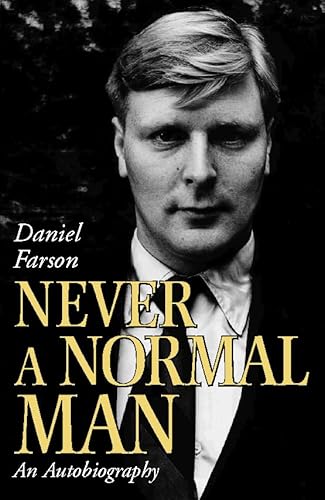
The son of an English mother and an American father, the foreign correspondent, big game hunter and alcoholic Negley Farson, Daniel Farson became the youngest-ever Parliamentary and Lobby correspondent at the age of 17, just after the war. At Cambridge his student magazine helped launch Ken Tynan. His first job was as a staff photographer for "Picture Post". Discovering homosexuality, he grew up again in Soho, joined the Merchant Navy and then ITV at the beginning of its career. He moved to Limehouse, developed "The Waterman's Arms" as a pub on the Isle of Dogs, wrote books on Jack the Ripper and his great-uncle Bram Stoker, moved to Devon, met Henry Williamson and Jeremy Thorpe, worked with Joan Littlewood, wrote a biography of Francis Bacon and travelled in Turkey and the Caucasus.
'Never a Normal Man' is the picaresque, candid and richly anecdotal autobiography of Daniel Farson, pioneering television reporter and interviewer, photographer, writer, biographer and art critic, not to mention a legendary bohemian, pub-owner and exotic traveller.
Discovering, in the 1950s, the joys of alcohol and homosexuality, he found a spiritual home in Soho, where his friends included Francis Bacon (whose biography he later wrote), Caitlin Thomas, John Deakin and many others. After a period in the Merchant Navy he was employed by the fledgling ITV, and soon found himself a nationally famous television personality. He later developed an ‘entertainment’ pub on the Isle of Dogs, wrote books on Jack the Ripper and his own great-uncle Bram Stoker, and eventually moved to Devon.
“An extraordinary career, an intriguing and eventful life, and a well-written and enthralling book.”
HARRY RITCHIE, 'Financial Times'
“He never fails to be intoxicatingly good company ... insightful, funny, hugely enjoyable. How Chekhov would have loved him.”
PETER LEWIS, 'Daily Mail'
“There are brilliant evocations of the famous, the infamous and the obscure, everything from thumbnail sketches to full-length portraits...a fine, courageous book.”
GEORGE MELLY, 'Daily Telegraph'
“Likely to become the classic chronicle of post-war bohemian life.”
PENNY WARK, 'Sunday Times'