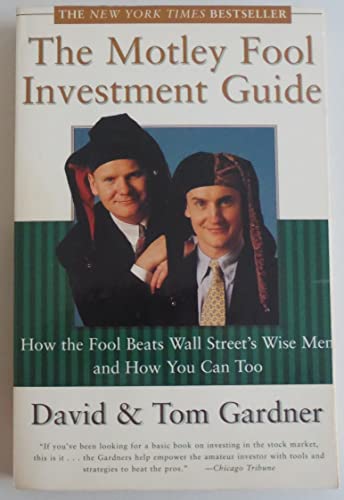
An entertaining guide to making money argues that not taking risks is the biggest danger to a potential investor's future and outlines a simple but effective strategy for investment success. Reprint. 100,000 first printing. Tour.
The Motley Fool Investment Guide
By David GardnerSimon & Schuster
Copyright © 1997 David Gardner
All right reserved.ISBN: 0684827034Chapter One: "Fool"?
· · · · ·
Take heed...The wise may be instructed by a fool...
You know how by the advice and counsel and prediction
of fools, many kings, princes, states, and commonwealths
have been preserved, several battles gained, and divers
doubts of a most perplexed intricacy resolved.
-- Rabelais Fool?
Not a very wise choice for a name when you're trying to ply your trade in the investment world. For decades financial professionals have done their best to sell customers on their Wisdom. Whether it's the pinstripe suit, the avuncular smile, the firm handshake, or the advertising jingle ("Rock Solid, Market Wise" comes to mind), your typical broker, money manager, or financial planner has striven for an image that smacks of success, intelligence, experience, respectability -- in a word, Wisdom.
And for years they've all been making a fair amount of money off fools. You know about fools. You may even have been one yourself at some point. Ever listened to a salesman on the other end of a phone long enough that the voice-activated vacuum cleaner he was trying to sell you began to make sense? You were being foolish. Ever bought a stock on your dentist's recommendation without even looking to see if it was listed? How very foolish of you. Or what about when you snapped up shares of International Dashed Hopes Load Fund just because your broker said it was the top performer in its category last year? Terribly, terribly foolish.
Basking in the excesses brought about by this folly, the financial establishment hadn't banked on one thing -- that one day the tables might turn when some Fools (and that's a capital F, maestro) actually showed up.
The Wise would have you believe that "a Fool and his money are soon parted." But in a world where more than 80 percent of all professional mutual fund managers lose to the market averages, year in and year out, how Wise should one aspire to be? In what other realms could such a compelling paradox exist, that the paid professional can do no better than -- in fact, cannot even do as well as -- dumb luck? And this general ineptitude has been made more ironic by the appurtenances that typically attend the Wise: expensive suits and gold cuff links (to impress their clients), Swiss watches (to convey the importance of their time), mahogany desks (to rest at between rounds of golf), and other similar displays designed to impress and intimidate their customers. Ah, the many-splendored totems of those who were paid too much to make too little.
In fact, we got to thinking after a while that we should just go ahead and call ourselves Fools, since our attitudes and approach to life were so radically different from what was being passed off as Wisdom all around us. So we launched our original Motley Fool, taking the name from a nondescript quotation from Shakespeare's As You Like It: "A fool, a fool! I met a fool i' the forest, a motley fool." We'd always loved Shakespeare's Fools...they amused as they instructed, and were the only members of society who could tell the truth to the king or queen without having their heads lopped off. The Motley Fool began as a monthly newsletter, then transformed into a daily feature on a national online service, then became one of the premier financial destinations on the World Wide Web. And among other things, of course, it is also a series of books (of which this is the second, following The Motley Fool You Have More Than You Think), all containing as much Foolishness as we can pack into them.
Our goal was and is very simple: Beat the market and show others how to do it -- the more novice, the better. In our brief Foolish history, we've enabled thousands of average people who didn't previously know a dividend from a divining rod to invest their own money without the help of Armani suits, and crush Wall Street at its own game.
Our approach is best characterized by its hostility to conventional wisdom. For example, the Wise will tell you just to invest your money in loaded mutual funds. (This "double dip" enables them to charge you for that advice and then charge you on an annual basis for the funds' management fees.) We, on the other hand, are telling you to buy stocks. They'll tell you, "All right, take on the risk of buying stocks. But if you're going to do that, just buy the safest ones and hold on." Or alternatively, some brokers will try to sell you a variety of rinky-dink shares of penny stocks, dubious entities with an even more dubious likelihood of ever paying off. We say poppycock, in both cases. We're telling you to sprinkle some more volatile growth stocks in with your blue-chips to improve your returns. And avoid penny stocks altogether! We're also educating you -- horror of horrors -- about shorting stocks, a devilishly fun attempt to profit off the decline of a stock, rather than its rise. To the Wise, there is no more risky, bad-faith investment decision than shorting stocks. To us, if you're an advanced investor for whom the stock market is more than a passing fancy, we believe you should at least consider the potential advantages of shorting. And the outrageous list goes on. It is topped off by the very idea that you would even manage your own money yourself. To many segments of the financial services industry today, and portions of the press, this idea remains well-nigh taboo.
In what follows, we therefore hope to teach you, to amuse you, and ultimately to make you good money at the same time.
But first we should introduce ourselves.
Who We Are, by Way of Explaining
What This Book Ain't Going to Do We're David and Tom Gardner, brothers, and the original editors of The Motley Fool. We hope that you have already gotten to know us through our first book in The Motley Fool trilogy, The Motley Fool You Have More Than You Think, but in case you haven't, let's mention again how we started. Yep, we originally began investing simply because, upon turning eighteen, we took over stock portfolios that our parents had started for us at our birth.
It takes some casual investors a lifetime to wean themselves off the numbing teat of mutual funds; we never knew the temptation. Our very first purchase was shares in a trucker called Leaseway Transportation (since acquired by a larger company). One hot summer we watched it go from $26 to $42, where we took our profit. The stock had been culled, using a few elementary measures, from the pages of Value Line, that redoubtable seven-inch-thick investment research monstrosity that we rarely use anymore because online resources are so much more powerful and timely. We cannot remember the exact rationale for the purchase of Leaseway, so it can't be listed among our most inspired investments. There is an enduring lesson here, however. If you're willing to take a risk and you're open to continuous learning about the world around you, you can succeed wonderfully in the stock market without paying the Wise for the privilege.
In this book we're going to break down into their primary components the reams of writing that we offer on a daily basis in cyberspace. The idea, as the Man says, is not just to hand you a Twinkie...rather, we're going to teach you how to locate your own Twinkies, so that you'll learn to feed yourself for years and years...prior to dying of a massive heart attack.
We want to help you help yourself make money. This was our intention back in 1993, when we launched The Motley Fool as an investment newsletter. Ye Olde Printed Foole -- as we fondly refer to it -- contained our stock picks, one monthly investment article, and a patchwork quilt of content in keeping with our motley interests. We mailed out unsolicited copies to a few thousand unsuspecting people and wound up our first month with exactly thirty-eight subscribers. Did the world care this little about getting educated about the stock market? We were depressed.
What we needed was visibility. So we decided to start a conversation about stocks on what at that point was a small but fast-growing national online service -- America Online.
Through the power and beauty of el cheapo modems, we connected to America Online over local phone lines and started typing. We offered our investment opinions and advice in response to requests from complete strangers, doing our best to provide them with as much information about their own holdings as they could handle. In so doing, we discovered some wonderful things (like how many people were willing to volunteer their own investment research for the benefit of many) and some bad things too (see Appendix D, "Zeigletics"). But what we mainly did was acquire new subscribers. Within a few months, our little gabfest had grown into the most popular financial discussion on America Online. The company approached us about opening up an actual business on its service, where we could get paid for doing interactively, on a daily basis, many of the same things we were doing just once a month, noninteractively, with Ye Olde Printed Foole. Even better.
Throwing away printing and mailing costs forever, we went into the electronic-publishing business.
By December, the word had started to get around, helped by a brief feature in the New Yorker. Soon we were AOL's most frequented service in Personal Finance. Why? Well, it didn't hurt that our Fool Portfolio, a real-money portfolio invested exclusively in stocks (now known as the Rule Breaker Portfolio), rose 11 percent in our first few months online, while the Standard & Poor's 500 (the index used most frequently to track money managers, also known as the S&P 500) stood flat. We closed out our first year up 59 percent, almost 40 percentage points ahead of the market. Lots of people were signing into our area to find out what was up.
What was up was that our stock-picking technique, founded in community involvement, was working. The better it worked, the more Fools came to the forum. And generally, that itself led to better performance. Today, a few million customers visit Fool.com to talk, share information, plan retirement, get out of debt, and discover new opportunities. Fools are helping Fools (and themselves) make money.
Copyright © 2000 by Simon & Schuster
Continues...
Excerpted from The Motley Fool Investment Guideby David Gardner Copyright © 1997 by David Gardner. Excerpted by permission.
All rights reserved. No part of this excerpt may be reproduced or reprinted without permission in writing from the publisher.
Excerpts are provided by Dial-A-Book Inc. solely for the personal use of visitors to this web site.