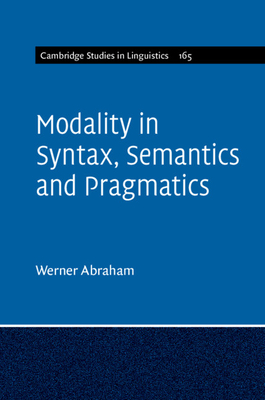

Modality in Syntax, Semantics and Pragmatics (Paperback or Softback)
Abraham, Werner
ISBN 10: 1107605504 ISBN 13: 9781107605503
Published by Cambridge University Press 4/6/2023, 2023
New
Paperback or Softback
From
BargainBookStores, Grand Rapids, MI, U.S.A.
Seller rating 5 out of 5 stars

AbeBooks Seller since 23 January 2002
This specific item is no longer available.
About this Item
Description:
Modality in Syntax, Semantics and Pragmatics. Seller Inventory # BBS-9781107605503
Synopsis:
What do we mean when we say things like 'If only we knew what he was up to!' Clearly this is more than just a message, or a question to our addressee. We are expressing simultaneously that we don't know, and also that we wish to know. Several modes of encoding contribute to such modalities of expression: word order, subordinating subjunctions, sentences that are subordinated but nevertheless occur autonomously, and attitudinal discourse adverbs which, far beyond lexical adverbials of modality, allow the speaker and the listener to presuppose full agreement, partial agreement under presupposed conditions, or negotiation of common ground. This state of the art survey proposes a new model of modality, drawing on data from a variety of Germanic and Slavic languages to find out what is cross-linguistically universal about modality, and to argue that it is a constitutive part of human cognition.
About the Author: Werner Abraham is Professor Emeritus in Linguistics and Mediaeval Studies at the Rijksuniversiteit Groningen, The Netherlands, Honorary Professor at the Universität Wien, and is still active at the Ludwig Maximilan University of Munich, Germany. He is author of more than 350 articles, 5 monographs, and 35 book collections.
"About this title" may belong to another edition of this title.
Bibliographic Details
Title: Modality in Syntax, Semantics and Pragmatics...
Publisher: Cambridge University Press 4/6/2023
Publication Date: 2023
Binding: Paperback or Softback
Condition: New
Book Type: Book
Top Search Results from the AbeBooks Marketplace

Stock Image
Modality in Syntax, Semantics and Pragmatics
Published by
Cambridge University Press, 2023
ISBN 10: 1107605504
ISBN 13: 9781107605503
New
Paperback
Seller: Revaluation Books, Exeter, United Kingdom
Seller rating 5 out of 5 stars
Paperback. Condition: Brand New. 454 pages. 9.00x6.00x0.92 inches. In Stock. This item is printed on demand. Seller Inventory # __1107605504
Buy New
£ 27.67
£ 12.50 shipping
Ships from United Kingdom to U.S.A.
Ships from United Kingdom to U.S.A.
Quantity: 1 available
Stock Image
Modality in Syntax, Semantics and Pragmatics
Published by
Cambridge University Press, 2023
ISBN 10: 1107605504
ISBN 13: 9781107605503
New
Softcover
Seller: GreatBookPrices, Columbia, MD, U.S.A.
Seller rating 5 out of 5 stars
Condition: New. Seller Inventory # 45366814-n
Stock Image
Modality in Syntax, Semantics and Pragmatics
Published by
Cambridge University Press, 2023
ISBN 10: 1107605504
ISBN 13: 9781107605503
New
Softcover
Seller: GreatBookPricesUK, Woodford Green, United Kingdom
Seller rating 5 out of 5 stars
Condition: New. Seller Inventory # 45366814-n
Buy New
£ 28.90
£ 15 shipping
Ships from United Kingdom to U.S.A.
Ships from United Kingdom to U.S.A.
Quantity: Over 20 available
Stock Image
Modality in Syntax, Semantics and Pragmatics
Published by
Cambridge University Press, 2023
ISBN 10: 1107605504
ISBN 13: 9781107605503
New
Paperback / softback
Seller: THE SAINT BOOKSTORE, Southport, United Kingdom
Seller rating 5 out of 5 stars
Paperback / softback. Condition: New. This item is printed on demand. New copy - Usually dispatched within 5-9 working days 655. Seller Inventory # C9781107605503
Buy New
£ 28.91
£ 17.30 shipping
Ships from United Kingdom to U.S.A.
Ships from United Kingdom to U.S.A.
Quantity: Over 20 available
Stock Image
Modality in Syntax, Semantics and Pragmatics (Cambridge Studies in Linguistics, Series Number 165)
Published by
Cambridge University Press, 2023
ISBN 10: 1107605504
ISBN 13: 9781107605503
New
Softcover
Seller: California Books, Miami, FL, U.S.A.
Seller rating 5 out of 5 stars
Condition: New. Seller Inventory # I-9781107605503
Stock Image
Modality in Syntax, Semantics and Pragmatics
Published by
Cambridge University Press, 2023
ISBN 10: 1107605504
ISBN 13: 9781107605503
Used
Softcover
Seller: GreatBookPrices, Columbia, MD, U.S.A.
Seller rating 5 out of 5 stars
Condition: As New. Unread book in perfect condition. Seller Inventory # 45366814
Stock Image
Modality in Syntax, Semantics and Pragmatics
Published by
Cambridge University Press, 2023
ISBN 10: 1107605504
ISBN 13: 9781107605503
Used
Softcover
Seller: GreatBookPricesUK, Woodford Green, United Kingdom
Seller rating 5 out of 5 stars
Condition: As New. Unread book in perfect condition. Seller Inventory # 45366814
Buy Used
£ 32.52
£ 15 shipping
Ships from United Kingdom to U.S.A.
Ships from United Kingdom to U.S.A.
Quantity: Over 20 available
Seller Image
Modality in Syntax, Semantics and Pragmatics
Published by
Cambridge University Press, 2023
ISBN 10: 1107605504
ISBN 13: 9781107605503
New
Softcover
Seller: moluna, Greven, Germany
Seller rating 4 out of 5 stars

Condition: New. Dieser Artikel ist ein Print on Demand Artikel und wird nach Ihrer Bestellung fuer Sie gedruckt. Über den AutorWerner Abraham is Professor Emeritus in Linguistics and Mediaeval Studies at the Rijksuniversiteit Groningen, The Netherlands, Honorary Professor at the Universitaet Wien, and is still active at the Ludwig Maximilan Uni. Seller Inventory # 775598105
Buy New
£ 33.37
£ 42.92 shipping
Ships from Germany to U.S.A.
Ships from Germany to U.S.A.
Quantity: Over 20 available
Seller Image
Modality in Syntax, Semantics and Pragmatics (Paperback)
Published by
Cambridge University Press, Cambridge, 2023
ISBN 10: 1107605504
ISBN 13: 9781107605503
New
Paperback
Seller: CitiRetail, Stevenage, United Kingdom
Seller rating 5 out of 5 stars
Paperback. Condition: new. Paperback. What do we mean when we say things like 'If only we knew what he was up to!' Clearly this is more than just a message, or a question to our addressee. We are expressing simultaneously that we don't know, and also that we wish to know. Several modes of encoding contribute to such modalities of expression: word order, subordinating subjunctions, sentences that are subordinated but nevertheless occur autonomously, and attitudinal discourse adverbs which, far beyond lexical adverbials of modality, allow the speaker and the listener to presuppose full agreement, partial agreement under presupposed conditions, or negotiation of common ground. This state of the art survey proposes a new model of modality, drawing on data from a variety of Germanic and Slavic languages to find out what is cross-linguistically universal about modality, and to argue that it is a constitutive part of human cognition. A state-of-the-art survey exploring the linguistic questions of modality and mood. It will appeal to researchers and advanced students working in the fields of syntax, semantics and pragmatics, and the interfaces between them. This item is printed on demand. Shipping may be from our UK warehouse or from our Australian or US warehouses, depending on stock availability. Seller Inventory # 9781107605503
Buy New
£ 33.99
£ 37 shipping
Ships from United Kingdom to U.S.A.
Ships from United Kingdom to U.S.A.
Quantity: 1 available
Seller Image
Modality in Syntax, Semantics and Pragmatics (Paperback)
Published by
Cambridge University Press, Cambridge, 2023
ISBN 10: 1107605504
ISBN 13: 9781107605503
New
Paperback
Seller: Grand Eagle Retail, Bensenville, IL, U.S.A.
Seller rating 5 out of 5 stars
Paperback. Condition: new. Paperback. What do we mean when we say things like 'If only we knew what he was up to!' Clearly this is more than just a message, or a question to our addressee. We are expressing simultaneously that we don't know, and also that we wish to know. Several modes of encoding contribute to such modalities of expression: word order, subordinating subjunctions, sentences that are subordinated but nevertheless occur autonomously, and attitudinal discourse adverbs which, far beyond lexical adverbials of modality, allow the speaker and the listener to presuppose full agreement, partial agreement under presupposed conditions, or negotiation of common ground. This state of the art survey proposes a new model of modality, drawing on data from a variety of Germanic and Slavic languages to find out what is cross-linguistically universal about modality, and to argue that it is a constitutive part of human cognition. A state-of-the-art survey exploring the linguistic questions of modality and mood. It will appeal to researchers and advanced students working in the fields of syntax, semantics and pragmatics, and the interfaces between them. This item is printed on demand. Shipping may be from multiple locations in the US or from the UK, depending on stock availability. Seller Inventory # 9781107605503