
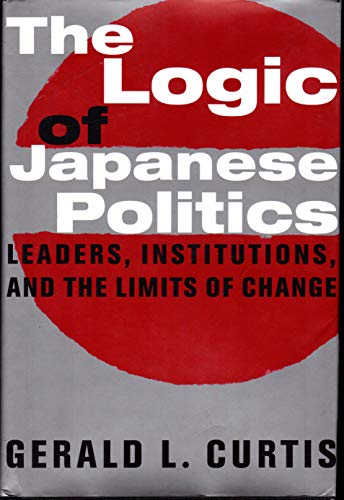
The Logic of Japanese Politics : Leaders, Institutions, and the Limits of Change
Curtis, Gerald
ISBN 10: 0231108427 ISBN 13: 9780231108423
Published by Columbia University Press, 1999
Used
Hardcover
From
Better World Books: West, Reno, NV, U.S.A.
Seller rating 5 out of 5 stars

AbeBooks Seller since 14 March 2016
This specific item is no longer available.
About this Item
Description:
Former library copy. Pages intact with minimal writing/highlighting. The binding may be loose and creased. Dust jackets/supplements are not included. Includes library markings. Stock photo provided. Product includes identifying sticker. Better World Books: Buy Books. Do Good. Seller Inventory # GRP16262388
Synopsis:
Widely recognized both in America and Japan for his insider knowledge and penetrating analyses of Japanese politics, Gerald Curtis is the political analyst best positioned to explore the complexities of the Japanese political scene today. Curtis has personally known most of the key players in Japanese politics for more than thirty years, and he draws on their candid comments to provide invaluable and graphic insights into the world of Japanese politics. By relating the behavior of Japanese political leaders to the institutions within which they must operate, Curtis makes sense out of what others have regarded as enigmatic or illogical. He utilizes his skills as a scholar and his knowledge of the inner workings of the Japanese political system to highlight the commonalities of Japanese and Western political practices while at the same time explaining what sets Japan apart. Curtis rejects the notion that cultural distinctiveness and consensus are the defining elements of Japan's political decision making, emphasizing instead the competition among and the profound influence of individuals operating within particular institutional contexts on the development of Japan's politics. The discussions featured here-as they survey both the detailed events and the broad structures shaping the mercurial Japanese political scene of the 1990s-draw on extensive conversations with virtually all of the decade's political leaders and focus on the interactions among specific politicians as they struggle for political power. The Logic of Japanese Politics covers such important political developments as * the Liberal Democratic Party's egress from power in 1993, after reigning for nearly four decades, and their crushing defeat in the "voters' revolt" of the 1998 upper-house election; * the formation of the 1993 seven party coalition government led by prime minister Morihiro Hosokawa and its collapse eight months later; * the historic electoral reform of 1994 which replaced the electoral system operative since the adoption of universal manhood suffrage in 1925; and * the decline of machine politics and the rise of the mutohaso-the floating, nonparty voter. Scrutinizing and interpreting a complex and changing political system, this multi-layered chronicle reveals the dynamics of democracy at work-Japanese-style. In the process, The Logic of Japanese Politics not only offers a fascinating picture of Japanese politics and politicians but also provides a framework for understanding Japan's attempts to surmount its present problems, and helps readers gain insight into Japan's future.
About the Author: Gerald L. Curtis is Burgess Professor of Political Science at Columbia University and the former director of the East Asian Institute. He is the author of The Japanese Way of Politics and Election Campaigning Japanese Style, both published by Columbia University Press.
"About this title" may belong to another edition of this title.
Bibliographic Details
Title: The Logic of Japanese Politics : Leaders, ...
Publisher: Columbia University Press
Publication Date: 1999
Binding: Hardcover
Condition: Good