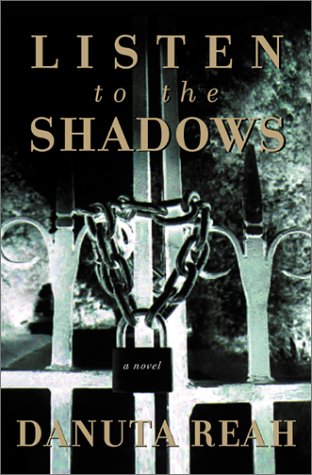
In the tradition of novels by Elizabeth George and Minette Walters, Listen to the Shadows is an edgy and atmospheric psychological thriller about a woman who becomes both the hunter and the target of a clever killer.
Underneath the shadow of an antique waterwheel in a city park, Suzanne Milner discovers the body of a young woman. The case is assigned to Detective Inspector Steve McCarthy, a tenacious cop who is determined to solve the crime. Suzanne is reluctantly pulled into the mystery of the young woman's life and death. Yet her understanding of events may be impaired by her struggle to overcome demons from her past. DI McCarthy's routine questioning of Suzanne leaves him with no clear answers, and as he tries to overcome her maddening evasions, he finds himself more and more drawn to her.
McCarthy's leads are taking him around blind corners to dead ends when another body is found in the same location and bearing an eerie resemblance to the first. Then the investigation kicks into high gear. What had seemed a crime with no leads and few connections reveals itself instead to be part of a twisted web of need and desire, in which Suzanne's best intentions could become her ultimate undoing.
Listen to the Shadows
By Danuta ReahWilliam Morrow & Company
Copyright © 2001 Danuta Reah
All right reserved.ISBN: 9780060199647Chapter One
It was dark now, the blackness pressing close, concealing the high roof spaces, the far corners, the heavy, shrouded shapes. Water ran behind the shuttered window, drip...drip...dripdripdrip...drip. The only light came from the glowing coals. Under the grate, the ashes whispered down onto the hearth. The warmth of the fire was fading, but even at its height, it hadn't pushed the shadows back far. The flagstones of the floor were damp, the timbers rotting and crumbling. The metal of the grate was rusty. But the metal in front of him was bright, its edge catching the firelight, imprisoning it in the brightness of the steel, turning it into a deep, glowing red. The voices in his head.
When?
Soon, Ashley, soon.
How soon?
Now.
"Take care if walking alone by allotments" -- the words were written in red felt-tip pen on a piece of lined notepaper. The paper was attached to the bottom of the notice at the entrance to the park, DOGS MUST BE ON A LEAD. The writing was unformed, the writing, perhaps, of a child. The paper gleamed white in the sun. It had rained in the night, but the paper wasn't wet or smeared. The rain had stopped about five in the morning. At six, on that particular day, the contractors took their cleaning truck through the park, emptied the bins, collected the litter, the broken glass.
A newspaper girl saw the paper as she cut through the park on the way to the next block of houses on her round. She stopped to read it, shrugged, went on her way.
It was still there when Suzanne passed shortly after ten. She had set herself the task of jogging through the two parks that formed a finger of green into the city, close to the street of redbrick terraced houses where she lived. There and back, it was probably about two miles, and yesterday, she had almost managed it without a break. Today, she would do it, and then look to extending her run farther through the woods. She reviewed her plan for the day as she ran. Thursday. A lot to do. It was her weekend to have Michael, a long weekend this time, and she wanted to have it carefully planned, filled with places to go and people to spend time with.
The notice caught her eye, and she stopped to read it.
Strange. What had happened to make someone put up a warning notice? She looked along the main path that ran on past the smooth grass and the carefully planted flower beds, narrowing and darkening as it disappeared into the shadows under the trees. About a year ago, a woman had been attacked in these woods. She looked around her. The park was deserted at this time in the morning, but the bright sun of early summer, the flowers and the fresh green of the new leaves made the woods look gentle and benign. Why the allotments? They were on the other side of the river.
She shouldn't have stopped. She was feeling tired now and she was cooling down. She could have gone on for ages if she hadn't stopped. Her eyes went back to the piece of paper, and she felt a touch of unease at the thought of the lonely path through the woods, so busy on the weekends when families followed the route to the old dam, so deserted during the week when the children were at school and their parents at work. Stop it!
She set off again at a brisk walk, watching the shadows as she passed out of the sun and under the trees. There was no wind, and the path was dappled and still. The park seemed empty. The early dog walkers had gone, and the later dog walkers weren't out yet.
The path forked. She could cross the river here and walk on the other side where the track was narrow and muddy. The Porter Brook ran through woods and parks now, but its banks, had one housed the small mills and workshops that harnessed the strength of the river to power the trip-hammers and grinding wheels of the nascent steel industry. You could still see the remains of the old works -- places where the river was diverted with goits -- artificial channels -- and weirs, the old dams that were abandoned, silted up, or turned into playgrounds. On weekends or holidays, people walked by the dams and fed the waterbirds that inhabited them now, or sailed model boats or fished.
Suzanne paused for a moment, then followed the path across the bridge, to the narrow track that ran by the allotments. She picked her way around puddles made where the mud had been churned up by the passage of mountain bikes. The path was still in the shadow of the trees, but the allotments were in full sun. She looked across at them. Some were carefully tended, neat rows of green, raked, weeded, staked; but most were neglected or abandoned, bushes and brambles and wild raspberries growing among and through old sheds and allotment huts. It was quiet. An elderly couple in jerseys and wellies were working on a patch near the stream, but the other allotments were empty. She could see a thin curl of smoke from a chimney protruding from the roof of a hut. She wondered if she should ask the couple about the notice. Take care...
She frowned, then realized that her walk had slowed almost to a standstill. She speeded up her pace and headed determinedly along the path. She began to alter her step to a jog again.
Jog six, walk six, jog six, walk six. It was peaceful in the park, away from the demands of work and home. She could let her mind roam in a loose, unfocused way, watching the patterns of light on the path, the way the water swirled and eddied around rocks and banks. It was like the library...
Continues...Excerpted from Listen to the Shadowsby Danuta Reah Copyright © 2001 by Danuta Reah. Excerpted by permission.
All rights reserved. No part of this excerpt may be reproduced or reprinted without permission in writing from the publisher.
Excerpts are provided by Dial-A-Book Inc. solely for the personal use of visitors to this web site.