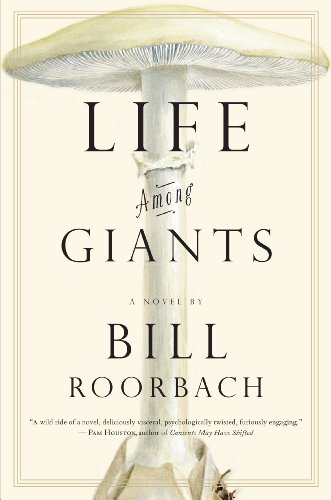
LIFE AMONG GIANTS
A NOVEL By Bill Roorbach ALGONQUIN BOOKS OF CHAPEL HILL
Copyright © 2012 Bill Roorbach
All right reserved.ISBN: 978-1-61620-076-3 Chapter One
I have a thing about last meals. Not as in prisoners about to be executed—they know it's going to be their last. But as in just about everyone else, most all of us. Whatever's coming, there's going to be that last thing we eat. My folks, for example. They did pretty well in the last-meal department, beautiful restaurant, family all around them, perfect sandwiches made by someone who truly cared about food. Lunch, as it happened. Their last meal, I mean. For my sister it was breakfast, but that was years later, and I'll get to all that. The point is, I like to eat every meal as if it were the last, as if I knew it were the last: savor every bite, be there with the food, make sure it's good, really worthy. And though it's an impossible proposition, I try to take life that way, too: every bite my last.
My father told me I could do what I set my mind to, though it hadn't been true for him. Mom told me not to expect everything to go my way, probably because of her own bad luck with Dad. She wasn't a mom to coddle you; she thought once you were ten you could make lunch for yourself. And we did, Katy and I, wild inventions, often edible. Dad ate what we offered, never a complaint.
He wasn't one of those fathers who did it all for a kid; he liked to stand back and watch, ready to give a standing ovation, but ready to withhold it, too. My mother was tough on Katy, pushed her toward tennis stardom. The same mom took no particular interest in my football career, hoped I'd pick up a more useful hobby, like gardening. And Mom and I spent hours in the borders around our modest house most Sunday mornings—the azaleas were our church. Who knew what Kate and Dad were up to? Always in cahoots, as my mother liked to say.
But Mom was Dad's one true love: Barbara Barton Hochmeyer, a real prize, her wedding photos like glamour shots, his only great success knocking her up to produce Katy, he wasn't shy to tell us, the very boy Mom's father dreaded: no-college Nicky H. She was a formidable woman, all right, tall and broad in the shoulders, a tennis star in her day, club champion to the end, always organized and scheduled and ready to go. Nick was slicker, looked for leeway, wasn't one for a plan. Words were their sharpest weapons, and they didn't need more than a few. She called him inept; he called her unloving. Kaboom! Their fights were like boxing matches—all the moves well practiced, weeks of workouts in preparation, strategies stored up, sucker punches in desperation.
Figurative punches, I mean.
He apologized elaborately after bouts of anger, after errors, after outlandish deceptions, foolish decisions, all of which were frequent. Mom wasn't one to apologize—Mom was always right—but quietly she'd wear a tight dress he loved, or bake him one of the oddball pies he liked: gooseberry, mincemeat, quince. And the two of them were constantly up to their bedroom, where they made way too much noise, lovers till the end.
Katy and I had a private world. The cellar was the crater made by the crash of our spaceship, the old stone stairs a rock-climb to the dangerous new planet above. The object was to make it to the attic, collect the magic cloak (a sable cape that had belonged to our grandma) and get back downstairs unnoticed by the natives, great fun during our parents' frequent parties: Mr. Coussens sniffing his way through Mom's underwear drawer, Mrs. Paumgartner slipping a porcelain bunny into her purse, the pockets of all those coats piled on the bed unsafe from our alien feelers: diaphragms, strange syringes, once even a revolver, pretty pearl handle, polished steel barrel, chambers fully loaded. My big sister and I passed it back and forth—surprisingly heavy.
On family trips back to Mom's lakeside Michigan from our corporate Connecticut, Kate and I were the backseat duo—barely a year apart—always some elaborate card trick or dance routine (no seat belts, not in those days). The motel rooms we shared inspired proto-sex games: Monster in the Dark, Cannibal, the Blob. But at Sleeping Bear Dunes National Seashore, summer of 1964, Katy stopped playing. Later in the week, as we sat bobbing bored on a raft, she said, "I've got hair." And pulled the crotch of her suit aside briefly to show me, frank kid.
She was even then a girl who harbored secrets, parceling them out on a need-to-know basis. She was a shoplifter in junior high, a Freon sniffer freshman year, a medicine-cabinet bandit after that, a dealer of hashish at times, small amounts in glassine envelopes she showed me the way she'd shown me her pubes: frankly, briefly, with the understanding it wasn't for me. Before long I was making pipes for her from every odd material in the house, gifts in adoration, though I never liked to smoke. Also—and this seems more important in hindsight—she had what she called "magnificent thoughts": sometimes she saw the world as if from high above. Looking off bridges she could feel her wings flex. Looking at the sea she grew fins. These big moods were balanced by weeks of darkness, bleak pronouncements, irritability, furtive movements.
Her most ironclad secret was boys. Tim Hayes was the only one I actually encountered, a kid I knew as the leather-jacket guy. Home early from freshman football one inclement afternoon I walked in on them, he naked, she fully clothed (still wearing her rain slicker, in fact), her face flushed dark. Arousal filled her pink bedroom as if with smoke, stung my eyes and caught in my throat as I made my escape: I'd been seen. Later, Katy pledged me to secrecy. "I made him strip." To what end, she didn't say.
My sister was what I knew about sex before I dated. In fact, she was what I knew about girls, period. Lady Kate sank into a kind of simmering monthly funk that I knew to be womanly in some way: she gave off actual heat, owned special items, left spots of blood on the bathroom tiles.
I came into the high school as into a foreign country, looked to Katy for guidance, but very little guidance was forthcoming. Where I wanted only to fit in, she was falling out. To all appearances we were a team, the clean-cut Hochmeyer kids, sharply dressed, serious students, successful athletes, sunny smiles, good deeds. And I believed in those things, felt them readily as our identity. But my sister clearly did not believe or feel the same.
Half the guys on the freshman football team had crushes on her, asked me how to proceed, asked me to put in a good word, asked me to set them up. Of course I didn't: what would Katy want with my jerky pals? She didn't really have boyfriends at all, not as far as I knew. Yet as soon as the pill became available, she was on it, a circular month's supply hidden among the dust balls under my dresser: Mom never searched my room for anything, ever.
And Kate's friends might have been a source of dates for me, but they were the tennis girls, a tight-knit crowd with muscular legs, deep tans, and lanky, bespectacled boyfriends from the local country clubs. Other wise, oddballs: she ate lunch with Giant Janine the goiter girl, who spat food and often burst into tears; she stood at the bus line with Mark O'Meara, the thalidomide boy, unafraid to grasp the tiny hands that grew from his shoulders; she idolized June Harrison, who played piano well despite the wheelchair, spent nights at her house. She courted drama, was enamored of difference.
She in her own heart was a freak, is my guess now.
Otherwise, why all the secrets?
In our nice stone house—three bedrooms, huge yard sloping to willow-wept water, one-car garage—we thought of ourselves as of modest means. Because across the pond, on what was called the High Side, there loomed an immutable example of what it was to be truly rich: a mansion the size of an embassy. In winter, you could see the far-flung wings of it across the ice and occasionally the movements of its tenant, the world-famous ballerina Sylphide (say it in the French manner: sill-feeeed, as many e's as you wish), whose even more famous husband, the English rocker Dabney Stryker-Stewart, had died on the Merritt Parkway (as everyone in the world knows), piling his Shelby GT Mustang at eighty-some miles per hour into the abutment of one of those handsome Depression-era WPA bridges. But the body wasn't with the car, didn't show up for two full days, found flopped by a muddy stream nearly half a mile from the accident scene. Had Dabney wandered dazed from the crash? Or was there foul play?
Despite months and then years and even decades of conjecture and investigation and conspiracy theory, answers were not forthcoming. The sorrow and disbelief (some say madness) on Sylphide's veil-shadowed face in the famous photo of her standing at his graveside in Newcastle, England—well, it still haunts me, haunts everyone, the closing visual bracket on an era that begins with John-John Kennedy saluting at the graveside of his dad.
There'd been another person at the High Side, too, Dabney's child from a previous marriage, just as famous as his father and step-mom: Linsey the Life magazine boy, visited for a photo shoot every year on his birthday, both physically and mentally deformed, as we would have said it then, anyway, profoundly challenged (fetal-alcohol syndrome is my diagnosis in hindsight—the abandoning birth mother was a lush and a leech, famously). He was sweet as a puppy, small and soft and helpless, those huge eyes, but with a weird sense of humor and sly smile, a secret nasty streak the rest of us delighted in. He'd been a vexed and cross-eyed fixture in my classes from kindergarten straight through, the richest kid in the public schools, mainstreamed before mainstreaming was even a concept, all because the private day schools in the area wouldn't have him, and his stepmother—the greatest ballerina in the history of the world—wouldn't allow him to be institutionalized. The superintendent of Westport schools was happy to oblige, as were Linsey's teachers: the boy wasn't charming, but you got to hobnob with the famous parents.
By the early sixties, Sylphide and Dabney had become the world's own royal couple, their courtship and subsequent wedding a glimmering fairy tale. He bought her various castles and mansions and retreats around the world, but the High Side became their home base. The permanent move to the U.S. from London came with her elevation in 1964 to principal of the New York City Ballet (George Balanchine her longtime mentor and devoted fan—"Her sweetness of thought," he famously wrote, "her sweetness of motion and lineament emerges from the very core of her soul, moves ever outward"—of course I'm working from Google for my quotations), and was followed by Dabney's megaplatinum album Dancer (the only album at the time other than Meet the Beatles to contain more than one number-one single, four in fact; I'm still always catching his melodies in waiting rooms and elevators). The beloved in all the songs was Sylphide, or so we thought, and that's her on the wildly controversial original album cover (the cover that got pulled after two weeks in favor of the safer and more familiar airplane image), that sleek, modest, achingly shy nymph fleeing naked into the forest with an almost taunting glance over her shoulder, blond hair streaming sweetly, misty golden light, her high, pretty fanny more plain lovable than erotic.
But then, I was just eleven.
My big sister was to become well acquainted with the dancer. By the time I finished junior year Kate had, in fact, babysat and tutored and contained Linsey for nearly four years. She'd been pledged to utmost discretion, became insufferable about her constant contact with fame. She was stingy with the free Swan Lake and Dabney Stewart-Stryker tickets and hoarded amusing or shocking inside stories (dinner parties attended by Mick Jagger or Julie Christie or Muhammad Ali, even the likes of Twiggy; Marlon Brando naked with three girls in the High Side pool, no one swimming). Katy's closets were filled with old Nehru jackets and worn-out guitar straps, her summers with exotic jaunts, three weeks here, four weeks there, various points in Europe or Africa, trips to famous Japanese and Brazilian and Australian cities during every school vacation and often during school, the lucky duck. The Prince and Princess needed her, and of course the puppy-eyed Princeling most of all.
One Wednesday evening in my senior year, Kate off at college, one especially wonderful Wednesday in the especially warm October of 1970, just as Mom and Dad and I were sitting down to an especially wonderful dinner (fishsticks and frozen French fries, plenty of ketchup, mounds of canned peas), several black cars pulled into our cul-de-sac and parked neatly along the curb. Two men from each car headed for our different doorways. We could see them coming every step of the way. If we'd been armed and dangerous, they'd have been toast. Dad was calm, simply let the main guys in the front door. "FBI," one of them announced. Another offered him sheaves of papers, which he didn't take. They let him gather a few things—toothbrush, fresh underwear—and then they took him away, multiple felonies connected to his work at Dolus Financial. (Yes, that Dolus Financial, the one that all these years later has collapsed under its own weight despite some 15 billion in federal cash.)
"Dad's had some trouble at work," Mom said when he was gone, no particular emotion. "Bail has been set very high."
Later I heard her cursing him out in her room. "Fucking asshole" was the exact phrase, repeated endlessly, Bar-Bar someone who never swore, except on the tennis court.
A few days later (October 30, 1970, to be exact), Dad's court-appointed lawyer—a portly sycophant named McBee—met us at the courtroom steps, gazed up at me.
"Ozymandias," he said darkly.
I knew what he was saying, more or less, knew my Shelley from Honors English. "It just means I hit my head a lot," I said.
"Seven feet?"
"Only six eight," I told him.
McBee wheezed, sighed, gave us our marching orders: "Okay, just as I discussed with your mom. You kids, you must look solemn. Pretend it's his funeral. Look one part pissed, two parts forgiving, like people who are going to put your old man on the straight and narrow. Got it?"
My sister put on a face—pissed forgiveness is hard to do—and of course kept putting it on, and soon I couldn't stop giggling. Kate wasn't laughing much in those days, kept the straightest face possible, which just made things the worse for me. Mom was plainly irritated with her, but said nothing, just as she'd said nothing about Katy's tennis clothes, which were hardly appropriate for the occasion. They hadn't seen each other since Katy had left home for her first year at "New Haven" (you weren't supposed to say the name of the school), and maybe Mom just couldn't admit that her daughter looked great.
Katy's new boyfriend was there, Jack Cross, who (shockingly enough) was her professor. He was a stoic guy with wild hair and posh court-day clothing, meeting Mom for the first time. Solicitous, he took the old lady's arm, shot Kate a look that froze her. And silenced me, too. Because, well, I'd met him before.
Plenty of secrets in our family.
Under the dome of the stately courthouse lobby (still not so grand as the High Side foyer), Mom brushed her hair and pinned it into a bun, made her face up in a tiny mirror, reclaimed her gorgeous poise. The courtroom itself was just plain, nothing but cinderblocks and workaday furniture, the judge at a table in shirtsleeves, not what I'd pictured.
Mom and Kate and I took seats in the front row. Jack sat in the row behind us. He was Dad's age, Mom's age, craggy as a sea cliff. My mother had asked if I thought he and Kate were sleeping together. Unlikely, I told her. Kate, who'd never even had a boyfriend? Sleeping with a professor? Easy lies. Because I knew more, a lot more. Kate basically lived at Jack's beautiful house, for example. And I'd visited them there. I'd liked him for not mentioning my height, a feat few could manage. He'd even loaned me a car to take home to our family. That was the kind of man he was, someone with extra cars. Dad had lost ours. The kind of man who lost them. For Mom's sake I'd said the loan was from Katy's roommate, true enough, as far as it went.
(Continues...)
Excerpted from LIFE AMONG GIANTS by Bill Roorbach Copyright © 2012 by Bill Roorbach. Excerpted by permission of ALGONQUIN BOOKS OF CHAPEL HILL. All rights reserved. No part of this excerpt may be reproduced or reprinted without permission in writing from the publisher.
Excerpts are provided by Dial-A-Book Inc. solely for the personal use of visitors to this web site.