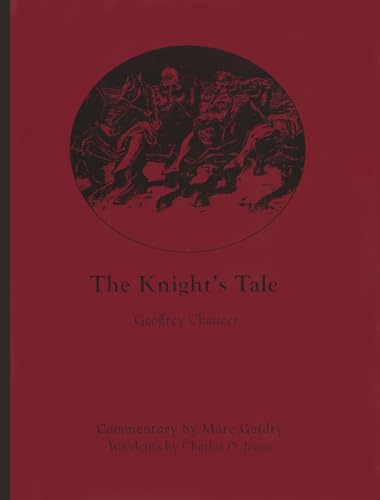
Chaucer's
Knight's Tale breaks boundaries. It uncovers the dark heart of chivalric idealism, injects the political seriousness of epic into the timeless summer of romance, insists on a pagan outlook within a Christian culture, and draws compassion for female suffering from a man's world. Along with the exquisite anonymous poem Sir Gawain and the Green Knight, the Knight's Tale is the most intricately structured and stylistically pleasing of medieval English romances. For these reasons, it is worthy of its own edition, but what makes it particularly suitable to an illustrated edition is how its narration works by condensing actions and their effects into powerful images and figures. The Knight's Tale has, in fact, been illustrated many times, but never so thoroughly as in the current edition. Moreover, past illustrations have tended to romanticize or sentimentalize the story, eschewing its most violent and disturbing images. The illustrations in this edition attempt to recapture Chaucer's mature vision of the noble life, which refuses to deny the tragic aspects of the chivalric equation of love with war and war with honor. Past illustrations have also tended to adopt a Gothic idiom. The illustrations in our edition adopt a Classical Greek idiom drawn from the Parthenon frieze, Attic black- and red-figure pottery, and ancient Greek sculpture - an idiom suitable to the setting of the tale in legendary Athens and Thebes as well as to Chaucer's humanist impusle.
The
If considering Theseus's prosecution of war as a civilizing force, one can point to the fact that he puts an end to Creon's "tirannye" (941), restoring the bodies of the desecrated dead to the Argive widows. However, if his objective in attacking Thebes is to avenge the widows on Creon, why does he destroy the city after he has already killed him and routed the Theban army, tearing down "wall, and sparre and rafter" (line 990)? The motive is hardly humanitarian, nor even strategic in the military sense since the Theban forces have already been defeated. Its only objective is pillage - to pay off the Athenian troops - and, of course, it is while ransacking the dead that they find Palamon and Arcite still alive among a pile of corpses, a detail unique to Chaucer's text. While such a practice was endemic to chivalric warfare, it was difficult to contain once started, and it would inevitably produce results inimical to Theseus's stated purpose for going to war against Thebes, which was to right a wrong done to a group of helpless women. As Maurice Keen writes, the trouble with the practice of looting-as-pay was that to pay off soldiers in this way
was not the same as to disband them. They had to be left at large, still armed with equipment that was their own, beyond control; and so whole provinces were subjected to the indiscriminate pillaging of soldiery that sought to claim a share in chivalry but whose manner of living was the antithesis of what chivalry stood for, the protection of the poor, the fatherless and the widow.
Knight's Tale poses the pivotal question about war: Is there such a thing as civilized warfare, as war fought for a just cause in a controlled manner as a means of restoring order to society, or do all wars inevitably lead to acts of savagery and excess that make a mockery of policy?35 Ancient Thebes is the story of a sustained, sordid, brutal, and self-indulgent lust for power and pleasure eventuating in spectacular violence - Cadmus and the dragon-tooth warriors, Oedipus's primal crimes against nature, Eteocles and Polynices' impiety and fratricidal warfare, Creon's desecration of his nephew's corpse and subsequent murder of his niece Antigone. The idea of a moderate use of force to serve the common good is alien to the Theban legend. Statius considers the possibility of a good war by inserting the Athenian warlord Theseus into the myth of Thebes. Theseus brings peace to Thebes and, in Statius's version of events, saves Antigone, but only after an unforgettable orgy of death has occurred. As discussed above, Chaucer returned to Statius's brooding treatment of the Theban material in order to foreground it. He rereads the Teseida through the lens of the Thebaid, turning it from a conventional love story into a philosophical reflection on the nature of love, war, and governance - both earthly and cosmic. Indeed, it becomes a kind of theodicy, asking why humans must suffer so much and whether there is a benevolent order that transcends the individual ills of human experience, providing an origin for temporal governance. In this vein, Chaucer presents the stadium Theseus builds to hold the tournament as a theatrum mundi, a microcosmic space in which Theseus will try to civilize the unruly dispute between Palamon and Arcite, itself symbolic of the dynastic rivalry between Polynices and Eteocles. 36 Ominously, there is nothing to stop Theseus's men from just such rapine, as he "dide with al the contree as hym leste" (line 1004).
For Chaucer, it seems it is not justice but fortune that decides the outcome of war. The eldest Argive widow reminds Theseus of the role of "Fortune" in war, and Chaucer returns to the idea of the uncertainty of military ventures in the temple of Mars murals, where an enthroned "Conquest" (line 2028) is depicted with the sharp sword of Damocles hanging over his head by the thinnest of threads. Perhaps Theseus learns this lesson, as he moves steadily away from militarism in Chaucer's narrative, changing the rules of the tournament to prevent mortal combat and ending the strife with Thebes through the diplomacy of the parliament. Yet, even in the mock battle of the tournament, death cannot be prevented, despite his best efforts. Is Chaucer suggesting that the prospect of limited warfare for some greater purpose (in this case the eventual pacification of Thebes) is human folly?
CHARLES D. JONES, Regents Professor of Art, is the director and master printer of the LaNana Creek Press at Stephen F. Austin State University in Nacogdoches, Texas and has taught printmaking since 1971. MARC GUIDRY received his PhD from Louisiana State University. He has published essays on Chaucer in
The Chaucer Review and
Medieval Rhetoric, a Routledge casebook.