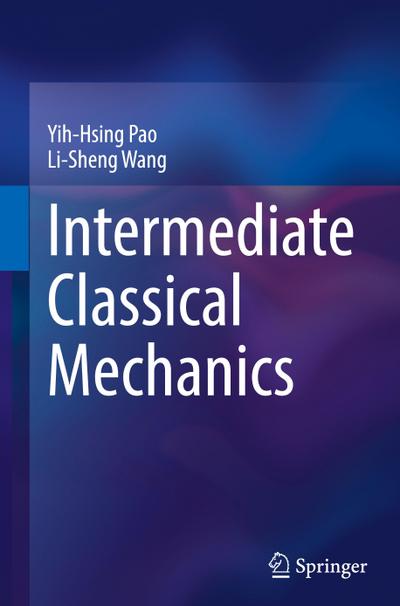
Intermediate Classical Mechanics
Li-Sheng Wang
Sold by AHA-BUCH GmbH, Einbeck, Germany
AbeBooks Seller since 14 August 2006
New - Hardcover
Condition: New
Ships from Germany to U.S.A.
Quantity: 1 available
Add to basketSold by AHA-BUCH GmbH, Einbeck, Germany
AbeBooks Seller since 14 August 2006
Condition: New
Quantity: 1 available
Add to basketDruck auf Anfrage Neuware - Printed after ordering - This book describes the basic concepts and principles of classical mechanics in the intermediate level. Given the perspective thatdifferent mechanical problems require an appropriate approach drawn from various methods or principles, a textbook discussingmultiplemethods or principles in mechanics is highly desirable.Additionally, a good textbook should include historicalcontexton the motivation and the development of the methods or principles, allowing students to gain insights that may help them discover new theories. However, after many years of teaching Dynamics in the graduate school, the authorswere unable tofind a suitableintermediate-level textbook on classical mechanics, whichmotivated them to begin writing this book.For theaforementioned reasons, this book includes the descriptions of various methods or principles in mechanics, such as the Newton-Euler Principle, the d'Alembert Principle, Lagrangian methods, Gauss's Principle of Least Constraint, the Gibbs-Appell equation, Jourdain's equation, the Principle of Virtual Power, the Appell-Kane method, the Hamilton Principle, and the Hamiltonian mechanics, among others. Moreover, many historical remarks on the motivation and the development of the methods or principles are given in this book, as well asnumerousapplications. The authors also believe that instudyingthe motion of a material body, different models may be used depending on the application. If the position of the body is of interest, a particle model may be chosen. If the orientation or attitude of the body is under consideration, a rigid body model should be adopted. If deformation is a concern, a model of deformable body should be applied.Consequently,a book in mechanics for engineers should encompassa variety ofmodels of the body, ranging from particles to continua such as solids or fluids.This book also meets that need.
Seller Inventory # 9789819791354
This book describes the basic concepts and principles of classical mechanics in the intermediate level. Given the perspective that different mechanical problems require an appropriate approach drawn from various methods or principles, a textbook discussing multiple methods or principles in mechanics is highly desirable. Additionally, a good textbook should include historical context on the motivation and the development of the methods or principles, allowing students to gain insights that may help them discover new theories. However, after many years of teaching Dynamics in the graduate school, the authors were unable to find a suitable intermediate-level textbook on classical mechanics, which motivated them to begin writing this book. For the aforementioned reasons, this book includes the descriptions of various methods or principles in mechanics, such as the Newton-Euler Principle, the d’Alembert Principle, Lagrangian methods, Gauss’s Principle of Least Constraint, the Gibbs-Appell equation, Jourdain’s equation, the Principle of Virtual Power, the Appell-Kane method, the Hamilton Principle, and the Hamiltonian mechanics, among others. Moreover, many historical remarks on the motivation and the development of the methods or principles are given in this book, as well as numerous applications. The authors also believe that in studying the motion of a material body, different models may be used depending on the application. If the position of the body is of interest, a particle model may be chosen. If the orientation or attitude of the body is under consideration, a rigid body model should be adopted. If deformation is a concern, a model of deformable body should be applied. Consequently, a book in mechanics for engineers should encompass a variety of models of the body, ranging from particles to continua such as solids or fluids. This book also meets that need.
Prof. Yih-Hsing Pao was born on Jan 1930 in China. He received the B.S. degree in Civil Engineering from the National Taiwan University, Taipei, Taiwan, in 1952, the M.S. degree in Mechanics from Rensselaer Polytechnic Institute, U.S.A. in 1955, and Ph.D. degree in Applied Mechanics from Columbia University, U.S.A. in 1959. In 1958, he joined the faculty group of Institute of Theoretical and Applied Mechanics (T&AM), College of Engineering, Cornell University, and became a Professor in 1968, and J.C. Ford Chair Professor of Theoretical and Applied Mechanics in 1984. He also served as the Chairman of T&AM from 1974 to 1980. He retired completely from Cornell University as J.C. Ford Chair Professor Emeritus in 2000. During his leave from Cornell University, he was appointed as the Director and Professor of the Institute of Applied Mechanics, National Taiwan University from 1984 to 1986, and from 1989 to 1994. In 1994, he resigned from the position of Director and served as Professor of Emeritus since 1998. In 2003, YH Pao was invited by Zhejiang University, China to be a professor of College of Civil Engineering and Architecture, a lifetime faculty position. Due to illness, he passed away in 2013. In resarch, he devoted himself to the area of Elastodynamics, Physical Acoustics, Electromagneto-Mechanics, Mechanical Vibrations, Civil Aviation Structure Dynamics, Rock and Soil Dynamics, Propagation in Elastic Solids, Non-Destructive Testing, Earthquake Engineering and Structural Dynamic, and so on. Prof. Pao was elected a member of U.S. National Academy of Engineering in 1985, the highest honor bestowed on an engineer by the U.S. government. In 1986, he was elected an Academician by the Academia Sinica (at Taipei), a lifetime honor for a Chinese scholar. In 1989, he received the senior U.S. Scientist Award from Humboldt Foundation, Germany, visiting T.H. Darmstadt. In 1995, he was awarded an Honorary Doctoral Degree by National Chiao-Tung University (Hsin-Chu, Taiwan). Because of contribution to the scientific research and education of Taiwan, he was one of three recipients of Presidential Science Prize of Taiwan in 2003. His 1977 paper “Generalized Ray Theory and Transient Responses of Layered Elastic Solids” was selected in 2000 by the International Union of Theoretical and Applied Mechanics (IUTAM) as one of the landmark papers in Mechanics of the 20th century.
Prof. Li-Sheng Wang was born in Taiwan in 1961. He received the B.S. degree in Electrical Engineering from the National Taiwan University, Taipei, Taiwan, in 1983, and the M.S. and the Ph.D. degrees in Electrical Engineering from the University of Maryland, College Park, U.S.A. in 1987 and 1990, respectively. From 1990 to 1991, he was a Research Associate with the Department of Mathematics, University of Maryland. Since 1991, he has been with the Institute of Applied Mechanics, National Taiwan University, where he is currently a Professor. In resarch, his major interests include classical mechanics, dynamics, control, and navigation. He is a senior member of the society of IEEE, and served as an Associate Editor for the IEEE Transactions on Automatic Control from 1998 to 1999.
"About this title" may belong to another edition of this title.
General Terms and Conditions and Customer Information / Privacy Policy
I. General Terms and Conditions
§ 1 Basic provisions
(1) The following terms and conditions apply to all contracts that you conclude with us as a provider (AHA-BUCH GmbH) via the Internet platforms AbeBooks and/or ZVAB. Unless otherwise agreed, the inclusion of any of your own terms and conditions used by you will be objected to
(2) A consumer within the meaning of the following regulations is any natural person who concludes...
**Right of withdrawal for consumers **
(A consumer is any natural person who concludes a legal transaction for purposes that can predominantly be attributed neither to their commercial nor their independent professional activity.)
Cancellation
Withdrawal
You have the right to revoke this contract within fourteen days without giving reasons.
The revocation period is fourteen days from the day,
on which you or a third party named by you, who is not the carrier, has taken possession of the goods, provided that you have ordered one or more goods within the framework of a uniform order and these are or will be delivered uniformly;
on which you or a third party named by you, who is not the carrier, has taken possession of the last goods, provided that you have ordered several goods within the framework of a single order and these are delivered separately;
on which you or a third party named by you, who is not the carrier, has taken possession of the last partial shipment or the last piece, provided that you have ordered goods that are delivered in several partial shipments or pieces;
In order to exercise your right of withdrawal, you must inform us (AHA-BUCH GmbH, Garlebsen 48, 37574 Einbeck, telephone number: 05563 9996039, fax number: 05563 9995974, e-mail address: service@aha-buch.de) of your decision to revoke this contract by means of a clear declaration (e.B. a letter sent by post, fax or e-mail). You can use the attached model withdrawal form, but this is not mandatory.
To comply with the revocation period, it is sufficient that you send the notification of the exercise of the right of revocation before the expiry of the revocation period.
Consequences of revocation
If you withdraw from this contract, we shall reimburse you all payments that we have received from you, including delivery costs (with the exception of the additional costs resulting from the fact that you have chosen a different type of delivery than the cheapest standard delivery offered by us), immediately and at the latest within fourteen days from the day on which we received the notification of your revocation of this contract.
For this repayment, we will use the same means of payment that you used for the original transaction, unless expressly agreed otherwise with you; in no case will you be charged any fees for this repayment.
We may withhold reimbursement until we have received the goods back or until you have provided proof that you have returned the goods, whichever is the earlier.
You must return or hand over the goods to us immediately and in any case at the latest within fourteen days from the day on which you inform us of the revocation of this contract. The deadline is met if you send the goods before the expiry of the period of fourteen days.
You bear the direct costs of returning the goods.
You only have to pay for any loss of value of the goods if this loss of value is due to handling of the goods that is not necessary to check the nature, characteristics and functioning of the goods.
Reasons for exclusion or extinction
The right of revocation does not apply to contracts
The right of revocation expires prematurely in the case of contracts
Sample withdrawal form
(If you want to cancel the contract, please fill out this form and send it back.)
To AHA-BUCH GmbH, Garlebsen 48, 37574 Einbeck, fax number: 05563 9995974, e-mail address: service@aha-buch.de :
I/we () hereby revoke the contract concluded by me/us () for the purchase of the following goods ()/
the provision of the following service ()
Ordered on ()/ received on ()
Name of the consumer(s)
Address of the consumer(s)
Signature of the consumer(s) (only in case of notification on paper)
Date
(*) Delete as appropriate.
We ship your order after we received them
for articles on hand latest 24 hours,
for articles with overnight supply latest 48 hours.
In case we need to order an article from our supplier our dispatch time depends on the reception date of the articles, but the articles will be shipped on the same day.
Our goal is to send the ordered articles in the fastest, but also most efficient and secure way to our customers.
| Order quantity | 30 to 40 business days | 7 to 14 business days |
|---|---|---|
| First item | £ 55.37 | £ 64.00 |
Delivery times are set by sellers and vary by carrier and location. Orders passing through Customs may face delays and buyers are responsible for any associated duties or fees. Sellers may contact you regarding additional charges to cover any increased costs to ship your items.