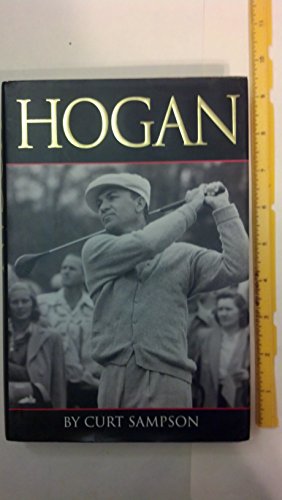
A biography of the legendary golf champion explores his private life, the source of his motivation, and his personal difficulties in later life
Hogan
By Curt SampsonRutledge Hill Press
Copyright © 1996 Curt Sampson
All right reserved.ISBN: 9781558533875CHAPTER 1
The two riders on the Deep Creek trail had the morning to themselves. Within the range of their attention nothing moved.
The vast sky arched blue and empty to the horizon. Before them the trail was a white, winding line across the face of the desert plain. On both sides of the trail the bunch-grass levels stretched far toward the blue hills, and in the bottoms along Deep Creek were grassy meadows and a scattering of willow and cottonwood.
Behind them, looming suddenly from the desert, was isolated Deep Creek Range, a fifty-square-mile group of mountains. Its lower slopes were naked rock or rock clad with the sparse, dry-land brush of the middle desert. Along the crests there appeared at intervals the darker tufts of pine tops.
Within the rough circle of Deep Creek Range lay the basin of the creek, a high plateau heavily timbered and slashed by the canyons and valleys of Deep and Cave creeks, carrying a fine stand of virgin timber. The high meadows were rich with grass, well watered and green; the inner slopes of the mountains, except for a few places where lightning-started fires had struck, were thickly clad with ponderosa pine and fir.
There was only one road through the Deep Creek Range, a long abandoned trail used by west-bound pioneers and later, briefly, by a stage line. No wagon had used that road in many years, only the riders of the B-Bar.
"New folks in town." Bill Coffin volunteered the information after three miles of silence and chill morning. "A good-lookin' blonde."
Clay Bell drew on his cigarette, found it dead, and after pinching it to be sure, tossed it into the desert. Here there was no danger of fire but the habit remained from forest living.
"A couple of lumberjacks," Coffin added. "And some city man . . . all duded up."
"You talk too much." Clay took out the makings and began to build a smoke. He glanced over at Coffin, fine lines of remembered laughter showing at the corners of his eyes. "What would lumberjacks be doing in Tinkersville?"
"Search me." Bill Coffin was a lean, strongly built young cowhand, a good man with a rope or horse. "What would a beautiful blonde do there?"
"You mean you didn't offer any suggestions?"
"No chance. Just seen her, then she was gone."
"Smart girl."
Tinkersville sprawled in ungainly, clapboarded charm on the flatland near the Creek. One street of false-fronted stores, and a half-dozen streets of dwellings, few of them painted, some of adobe. On the outskirts, near some ancient adobe ruins, three youngsters hunted Indians, and from the shouts of "bang-bang" they were having good hunting.
As the two riders neared the outskirts, a big man on a gray horse rode past them, his face stiff.
Coffin grinned at Bell. "Schwabe ain't forgot that whippin' you gave him. Looks mighty unhappy with you."
The street was lazy and sun-filled. A hen picked at an apple core in front of the general store. A dog lay sprawled in the dust, soaking up sun. Two men in high-heeled boots, hats tipped back, sat on the edge of the boardwalk, another leaned against the post of the ramada smoking a cigarette. He slanted his eyes at them and lifted a negligent hand in greeting.
Clay Bell regarded the street with pleasure. He was an easy-going man with the wide shoulders and lean hips of a desert rider, a man who looked cool, competent, and ready, yet one in whom behind the quiet of his eyes the humor lay close to the surface. He wore his gun with the same casual ease that he wore his hat or his shirt.
He knew the people in this town and he liked them. He had come here a stranger, now he was a part of something. It had been a long time before that since he had belonged anywhere or to anything.
A big man in a plaid wool shirt worn outside his pants came out of the Homestake. He wore "high-water" pants, rolled up halfway to his knees, and laced boots. It was the unfailing brand of the lumberjack.
Curiosity tinged with worry touched Bell . . . the only timber within miles of Tinkersville was on his own place, at Deep Creek.
A clatter of running hoofs sounded on the loose planks of the bridge at the far end of town, then the rattle of a buckboard. It rounded into the street and a couple of fine blacks brought it down toward the riders at a spanking trot.
The buckboard drew up sharply opposite them, its trailing dust cloud sifting over and around it, then settling into the like dust of Tinkersville's main street.
A big man in laced boots tossed the reins to his companion and sprang lightly from the buckboard. His dark, well-tailored suit and white, stiff-brimmed hat were in marked contrast to the nondescript range clothes of the men along the street.
There was hard, brusque confidence in the way he came toward them. His every action spoke of impatience and assurance. He had seen Clay Bell sitting his horse and had noted the B-Bar brand.
He lifted a hand. "You, there!"
Bill Coffin nudged Bell. "Look what's comin'," he said softly. "Wants to make talk."
The big man's smooth-shaven, white-skinned face was eastern, but Bell knew instinctively this man was no tenderfoot. Not, at least, in the usual acceptance of the term. Bell waited, his lean face offering nothing, his eyes measuring the man.
"Are you Bell?"
Several passers-by drifted to a halt and turned hopefully toward the loud voice. There was a challenge and tone in the voice that seemed to promise trouble, and the citizenry of Tinkersville were interested in trouble. Aside from vague talk of gold prospects, cattle prices, and the way somebody carried on at somebody else's dance, there was little to talk about.
Clay Bell let the man come up to his horse before he replied. Even then he held it a little, letting the man look up at him. "That's my name," he said.
He struck a match on the pommel and lifted it to his cigarette, cupping the match in his left hand. He did not move the right hand, which was a way he had. Old Sam Tinker had noticed that way, and knew what it meant. Bill Coffin had drawn his own conclusions.
Bell waited deliberately, not liking the stranger or his abrupt manner. He had crossed the street as if he owned it, addressed Bell as if he were a Digger Indian.
"You're the man who runs those B-Bar cattle up on Deep Creek?"
"I reckon." Clay studied the man calmly, noting the strong, almost brutal jaw, the powerfully boned face, and the taut white skin. There was no warmth in the eyes. They were impatient eyes, domineering.
"Well, get 'em out of there! I'm logging off that mountain and the flatland beyond it. Starting next week."
"My cattle like it there." Bell studied the end of his cigarette. "I'm not figuring on moving them as long as they are happy. As for logging off that piece, you aren't going to, now or any other time."
He spoke quietly, but with a cool confidence that irritated the big man. Clay Bell had his own brand of assurance, and he had won it along trails far from Tinkersville.
He sat his saddle now, liking the warmth of the morning sun after the chill of the early ride. He liked the town, the shabby red of the brick buildings, the two squat, powerful structures of gray stone, and the jerry-built stores, false-fronted and clapboarded that made up the rest of it. He even liked the worn and polished hitch rails, the shadows under the awnings. After a long time of belonging nowhere, he had come to rest here, and he liked it.
"Probably you don't know who I am." The stranger's smile was tolerant. "I'm Jud Devitt."
Clay looked at him through his cigarette smoke, his eyes faintly amused. "Well, now! That's right interesting, I expect. Only I never heard of Jub Debit. And as far as those cows are concerned, I don't imagine it would make much difference if I had."
The spectators chuckled, and one man laughed outright. Devitt's lips tightened with anger and his face flushed. He had become used to being treated with respect, and the cool assurance of the cattleman annoyed him.
"Whether you've heard of me or not," he said harshly, "you get those cattle out of the woods, and get them out now!" He paused. "I won't tell you again."
Clay Bell drew deep on his cigarette and then exhaled, taking his time. Devitt's demand had been wholly unexpected, yet it struck at the core of all his problems. The Deep Creek range was more than just a stretch of land to him, more than grass for his cows. It was life itself. He had never wanted to stop anywhere until he saw Deep Creek, had never felt that he belonged anywhere. He had come to love that land as a man may love a woman. Not any woman, but the woman, the one woman.
None of this showed in his face. He had learned to live without showing what he felt. Seconds had passed. He looked past his cigarette at Jud Devitt and he smiled. "Sorry, friend. I like that land. My cattle like it. They stay."
As he spoke he let amusement show in his eyes, for he had read Jud Devitt, and read him right. Here was a strong, dangerous man, but a man who had won too often, who took himself too seriously. He had no sense of humor that applied to himself, and amusement had the power to irritate him.
Devitt's anger had been mounting. The grins of the spectators annoyed him, and the faint twinkle in Bell's eyes stirred his fury. "One of these days," he said, anger overcoming his good sense, "somebody will pull you off your horse and slap some sense into you!"
Clay smiled and put his palms on the saddle horn. "Want to try it now, mister?"
Jud Devitt had turned and started away. Now he halted in mid-stride. He turned slowly and looked back at Bell, his momentary anger gone, his eyes icy.
"When the time comes, cowboy, I'll do it. And when I do it, the job will be well done, I promise you!" Then he strode back to his buckboard.
Clay Bell watched him go. Not many men would walk away from such a direct challenge, and even fewer could do it and leave the impression Jud Devitt was leaving. Not one person who saw him walk away had any idea that he was dodging a fight. He was simply not ready.
The man was big, too. At least thirty pounds heavier than Clay's one-ninety.
Clay studied the situation, reviewing it in his mind as he watched the buckboard drive away. "Bill"--he turned suddenly in his saddle--"you drift back to the ranch and tell Hank Rooney to take that bunch of cows off Stone Cup and push 'em up to Deep Creek."
"Sure, Boss," Coffin was reluctant, "only I surely wanted to see that blonde again. Man, was she somethin'!"
"You get back to the ranch. I'll handle the blondes!"
The move from Stone Cup to Deep Creek was not due for two weeks, but it would have a dual effect. It would indicate definitely where he meant to make his stand; and also, if something went wrong, his cattle would have the benefit of that extra two weeks on good grass, where there was plenty of water.
He walked his horse along the street to Tinker House, studying the situation. There were not many ranches in this part of the country, and his was the best range within miles, yet without Deep Creek he could never make a go of it with what remained.
Until he had come to Tinkersville and located on the Deep Creek range, he had been a drifting man. It had been Sam Tinker himself, sitting in his polished chair, one elbow leaning on the arm, a shock of iron-gray hair rumpled and awry on his head, who told him of Deep Creek.
Clay Bell remembered the day he had come down that main street the first time, his horse weary of long trails, his clothes dusty. He drew up and looked down the street and it was no different from any other western town . . . yet he felt different about it.
He had stabled his horse and cared for it; he had a drink and a meal. He had walked along the street, looking at the town, and his eyes had kept straying toward the hills, not too far off.
"Passin' through?"
It was then he had seen Sam Tinker for the first time. A big, fat old man with shrewd eyes who rarely moved from his chair.
"Maybe . . . What's in those hills?"
Tinker studied him. "Cattleman?"
"Figure to be. I've taken herds over the trail."
"Ride like a soldier."
"I was--cavalry."
Sam Tinker had watched men come and go for more years than he liked to remember. Tinkersville was his town. He had planted the seed and been midwife at the birth. He wanted it to grow, but to grow right.
"Range up there," he indicated the hills, "finest cow country in the world. Thick green grass all summer, no end of water. A man could hold his stock down on the flat until hot weather, then move 'em to the Deep Creek range to top 'em off."
"Who's up there?"
"Nobody. Country's like God left it. Not even a trapper." Tinker shifted his huge bulk in his chair. "Only timber in miles, and too far away from any big forest to make lumbering pay. So there she stands."
When the morning sun broke over the hills he was already high among them, and he found it as Tinker had said, and more. He started his first cabin that morning, finished it and a corral before he returned to town. He had sent for Hank Rooney, and things had moved along.
Until now there had been no break in the steady forward progress of the B-Bar, and there was market for considerable beef right in the country, which had few ranches. There were mines scattered around, and miners ate beef. He could pay running expenses with local sales, so he built his herds.
Jud Devitt seemed sure of himself and he must already have laid plans to log off the Deep Creek country. And he must have moved very swiftly and silently for Bell not to have heard of the venture.
Swinging down at the Tinker House, Bell pushed through the bat-wing doors into the saloon. Other swinging doors divided the saloon from the hotel lobby. He walked to the bar, noting two wool-shirted men with the bottoms of their overalls turned up to a few inches below the knee.
From the Paperback edition.Continues...Excerpted from Hoganby Curt Sampson Copyright © 1996 by Curt Sampson. Excerpted by permission.
All rights reserved. No part of this excerpt may be reproduced or reprinted without permission in writing from the publisher.
Excerpts are provided by Dial-A-Book Inc. solely for the personal use of visitors to this web site.