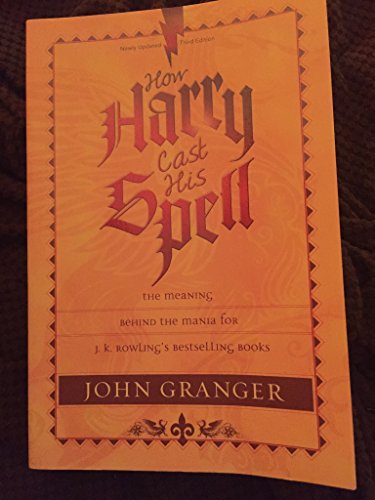
More than any other book of the last fifty years (and perhaps ever), the Harry Potter novels have captured the imagination of children and adults around the world. Yet no one has ever been able to unlock the secret of Harry's wild popularity . . . until now. Updated and expanded since its original publication as Looking for God in Harry Potter (and now containing final conclusions based on the entire series), How Harry Cast His Spell explains why the books meet our longing to experience the truths of life, love, and death; help us better understand life and our role in the universe; and encourage us to discover and develop our own gifts and abilities.
How Harry Cast His Spell
The Meaning Behind the Mania for J. K. Rowling's Bestselling BooksBy JOHN GRANGERTyndale House Publishers Inc.
Copyright © 2008 John Granger
All right reserved.ISBN: 978-1-4143-2188-2Contents
Acknowledgments............................................viiPublisher's Preface........................................ixIntroduction...............................................xi1: Magic, Fantasy, and Transcendence.......................12: Cosmic White Hats and Black Hats........................133: The Hero's Journey......................................214: The Alchemy of Spiritual Growth.........................295: One Person, Two Natures.................................416: Don't Judge, Lest You Be Judged.........................537: The Triumph of Love over Death..........................638: The Question of Identity................................779: Evidence of Things Unseen...............................9110: Fun with Names.........................................10911: The Purification of the Soul...........................12512: Dangerous Books and Edifying Books.....................13513: Despair and Delivery...................................14514: Girded with Virtue.....................................15715: Dark Night of the Soul.................................16716: Baptism into a Sacrificial Death.......................17917: Choosing to Believe....................................19518: Christian Birth and Baptism............................21319: Victory Over Death.....................................22520: FAQs...................................................245Notes......................................................271
Chapter One
MAGIC, FANTASY, AND TRANSCENDENCE The magic in Harry Potter is traditional literary spellwork that acts as a counterspell to the materialism of our times.
More than any other book of the last fifty years (and perhaps ever), the Harry Potter novels have captured the imagination of the reading public worldwide. Hundreds of millions of copies have been sold to date. However, although the books have been wildly successful, no one as yet has been able to explain their popularity. The aim of How Harry Cast His Spell is to answer the question "Why do readers young and old love these stories?" The answer, believe it or not, is not great marketing, movie tie-ins, or product placement; it's the transcendent meaning of the books, and more specifically, their Christian content.
The Harry Potter books, in case you have lived on the planet Zeno since 1997 or have recently come out of a coma, recount the adventures of an English schoolboy as he advances from grade to grade at Hogwarts School. Hogwarts is no ordinary boarding school, however, and Harry Potter is no typical student-the former is a school for witchcraft and wizardry, and Harry is not only a wizard-in-training, but the target of attack by the worst of evil wizards, Lord Voldemort, and his followers, the Death Eaters. Each book ends with a life-or-death battle against Voldemort or his servants and enough plot twists to make you dream of saltwater taffy.
I am convinced that the fundamental reason for the astonishing popularity of the Harry Potter novels is their ability to meet a spiritual longing for some experience of the truths of life, love, and death that are denied by our secular culture. Human beings are designed for transcendent truths, whether they know it or not, and they pursue experience of these truths and some exercise of their spiritual faculties anywhere they can. Mircea Eliade suggested that modern entertainments, especially books and movies, serve a mythological or religious function in a desacralized world. That the Harry Potter stories "sing along" with the Great Story of Christ in the tradition of English literature is a significant key to understanding their compelling richness and unprecedented popularity. We love these books because they satisfy our desire for religious experience in a big way.
Sound loony? I take hits from both sides of the Potter wars for this thesis-from Potter fans who are shocked by the suggestion that they have been reading "Christian" books and from Potter foes who are shocked by the thought that there could be anything "Christian" or edifying about books with witches and wizards in them. But like it or not, Harry's Christian content and the fact that he takes us out of our materialist mental prisons are what keep his readers coming back again and again.
As the magical setting of the books has caused the most controversy in religious communities and has the most important and obvious spiritual significance, I'll start with the setting and several formulas Rowling observes in every book to begin the discussion of what drives Potter-mania.
Magical Setting
Some Christians have objected to Harry Potter because Christian Scripture in many places explicitly forbids occult practice. Though reading about occult practice is not forbidden, these Christians prudently prefer (again in obedience to scriptural admonishments to parents) to protect their children because of the books' sympathetic portrayal of occult practice. These Christians believe that such approving and casual exposure to the occult opens the door to occult practice.
Reading the Harry Potter books myself has convinced me that the magic in Harry Potter is no more likely to encourage real-life witchcraft than time travel in science fiction novels encourages readers to seek passage to previous centuries. Loving families have much to celebrate in these stories and little, if anything, to fear. What they have to celebrate is the traditional, edifying magic of English literature-a magic that fosters a spiritual worldview that is anything but occult oriented.
I say this without hesitation because the magic in Harry Potter is not "sorcery" or invocational magic. In keeping with a long tradition of English fantasy, the magic practiced in the Potter books, by hero and villain alike, is incantational magic, a magic that shows-in story form-our human thirst for a reality beyond the physical world around us.
The difference between invocational and incantational magic isn't something we all learned in the womb, so let me explain. Invocational means literally "to call in." Magic of this sort is usually referred to as sorcery. Scripture of every revealed tradition warns that "calling in" demonic principalities and powers for personal power and advantage is dangerously stupid. History books, revealed tradition, and fantasy fiction (think Dr. Faustus) that touch on sorcery do so in order to show us that the unbridled pursuit of power and advantage via black magic promises a tragic end.
But there is no invocational sorcery in the Harry Potter books.
Even the most evil wizards do their nasty magic with spells; not one character in any of the seven books ever calls in evil spirits. Not once.
The magic by spells and wands in Harry Potter is known as incantational wizardry. Incantational means literally "to sing along with" or "to harmonize." To under stand how this works, we have to step outside our culture's materialist creed (that every thing in existence is quantitative mass or energy) and look at the world upside down, which is to say, God-first.
For some, the distinction between invocational and incantational magic is a new idea. I've been asked how prayer fits. "Isn't prayer invocational? Aren't we calling out to God with this concept-invoking his name-when we pray? How is this 'bad magic'?"
Calling out to God isn't bad magic, of course, and the reason helps to clarify the difference between sorcery and the "good magic" of English literature. It is the difference between the psychic and the spiritual realms.
In a materialistic age such as the one in which we live, the distinction between the psychic and the spiritual is hard to keep straight, though it is an understanding all traditional faiths have in common. We struggle to hold on to this distinction because we have been taught that everything existent is some combination of matter and energy. Everything that's not matter and energy, consequently, is lumped together as "peripheral stuff" or "delusion." It's hard to remember the differences between things thrown together in the garbage can of ideas!
The distinction between the psychic realm and the spiritual realm is critical. The psychic realm-accessible through the soul and including the powers of the soul, from the emotions and sentiments to the reason and intellect-is home to demonic and angelic created beings and is predominantly a fallen place apart from God. The spiritual realm is "God's place"-the transcendent sphere within and beyond creation and the restrictions of being, time, and space.
Invocational magic is calling upon the fallen residents of the psychic realm. Prayer is the invocation of God's name that we might live deliberately and consciously in his presence within time and space.
Incantational magic in literature-a harmonizing with God's Word-is the story-time version of what a life in prayer makes possible. Invoking the powers of the psychic realm is universally forbidden in both literary and revealed traditions. However, calling on the spiritual realm and pursuing graces from it are the tasks for which human beings are designed, insofar as we are homo religiosus. One function of traditional English literature, of which Harry Potter is a part, is to support us in this spiritual life.
Christianity-and all revealed traditions-believes creation comes into being by God's creative Word, or his song. As creatures made in the image of God, we can harmonize with God's Word and his will, and in doing so, experience the power of God. The magic and miracles we read about in great English literature are merely reflections of God's work in our life. To risk overstating my case, the magic in Harry Potter and other good fantasy fiction harmonizes with the miracles of the saints.
C. S. Lewis paints a picture of the differences between incantational and invocational magic in Prince Caspian. As you may recall, Prince Caspian and the Aslan-revering creatures of the forest are under attack from Caspian's uncle. Things turn bad for the white hats, and it seems as if they will be overrun and slaughtered at any moment. Two characters on the good guys' side decide their only hope is magic.
Prince Caspian decides on musical magic. He has a horn that Aslan, the Christlike lion of these books, had given to Queen Susan in ages past to blow in time of need. Caspian blows on this divinely provided instrument in his crisis. By sounding a note in obedience and faith, Caspian harmonizes with the under lying fabric and rules of the Emperor over the Sea, and help promptly and providentially arrives in the shape of the Pevensie children themselves.
Nikabrik the dwarf, in contrast, decides a little sorcery is in order. He finds a hag capable of summoning the dreaded White Witch in the hope that this power-hungry, Aslan-hating witch will help the good guys (in exchange for an opening into Narnia). Needless to say, the musical magicians are scandalized by the dwarf's actions and put an end to the sorcery lickety-split.
In the Narnia stories and other great fantasy fiction, good magic is incantational, and bad magic is invocational. Incantational magic is about harmonizing with God's creative Word by imitation. Invocational magic is about calling in evil spirits for power or advantage-always a tragic mistake. The magic in Harry Potter is exclusively incantational magic in conformity with both literary tradition and scriptural admonition. Concern that the books might "lay the foundation" for occult practice is misplaced, however well intentioned and under standable, because it fails to recognize that Potter magic is not demonic.
Perhaps you are wondering, If Harry Potter magic is a magic in harmony with the Great Story, why are the bad guys able to use it? Great question.
Just as even the evil people in "real" life are certainly created in God's image, so all the witches and wizards in Potterdom, good and bad, are able to use incantational magic. Evil magical folk choose of their own free will to serve the Dark Lord with their magical faculties just as most of us, sadly, lend a talent or power of our own in unguarded moments to the Evil One's cause. As we will see, the organizing structure of the Potter books is a battle between good guys who serve truth, beauty, and virtue and bad guys who lust after power and private gain.
Some fans of Lewis and Tolkien contrast those writers' use of magic with Rowling's, arguing that, unlike the world of Harry Potter, the subcreations of these fantasy writers had no overlap with the real world. They suggest that this blurring of boundaries confuses young minds about what is fiction and what is reality.
But Lewis and Tolkien blurred boundaries with gusto in their stories-as did Homer, Virgil, Dante, and other authors whose works regularly traumatize students in English classes. Certainly the assertion that Middle Earth and Narnia are separate realities is questionable, at best. Middle Earth is earth between the Second and Third Ages (we live in the so-called Fourth Age). Narnia overlaps with our world at the beginning and end of each book, and in The Last Battle is revealed as a likeness with earth of the heavenly archetype, or Aslan's kingdom. Singling out Rowling here betrays a lack of charity, at least, and perhaps a little reasoning chasing prejudgment.
That the magical world exists inside Muggledom (nonmagical people are called "Muggles" by the witches and wizards in Harry Potter), however, besides being consistent with the best traditions in epic myth and fantasy, parallels the life of Christians in the world. I don't want to belabor this point, but C. S. Lewis described the life of Christians as a life spent "in an enemy occupied country." What he meant is that traditional Christians under stand that man is fallen, that he no longer enjoys the ability to walk and talk with God in the Garden, and that the world is driven by God-opposing powers. Lewis's Ransom novels illustrate this idea.
Why do we love the magic of Harry Potter? I think we have three big reasons to be excited by it. First, we live in a time in which naturalism, the belief that all existence is matter and energy, is the state religion and belief in supernatural or contra-natural powers is considered delusion. The incantational magic in Harry Potter, because it requires harmonizing with a greater magic, undermines faith in this godless worldview. Harry's magic, even if only experienced imaginatively in a state of suspended disbelief, gives our spiritual faculties the oxygen our secular schools and the public square have tried to cut off. And by under mining the materialist view of our times, it can even be said that the books lay the foundation for a traditional understanding of the spiritual, which is to say "human," life.
Next, because there is overlap between the "magical" and "Muggle" worlds of Harry Potter, there is the edifying suggestion that the prevalent bipolar worldview of Americans, in which the world is divided by an arbitrary state versus church dichotomy, not to mention the secular versus sacred illusion, is just so much nonsense. The spiritual and traditional understanding of the world is a sacramental one, in which the spiritual suffuses the material (just as the human person is a psychosomatic unity with spiritual faculties). The breakdown of the Muggle/magic divide helps readers see that existence itself (in not being matter or energy) unites all reality and that "greater being" is found only in pursuit of the sacred, not the "scientific" and profane.
And third, we love the magic in Harry Potter because it helps us exercise those atrophied spiritual powers we have (as we identify with Harry and his friends), while at the same time encouraging us to be heroic and good alongside them. This is no small thing, and we'll be returning to it in the coming chapters.
Have you heard stories of children being sucked into witches' covens because they want to be like Harry? Reports of rising membership in occult groups since the Harry Potter books were published inevitably turn out to be generated by proselytizing members of these groups. People who track the occult for a living explain that, despite Buffy the Vampire Slayer and Harry Potter, membership in these groups in Europe and the United States are minuscule and are in decline despite a decade of Harry, Buffy, and occult milieu entertainment. Children are far more likely to become Hare Krishna, gynecologists, or members of a Christian cult than real-world witches or wizards.
And even if children were being seduced into the occult because of their desire to do spells, I have to hope this would be under stood by thinking people as a shameful, tragic aberration, more indicative of the child's spiritual misformation than a danger in the books. The Dungeons and Dragons craze in the sixties and seventies and its attendant occult paraphernalia sprang from an unhealthy fascination and perverse misunderstanding of The Lord of the Rings, an epic with clear Christian under tones. If we were to avoid books that could possibly be misunderstood or whose message could be turned on its head, incidents like Jonestown would logically suggest thinking people should not read the Bible.
What about the title of the first book in the Potter series? If there's no sorcery in these books, how come the first book and movie are titled Harry Potter and the Sorcerer's Stone? Well, because that isn't the title of the first book. Arthur Levine, under whose imprint the books are published by Scholastic in the United States, changed the title from Philosopher's Stone to Sorcerer's Stone because he was sure that no American would buy a book with philosophy in the title.
(Continues...)
Excerpted from How Harry Cast His Spellby JOHN GRANGER Copyright © 2008 by John Granger. Excerpted by permission.
All rights reserved. No part of this excerpt may be reproduced or reprinted without permission in writing from the publisher.
Excerpts are provided by Dial-A-Book Inc. solely for the personal use of visitors to this web site.