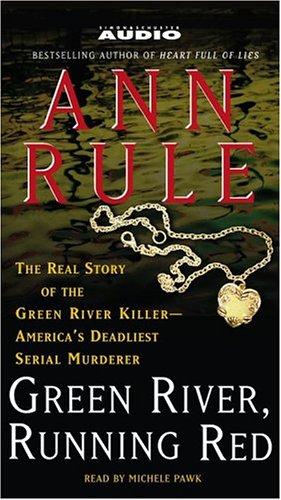
In the most extraordinary journey Ann Rule has ever undertaken, America's master of true crime has spent more than two decades researching the story of the Green River Killer, who murdered more than forty-nine young women.For twenty-one years, the Green River Killer carried out his self-described "career" as a killing machine, ridding the world of women he considered evil. His eerie ability to lure his victims to their deaths and hide their bodies made him far more dangerous than any infamous multiple murderer in the annals of crime.A few men eventually emerged as the prime suspects among an unprecedented forty thousand scrutinized by the Green River Task Force. Still, there was no physical evidence linking any of them to the murders until 2001, when investigators used a new DNA process on a saliva sample they had preserved since 1987, with stunning results.Green River, Running Red is a harrowing account of a modern monster, a killer who walked among us undetected. It is also the story of his quarryof who these young women were and who they might have become. A chilling look at the darkest side of human nature, this is the most important and most personal audiobook of Ann Rule's long career.
Green River, Running Red
The Real Story of the Green River Killer--Americas Deadliest Serial MurdererBy Ann RuleSimon & Schuster Audio
Copyright © 2004 Ann Rule
All right reserved.ISBN: 9780743538251Introduction
As I began this most horrifying of all books in my long career as a true-crime writer, I found myself faced with the same dilemma I encountered some twenty-five years ago. In the early 1970s, I worked as a volunteer at the Crisis Clinic in Seattle, Washington. Two nights a week, I worked an all-night shift with a young male psychology student at the University of Washington as my partner. Together we fielded calls from suicidal and distraught people. I hadn't published a book yet, but by 1975 I had a contract to write one if the nameless killer of at least seven young coeds in Washington and Oregon was ever caught. As many readers know, that murderer turned out to be my partner: Ted Bundy. By the time I learned that, however, he had left the Northwest and continued his murderous rampage in Utah, Idaho, and Colorado. Convicted of attempted kidnapping in Utah, Ted was extradited to Colorado in 1976 to await his murder trials for eight victims in that state, but he escaped from two jails, making his way to Florida after his second - successful - escape on New Year's Eve, 1977. There he took the lives of three more young women and left another three for dead in Tallahassee and Jacksonville before he was finally arrested, convicted of murder in two trials, and sentenced to death. After nine years of appeals, Ted was electrocuted on January 24, 1989, at Raiford Prison.
How many women did Ted Bundy kill? No one really knows for sure, but when Florida detectives told him that the F.B.I. believed his toll was thirty-six victims, he said, "Add one digit to that, and you'll have it." Only he knew if he meant 37, 136, or 360.
Throughout his years of imprisonment, Ted wrote dozens of letters to me, and sometimes made oblique statements that could be construed as partial confessions.
Initially, I tried to write the Ted Bundy saga as if I were only an observer, and no part of the story. It didn't work because I had been part of the story, so after two hundred pages, I started over on The Stranger Beside Me. There were times when I had to drop in and out of the scenario with memories and connections that seemed relevant. Stranger was my first book; this is my twenty-third. Once again, I have found myself part of the story, more than I would choose to be in some instances. Many of the men and women who investigated these cases are longtime friends. I have taught seminars at law enforcement conferences with some of them and worked beside others on various task forces, although I am no longer a police officer. I have known them as human beings who faced an almost incomprehensible task and somehow stood up to it and, in the end, won. And I have known them when they were relaxed and having a good time at my house or theirs, setting aside for a short while the frustrations, disappointments, and tragedies with which they had to deal.
Was I privy to secret information? Only rarely. I didn't ask questions that I knew they couldn't answer. What I did learn I kept to myself until the time came when it could be revealed without negatively impacting the investigation.
So, the twenty-two-year quest to find, arrest, convict, and sentence the man who is, perhaps, the most prolific serial killer in history has been part of my life, too. It all began so close to where I lived and brought up my children. This time, I didn't know the killer, but he, apparently, knew me, read my books about true homicide cases, and was sometimes so close that I could have reached out and touched him. As it turned out, varying degrees of connection also existed between his victims and people close to me, but I would learn that only in retrospect.
There were moments over the years when I was convinced that this unknown personification of evil had to appear so normal, so bland, that he could have stood behind me in the supermarket checkout line, or eaten dinner in the restaurant booth next to mine. He did. And he had.
Looking back now, I wonder why I cut a particular article out of the Seattle Post-Intelligencer. It wasn't headline news, and it was so brief that it would have been easy to miss. By the summer of 1982, I had moved on from covering six to eight homicide cases for True Detective and four other fact-detective magazines every month and was concentrating on writing books. I was under contract to do a novel at the time and I wasn't even looking for true-crime cases to write about. But the short item in the "Local News" section was very sad: Two young boys had found the body of a young woman snagged on pilings under the Peck Bridge on Meeker Street in Kent, Washington. She had floated in the shallows of the Green River, her arms and legs entangled in a rope or some similar bonds.
The paper wasn't specific about the cause of death, but police in Kent suspected that she had been strangled. Although she had been in the river for several days, no one had come forward to identify her.
The woman was white, estimated to be about twenty-five years old, and at five feet four, she weighed about 140 pounds. She had no identification on her body, and she wore unhemmed jeans, a lacetrimmed blue-and-white-striped blouse, and white leather tennis shoes.
Her clothing wasn't distinctive, but King County medical examiner Dr. Don Reay noted that she had five tattoos on her body: a vine around a heart on her left arm, two tiny butterflies above her breasts, a cross with a vine around it on her shoulder, a Harley-Davidson motorcycle insignia on her back, and the unfinished outline of a unicorn on her lower abdomen. The delicacy of four of the tattoos warred with the motorcycle-gang mark, but Kent detectives still thought that it might be the likeliest lead they had in finding out who she was - if any members of local motorcycle organizations would admit to knowing her.
I clipped out the coverage of the woman's death, being careful to save the upper margin of the page with the date. It was published on July 18, 1982. She had actually been found on Thursday, July 15.
The victim hadn't drowned; she had been dead when she was placed in the river. When a description of her tattoos was published in area papers, a tattoo artist recognized his work and came forward to identify the victim. She wasn't a grown woman at all; she was much younger. He knew her as Wendy Lee Coffield. "I think she lives in Puyallup with her mother," he added. "She's only sixteen."
Detectives located her mother, Virginia Coffield. Although she appeared to be in shock, the woman murmured, "I kind of expected it." She explained that she suspected Wendy had been working as a prostitute and might have been attacked and killed by a "john."
"I know that was the kind of life she chose for herself," Virginia Coffield said with a sigh. "We taught her the best we could."
Wendy Lee's mother said her daughter had been a good little gir when they were living in the country, but that her "trouble" had started when they moved to Auburn and Kent, both of which were still very small towns compared to Seattle and Tacoma.
Wendy and her mother never had much money as Virginia struggled to support the two of them after Virginia and her husband, Herb, divorced; they lived in one low-rent apartment after another. There had even been times in the warm summer months when they had to live in a tent, picking blackberries to sell so they could buy food.
"Wendy dropped out of school - way back in junior high," her mother said wearily.
She didn't say, but Wendy had been caught in an all too familiar vicious circle. Virginia herself was only thirty-six, worn and discouraged beyond her years. Her own childhood had been a miserable time where many of the adults who were supposed to be caring for her were more interested in the fuzzy escape of alcohol. She had come from "a big family of drinkers."
Virginia had become pregnant at sixteen and given that child up for adoption. Then she spent two teenage years at Maple Lane, Washington's juvenile corrections facility for girls. "I felt like I was a misfit; nobody understood me. She [Wendy] was seeking help just like I did, but they put her out [of juvenile detention] when they should have given her supervision. She just needed a couple of years off the street to grow up."
By mid-1982, Virginia and Wendy were living in another rundown apartment in downtown Puyallup. Photographs of Wendy showed a smiling girl with a wide, open face. She could have passed for eighteen or nineteen, but she was only a few years past childhood. After she stopped going to junior high, she had been enrolled in Kent Continuation School in the hope that she could catch up. But she was a chronic runaway, perhaps wanting to leave behind a home where she wasn't happy, or simply looking for excitement out in the world - or both.
Her mother had lost control of her. "Wendy just started having trouble," Virginia Coffield said, explaining that her daughter was known to police for minor offenses in both King and Pierce Counties. "The last thing she did was she took $140 in food stamps from one of our neighbors."
One night, when Wendy was fourteen or fifteen, Virginia recalled, she had come home disheveled and upset. "She said some guy raped her while she was hitchhiking. That's the way she got around. Hitchhiking. I told her that's what happens."
Wendy changed after that and her problems grew. Her theft of the food stamps landed her in Remann Hall, the Pierce County juvenile detention center in Tacoma, and then into a foster home. She became a runaway from there on July 8 when she didn't return from a twenty-four-hour pass to visit her grandfather.
Wendy and her mother had lived a hardscrabble existence, and neither seemed to have met the other's expectations. Fathers drift away and single mothers despair of ever making enough money to keep going. Rebellious teenage daughters make it more difficult as they act out of their own pain. And so it continues. Wendy Lee got caught in the centrifugal force of it. She wanted the things she didn't have and she took terrible chances to get them. Somewhere along the way, she had met someone who was angry enough or perverted enough to consider her survival in the world insignificant.
Since Wendy's body had been found within the Kent city limits, her murder would be investigated by the Kent Police Department. Chief Jay Skewes said that the last time anyone had seen Wendy alive was shortly after she had slipped out of Remann Hall, a week before her corpse was discovered in the Green River. She had been listed as a runaway, but no one had been actively looking for her. There were so many runaways that it was hard to know where to start.
And now Wendy's sad little life was over before it really began. Her blurry photo appeared over and over in the media as the story of her murder was updated and details added. She was an attractive blond-haired girl, and I had written about hundreds of homicide cases in the dozen years before Wendy was killed, a number of them about pretty blondes who had been strangled.
But she was so young, and I learned she had been violently choked with her own panties. I had teenagers myself, and I remembered the girls I'd known when I was in college and worked summers as a student intern at Hillcrest, the juvenile girls' training center in Salem, Oregon (a facility once known as a reform school). The Hillcrest residents ranged in age from thirteen to eighteen, and they tried to act tough, although I soon realized just how frightened and vulnerable most of them were.
Maybe that's why I saved the clipping about the girl in the Green River. Or maybe it was because Wendy's body had been found close to where I lived in the south end of King County, Washington. At least a thousand times over the forty years I've lived here, I've passed the very spot where someone threw her away.
To reach this stretch of the Green River from my house, I had to cross Highway 99 and head about four miles down the long curving hill that is the Kent-Des Moines Road. The Green River coursed south from Eliott Bay and the Duwamish Waterway, irrigating the floor of the Kent Valley. In the days before the Boeing Airplane Company expanded and the Southcenter Mall mushroomed, the valley was known for its rich loamy soil and was home to family farms, many of which supplied produce to Seattle's Public Market, or who simply put up their own stands along the road. When my children were small, I took them every summer to one of the U-Pick strawberry patches that abounded in the valley. We often took Sunday drives through Kent, Auburn, and Puyallup.
I had also driven along Frager Road on the Green River's western bank in almost total darkness any number of nights, coming home from dinner with friends or from shopping at the Southcenter Mall. The lights of the huge mall faded within minutes as the road became indistinguishable from the river.
North of the Meeker Street Bridge, Frager Road and the rushing river frightened me a little at night because there were hardly any houses nearby, and winter rains made the Green River run so deep that it nudged the shoulders of the road. Drivers under the influence or inexperienced or reckless often missed turns on the narrow road and sailed into the river. Few of them survived. Sometimes they floated in the depths for a long time, because nobody was aware that their cars and bodies waited there beneath the surface.
In the moonless dark, the lonely road along the river seemed somehow sinister, although I could never come up with a good reason why I felt that way. It was just a river in the daytime, running past fields, tumbling-down farmhouses, and one tiny park that had two rickety picnic tables. There were usually a few dozen fishermen huddled in little lean-tos made of scrap wood, angling for steelheads along the river.
Despite my foreboding, I often took Frager Road home after midnight because it was a shortcut to my house on S. 244th Street. When I came to S. 212th, I drove away from the river, turning right and then left up a hill, past the "Earth Works Park," which was not really a park at all but a huge pile of dirt that had been bulldozed into oblique ascending levels and then thinly planted with grass. The City of Kent had commissioned it as an art project. It wasn't pretty, it didn't seem like art and it, too, was faintly threatening as it loomed beside the secluded road that wound up a hill that became steeper and steeper.
I was always relieved when I reached the top and crossed Military Road onto S. 216th. Highway 99 - the SeaTac HiWay - where the lights were bright again, was only two blocks ahead and I was almost home.
I rarely had occasion to drive on Frager Road between S. 212th and Meeker Streets, and Wendy's body had drifted south of where I always turned off. In the summer months when she was found, the water wasn't deep beneath the Meeker Street Bridge.
Continues...
Excerpted from Green River, Running Redby Ann Rule Copyright © 2004 by Ann Rule. Excerpted by permission.
All rights reserved. No part of this excerpt may be reproduced or reprinted without permission in writing from the publisher.
Excerpts are provided by Dial-A-Book Inc. solely for the personal use of visitors to this web site.