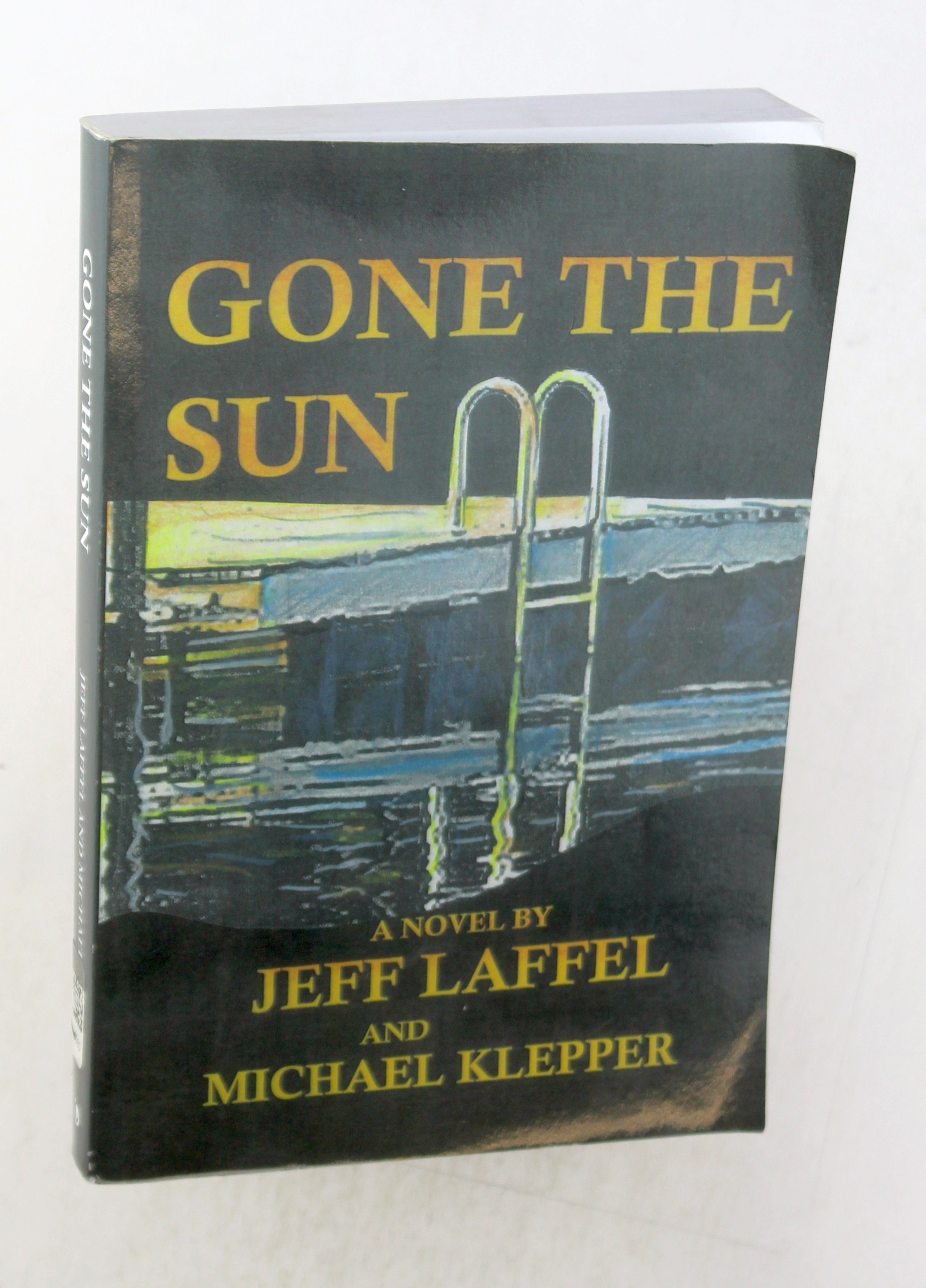
GONE THE SUN
A NOVELBy JEFF LAFFEL MICHAEL KLEPPERiUniverse, Inc.
Copyright © 2010 Jeff Laffel and Michael Klepper
All right reserved.ISBN: 978-1-4502-7166-0 Chapter One
POV: Lennie Dorff:
I grew up in hand-me-downs.
When we had to buy new, which was seldom, we headed for Woolworths. Jeans for instance. Woolworths. Woolworths' brand, never Levis or Lees or even Wrangler! Woolworths. The kind of jeans that had red flannel on the inside pant leg so that when you rolled them up ... well, you remember. But that was when we bought new. Most of my stuff, almost everything I owned, came from things that people outgrew or no longer wanted. My father was an expert schnurer, always getting something for nothing, somehow always there when someone was cleaning out a closet, moving or simply throwing out the old and bringing in the new. Because of this, and added to the fact that my father never knew how to make enough money to support his family, bits and pieces of other people's lives were given to me. That in itself may not be earth shaking to you, but then you didn't live my life, and, most of all, you didn't go to Kanuga.
How can I describe the Jews that went to that camp without sounding at once awe struck and at the same time anti-Semitic? It isn't easy. My father used to say that there was nothing worse than a self- loathing Jew. I can think of lots of things, the first being my father.
But, I get ahead of myself. To understand me, and I would like to believe that you would, you first have to understand the Dorff lineage.
My paternal grandfather Isaaz came from Tallinn, in Estonia. His real name was Isaac, but the man at Ellis Island inadvertently changed the 'c' to a 'z' on his entrance papers. Sadly, my grandpa was easily convinced by some landsmen "Yankees" who were already old timers for having having been in America for a few months, that if he changed the incorrect letter he would be instantly deported. He was Isaaz ever after. When he would introduce himself, people always thought he was Iranian. He lived, and finally died, tending his pushcart on Rivington Street, being spoken to in two tongues, Farsi and English, neither of which he understood.
My father's name was, Schmoil.
He called himself Larry.
Schmoil quickly realized that in order to succeed in America one had to become assimilated, hence the Larry. He read books on entrepreneurship and soon, thereafter, with great fanfare in the family, bought a second and larger pushcart. Since my Old World Grandfather sold strictly Jewish items like talisman and tiffilin and came home with next to nothing, my Yankee Doodle father, using what he had gleaned from his books and with a surety of his brilliance that could not be swayed, sold crockery with pictures of Jesus and the Holy Family on them. He was soon forced into bankruptcy, never figuring out that the Jews who shopped on Rivington Street were not much interested in the face of Jesus on plates, even if His eyes did follow you when you moved. He had always been a bitter man, my father, but this setback made him absolutely acrid. He ended up waiting on tables at Ratner's, and, when they closed, at an assortment of Jewish Restaurants around the city. So much for my father's side!
My mother's side of the family, the Mendelsohns came from Minsk. They loved their homeland, but the climate for Jews in Russia in the early 1900's had become extremely "pogramatic" and they were forced to pack up and head for New York.
Mother's father, Leonard, was a Cantor who sang flat. He sang with such passion, however, that no one in his congregation on the Lower East Side of New York had the heart to tell him, much less fire him. Even if they would have wanted to, they were too poor a congregation to hire anyone better, so there Leonard remained until he dropped dead during services one Saturday morning after going for a rather ill advised high C, which to everyone's amazement, I am told, was crystal clear and dead on key.
Leonard, and Sadie his wife, had three children, one of whom, Ruthie, died in childbirth. The other two, Howard and Dora, the latter being my mother, thrived.
My mother was, and is, a gentle soul with a heart far larger than her brain. Not that she is stupid. Far from it! But mother's intelligence is innate. Though she never got past tenth grade she soon became the one to whom people came with their problems. Had she been smart enough to hang up a shingle, we would have been loaded. Instead, she dispensed her comfort and advice for free, enriching all who came to her, while she did her shopping at, well, Woolworths. As mother would say, "Nobody ever said life was easy." That line might well have been a self- fulfilling prophecy, for soon after she met Schmoil at a Henry Street Settlement House social, she married him. It was not too long after that, I am led to understand, that she developed the soft pitying sigh that endeared her to all who came to her for comfort and made my father grind his teeth, even in his sleep.
But it was Howard who was the great success in the family.
Uncle Howard was a high school science teacher. That meant that along with the respect the title brought, he was bringing home a steady salary at a time when money for many others was tight.
Howard may have been a success in our family, but not, alas, in his. One day when he came home from teaching, he found a letter of farewell from his wife, Hannah, who had taken off with her fox trot instructor, along with anything of value they owned.
Howard grieved for the loss of his Hannah. My mother consoled her beloved and successful brother. My father snickered behind Howard's back that, "Mr. Bigshot" finally had been brought down a peg or two.
At any rate, after Hannah left, Uncle Howard became a fixture at my home. At one point my mother had actually convinced him to move in with us, but my father nixed that in a hurry. There was a major fight, complete with soft pitying sighs and grinding teeth, but this time, my father prevailed. Howard, hurt and resentful, stopped coming by, except for shabbos dinners at which he would whisper to my mother who sighed, wrung her hands, clucked her tongue, shook her head and ignored my father.
Shabbos dinners at our house were, forever after, even years later when I came along, something to be avoided at all costs.
But Uncle Howard was made of strong stuff. He soon met and married a blonde, blue-eyed woman called Phyllis whom he had met through friends. The fact that Aunt Phyllis was a gentile shocked my mother and delighted my father. That she was a rather masculine girl's Phys Ed teacher delighted my father even more, and to all who would listen he would always speak of his new sister-in-law as 'Gorgeous George.' Soon afterward, Howard went into partnership with Moe Feingold, a Math teacher who taught with him, and bought CAMP KANUGA.
And that's when Uncle Howard really hit pay dirt.
To understand this, I offer a short history lesson.
In 1948 when Howard and Moe became partners, the country was experiencing a post war boom. Things that had been rationed were now easily accessible and every American wanted the best for himself and his family.
The Jewish population of America was even more determined than their Christian counterparts to find ways to be living the good life. Indeed, after the shock of seeing just how tenuous life was through the deaths of so many of their family members in Europe, American Jews decided to live, and live well. So while the gentiles were still sitting around the piano in the parlor singing songs that extolled fellowship, many Jews were working their ass off amassing small fortunes.
And when the money was made, the fun began.
But there was a problem. Money or no money, Jews were persona non grata at exclusive Anglo Saxon bastions. Ever pragmatic, when restricted country clubs kept the wealthy Jews out, they built their own. "Restricted" country clubs, Jewish country clubs! Restricted private schools, Jewish private schools!
And so it was with summer camps.
Though many Jewish summer camps had been built prior to the war, after 1945 they really took off. If young Jewish boys and girls were not considered good enough to go to "goyem" camps, the enterprising Jews said, "Screw 'em," and built more of their own. No more discrimination for the Jews!
And the camps prospered.
But there was an irony to all this for in order to go to one of these camps, you had to have money, and plenty of it! No ordinary Jew need apply.
So much for no more discrimination!
Every summer on the first of July, buses would pull into designated meeting places in Westchester, Long Island, and the wealthier areas of Brooklyn and Queens, and pull out filled to capacity with the noisy and excited children of the Jewish elite.
Summer camp became a status symbol and Uncle Howard thrived.
He had found a year round handy man and caretaker named Ike Hayes who did all the dirty work, so all that was left to him was enticing the kids to come. He spent the off months doing that. His partner, Moe, ordered the food.
So that, as they say in Hollywood, is the "back story."
Enter me.
My maternal grandmother once described me as "not much to look at, but a wonderful boy."
Unfortunately, Grandma was not entirely right.
I was not much to look at. "Wonderful," however, according to those who knew me, was also up for discussion.
As a kid I was a triple threat. I wasn't good looking, I didn't have money and I couldn't play ball. Every boy's dream of a best friend and every maiden's prayer I wasn't. But what I could do, ah, what I could do, was write!
From the time I was a little kid I had a way with words. Low grades in Math and Science perhaps, but the highest in English.
My mother qvelled, and my father, who was never satisfied under any circumstances, wanted to know why I didn't do better in the 'important' subjects.
I wrote everything. Plays, stories, poems, essays; I was a natural. This, you might say, was my pushcart. I say this because I soon became so adept at writing that many of my school friends began to ask me to do important papers for them.
But let me clarify something before moving on to the meat of this narrative. When I mentioned school friends a moment ago, I lied. I didn't have any friends. Well one, Teddy Moskowitz, but since I was embarrassed to have him as my friend, you can imagine how many friends he had! To be fair, I had had one really good friend when I was eight, Billy Rothenberg. He had been part of a popular clique in school but was dumped for some infraction of their unwritten rules. We started talking from opposite sides of a long and empty table at lunch one day and then, for the next few months, we were inseparable. But Billy's father was transferred to Lincoln, Nebraska, and my entire social life thereafter became one of doing favors for others. I was a chip off my mother's block as it were, but without the sighs. I knew I was being used by people who, under other circumstances, wouldn't have given me the time of day, but strangely, or possibly perversely, I didn't mind. Though I never charged for my services, I still would cadge scraps from those I helped. If there were a party coming up, for instance, I would hint for an invitation. Since most of the people I wrote for were embarrassed that they couldn't do an assignment by themselves, and grateful that I never said a word about my part in their subsequent 'A's," an invitation to one of those parties was usually forthcoming.
Not that I liked going. I hated it. But it kept my parents off my back and it gave me a chance to see first hand all that I was missing.
And there was plenty.
Huge homes with finished basements! Girls with straight hair and bobbed noses! Maids! Cooks! Older brothers who went away to school! Beer. Cigarettes. Indeed, these were the things that dreams were made of! Many were the times that I jerked off thinking of one or a combination of all of the above. These people were my peers but existed in a different sphere. I loved them as deeply as I hated them.
At this point we had saved just enough to move out of the lower East Side and to a railroad apartment on the Van Wyck Expressway in Queens, halfway, as it were, between two very distinct worlds.
And then Uncle Howard changed my life forever.
Howard had found a way to repay my mother's kindness while at the same time rubbing my father's nose in all he didn't have.
He would, he said grandly at a long remembered shabbos dinner, send me to his camp, all expenses paid.
My mother sobbed in gratitude, my father ground his teeth, and I trembled. If the kids at school were the beautiful people, the kids at camp would be gods. I was both thrilled and terrified.
Of course there was no possibility of saying no. That would break my mother's heart while at the same time aligning me with my father. Neither was an option. From the moment Howard offered his largesse I knew I was heading, inexorably, to the world of Camp Kanuga, but what I didn't know, was that it was a world that would consume me forevermore.
Chapter Two
POV: Andrew (AKA Apple)
That summer, the summer York died, was the seventh the Stewart twins and I had spent at Camp Kanuga. We had all arrived at camp at the same time, as upper sophomores, babies, and by the time the season of '75 rolled around, we were Upper Seniors, what we perceived to be the "men" of the camp.
We were not alone in the bunk. Henry Sturtz, a really rich kid from the West Side had joined our group in Lower Junior year, Dickie Klinger a year later. There had been others who came and went over those years, but only Lennie Dorff, the nephew of one of the camp's owners who had joined us just the year before, remained.
And we were a mixed bag. From the finest of athletes, York, Gavin and Sturtz, to the average, Klinger and me, to the piss poor, Dorff, and from the very rich Sturtz, to the comfortable Klinger, me and the Stewarts, to the poor Dorff: we were Bunk 33 in 1975.
It is that "we", the "we" that was, that has ruled my life for the past thirty some odd years. So many years ago and I can still see each of us as though we were still "we," clear as day, sprawled around the bunk during a never-ending rest hour of the mind, still young, still happy ... still sixteen.
Henry Sturtz, lying on his bed, an ever present Baby Ruth in his hand, regaling the rest of us with stories of his life during the other ten months of the year, of the private school he went to, his achievements and, of course, his sexual conquests. All of us thought he was full of shit, though no one told him, for although Henry could be "hale fellow, well met", when he chose to be, he could also destroy someone with just a look or a word, and we all knew it.
Not only was Sturtz rich, he was also the street -wise kid in our group. An only child, he and his father lived in a lavish pre-war apartment on West End Avenue. He wore only the most expensive clothes, went to the best school, knew all of the best people, and with all that, when we would meet for lunch and a movie in the city, he never reached for a check. When it came to an argument he was unbeatable; when he was right he was insufferable and when he was wrong he would get on his high horse and fight as though he were right.
To Sturtz, nothing was simple. Everything was, as they say, 'the art of the deal.' Feeling really good to Henry usually meant that he had used his wit to demolish someone so that he could purr in the afterglow. Though he smiled a lot, Sturtz was dangerous, and everyone knew it. Now saying that, we, most of the guys in the bunk that is, could ride his ass and get away with it, but if anyone else said something he didn't like or crossed him in any way, there would be trouble. A terrific athlete, maybe a rung or two below York in talent, Sturtz delighted in breaking rules and in seeing what he could get away with. And get away with things he did. To say that he was mercurial would be an understatement and that his episodes manique were sudden and brutal purely stating a fact.
Like the time with the wig!
Sturtz, York, Gavin, Klinger and I had met just before camp and were walking down a street in the West Village when we spotted a middle- aged woman walking toward us from the opposite direction. There was nothing exceptional about her, in fact she was rather non-descript; thin, pale face, woolen coat, pocketbook, heavy black shoes, old world looking, topped off by a rather obvious wig that sat slightly askew on her head. I think we all noticed it at the same time. I can remember thinking in that moment, that she might be undergoing chemotherapy. York said later that he thought she might have been a very religious Jew. At any rate we reached the point where we were about to pass her, when Sturtz pulled away from us, strode up to her and in a second that I will remember forever put his face in hers and screamed, "You can't bullshit me with that fucked up wig, bitch." For an awful moment I had the horrible thought that Henry might actually pull the wig from the woman's head, but York grabbed him and pushed him forward. We all began to walk faster and faster until we were running, the sound of Klinger's high- pitched laughter accompanying us. A few blocks later, when we had run out of breath, we stopped, and looked at Sturtz. He stared back at us. "What?," he said. "Why?" York asked. Sturtz shrugged. "She was ugly. I didn't like her."
(Continues...)
Excerpted from GONE THE SUNby JEFF LAFFEL MICHAEL KLEPPER Copyright © 2010 by Jeff Laffel and Michael Klepper. Excerpted by permission of iUniverse, Inc.. All rights reserved. No part of this excerpt may be reproduced or reprinted without permission in writing from the publisher.
Excerpts are provided by Dial-A-Book Inc. solely for the personal use of visitors to this web site.